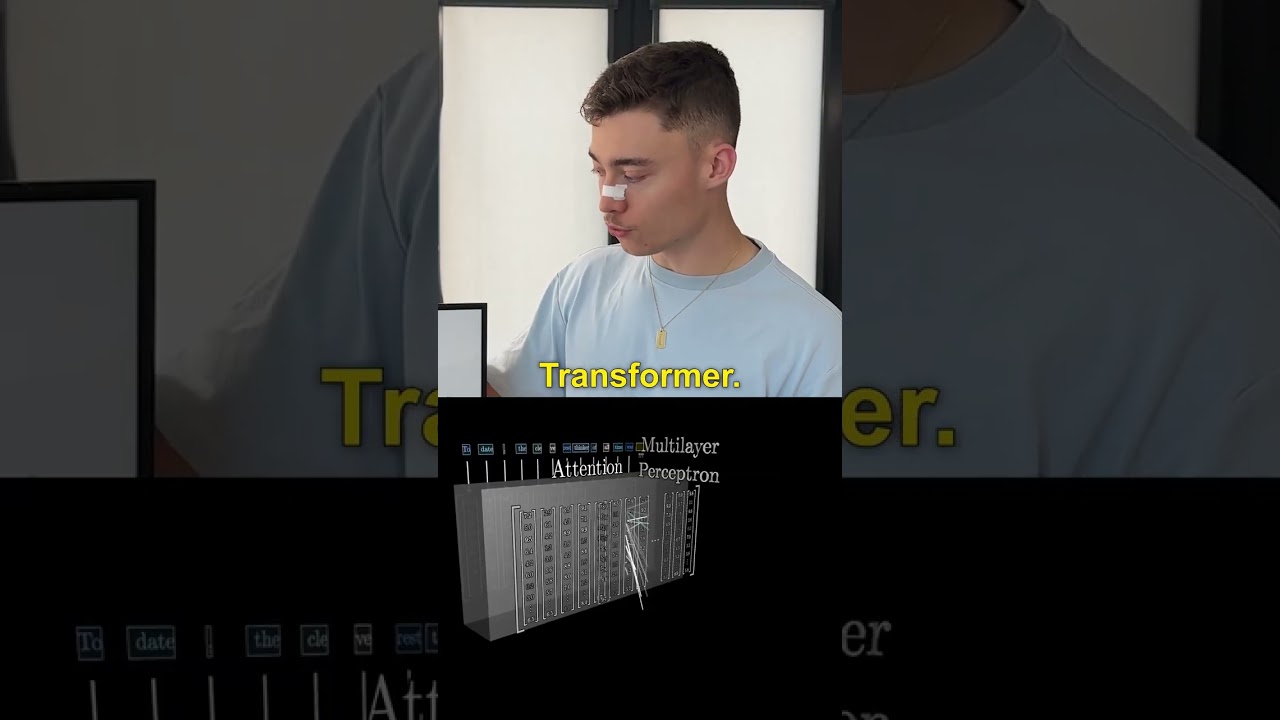
Ever wonder why ChatGPT can actually 'understand' the context of your conversation instead of just guessing the next word? It all started with one groundbreaking research paper that flipped the script on how machines process language.
The Simple Version
Before the Transformer, AI read text like a human reads a ticker tape—one word at a time, from left to right. The problem? By the time the AI reached the end of a long sentence, it often 'forgot' how the sentence started.
The Transformer changed this by looking at every word in a sentence simultaneously. It doesn't just read; it weighs the importance of every word relative to every other word.
How It Actually Works
Self-Attention: The Secret Sauce
The core innovation is Self-Attention. This allows the model to determine which other words in a sequence are most relevant to the word it is currently processing.
For example, in the sentence 'The animal didn't cross the street because it was too tired,' the AI uses attention to realize that 'it' refers to the 'animal,' not the 'street.'
Parallelization: Speeding Up the Brain
Because Transformers don't need to process words in a strict order, they can do it all at once. This is called parallelization.
This shift allowed researchers to train models on massive amounts of data using GPUs, which are designed for exactly this kind of simultaneous math.
Technical Deep Dive
At the heart of the Transformer is the Scaled Dot-Product Attention mechanism. The model creates three vectors for every input token: a Query (Q), a Key (K), and a Value (V).
The model calculates the dot product of the Query with all Keys to determine a score. This score is then scaled and passed through a Softmax function to create a probability distribution of where to focus attention.
To handle the fact that they don't process words in order, Transformers use Positional Encoding. This adds a unique mathematical signal to each token so the model knows where each word sits in the sequence without needing a recurrent loop.
Furthermore, Multi-Head Attention allows the model to run this process multiple times in parallel. This means it can simultaneously track different types of relationships, like grammatical structure and semantic meaning.
Why This Matters
Without this paper, we wouldn't have GPT-4, Claude, or Llama. The Transformer architecture provided the first viable blueprint for scaling AI; the more data and compute you threw at it, the smarter it got.
It also broke the 'language barrier' in AI. The same architecture used for text worked for images (Vision Transformers) and audio, leading to the current era of multimodal AI.
Key Takeaways
- The Transformer replaced Recurrent Neural Networks (RNNs) and LSTMs.
- Self-Attention allows the model to link distant words regardless of their position.
- Parallelization enabled the use of GPUs to train on internet-scale datasets.
- Q, K, and V vectors are the mathematical engines that drive the attention mechanism.
- Positional Encoding tells the model the order of words without sequential processing.
- This architecture is the foundation for nearly every modern Large Language Model (LLM).