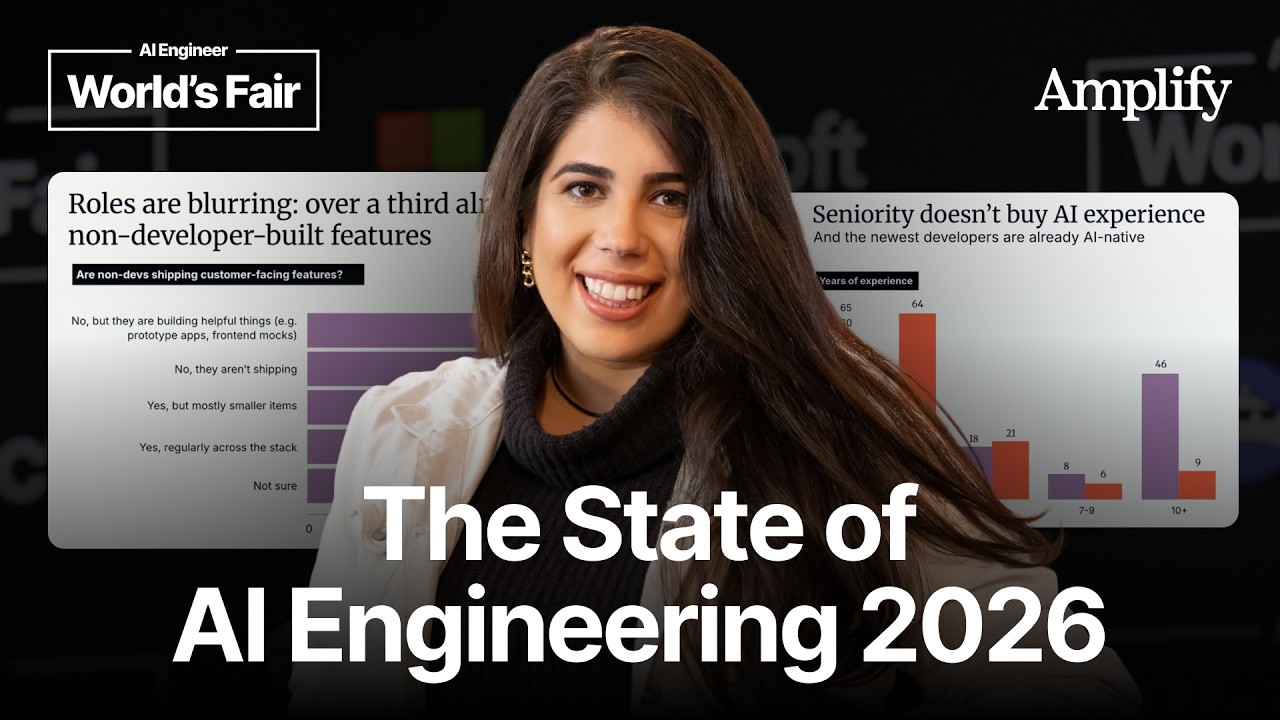
Barr Yaron, partner at Amplify Partners, drops a bombshell on the 2026 state of AI engineering.
The Simple Version
Think of AI engineering as a new layer of the software stack that everyone must learn.
How It Actually Works
The AI Engineering Workforce
The median new engineer has nearly as much AI experience as a decade‑old veteran.
Current Modalities and Adoption
Most teams are mixing closed‑weight models with open‑weight options.
Model Strategy: Closed vs. Open‑Weight
Closed models offer reliability; open models give flexibility and cost control.
Cost as an Engineering Constraint
Cost is now a first‑class engineering constraint.
The Rise of Agentic Workflows
Agents are no longer just reading and summarizing — they’re making decisions and invoking APIs.
Infrastructure Challenges and Evals
The biggest challenge in your stack? Every single year, the number one answer is eval.
The Build vs. Buy Trade‑off
Shipping software is not gated on being an engineer anymore.
Impact on Engineering Culture and Teams
Engineers can focus on outcomes, not just code, as AI handles routine tasks.
Technical Deep Dive
Developers are now writing prompts that trigger multi‑step actions, effectively turning LLMs into junior engineers.
Architectures are evolving to support persistent memory and tool‑calling loops, requiring new patterns for state management.
Evaluation frameworks are expanding to include not just accuracy but also cost, latency, and safety metrics.
Why This Matters
These shifts will redefine hiring, training, and budgeting for software teams.
Companies that master agentic workflows will outpace rivals by delivering features faster and cheaper.
Ignoring eval-driven development can lead to hidden technical debt that grows exponentially.
Key Takeaways
- AI experience is now as common as ten years of traditional coding.
- Cost is a primary design constraint, not an afterthought.
- Agents are moving from assistants to actors inside applications.
- Evaluation is the top challenge for every stack.
- Shipping software no longer requires a traditional engineer identity.
- Open‑weight models are gaining traction for flexibility.
- Culture is shifting toward outcome‑focused engineering.