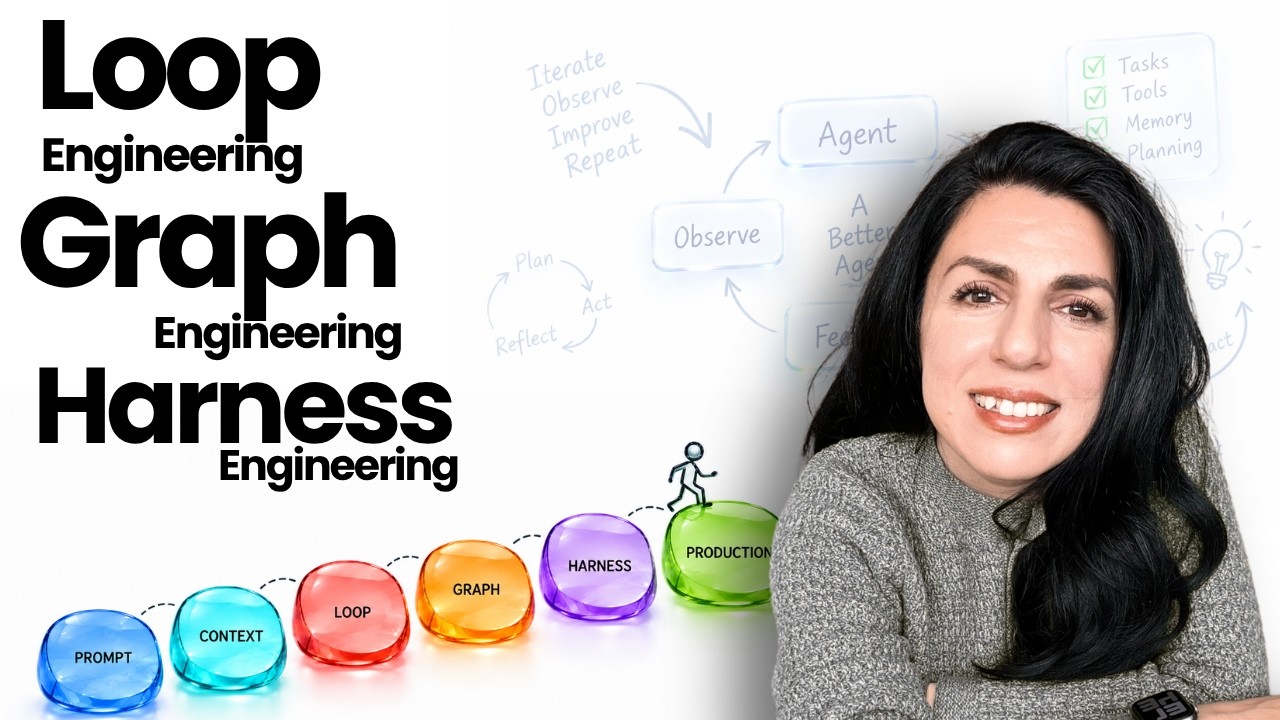
Most people think prompt engineering is the 'secret sauce' for AI agents, but that's like trying to build a skyscraper with just a fancy hammer. To build something that actually works in production, you need a real architectural blueprint.
The Simple Version
Imagine you're running a professional insurance company. You wouldn't just give one person a handbook and hope they handle every claim perfectly without any supervision.
Instead, you'd have a workflow. You'd have different specialists (agents), a manager to check their work (loops), a clear process map of who talks to whom (graphs), and a set of company rules and audits to keep everything legal (harness).
How It Actually Works
Agent Execution Engineering
This is the foundation. It's not just about the prompt, but how a single agent is configured to act, the tools it can access, and the specific context it's given to perform a task.
Loop Engineering
Loops turn a one-shot guess into a refined result. They introduce evaluation, feedback, and retries, allowing an agent to realize it made a mistake and fix it before the user ever sees it.
Graph Engineering
When one agent isn't enough, you need a team. Graph engineering orchestrates how agents hand off tasks to one another using conditional routing and shared memory.
Harness Engineering
This is the production wrapper. It adds the 'adult supervision'—permissions, audit trails, observability, and human-in-the-loop gates to ensure the AI doesn't go rogue.
Technical Deep Dive
For the developers, this is where we move from linear chains to cyclic graphs. Using frameworks like LangGraph, you can implement stateful orchestration where the 'state' is passed between nodes (agents).
A production system doesn't just 'hope' for the best; it uses evals (evaluation benchmarks). In a real-world insurance agent system, you might have 72 different evals to check for accuracy, compliance, and risk before a payout is approved.
Furthermore, GraphRAG and Graph Memory allow agents to navigate complex relationships in data. Instead of simple vector search, the agent can traverse a knowledge graph to find non-obvious connections between a policy detail and a claim evidence file.
Why This Matters
In a demo, a 5% error rate is 'impressive.' In a production insurance system handling millions of dollars, a 5% error rate is a catastrophe.
By implementing these engineering layers, we move from 'stochastic parrots' to reliable software. It allows businesses to actually trust AI with high-stakes workflows because there are guardrails and audit trails at every step.
Key Takeaways
- Prompting is not enough for production; you need a full engineering stack.
- Loop Engineering provides the feedback mechanism for self-correction.
- Graph Engineering manages the complex hand-offs between specialized agents.
- Harness Engineering ensures the system is safe, observable, and auditable.
- GraphRAG enhances how agents retrieve and connect complex knowledge.
- Evals are the only way to prove an agent is ready for the real world.