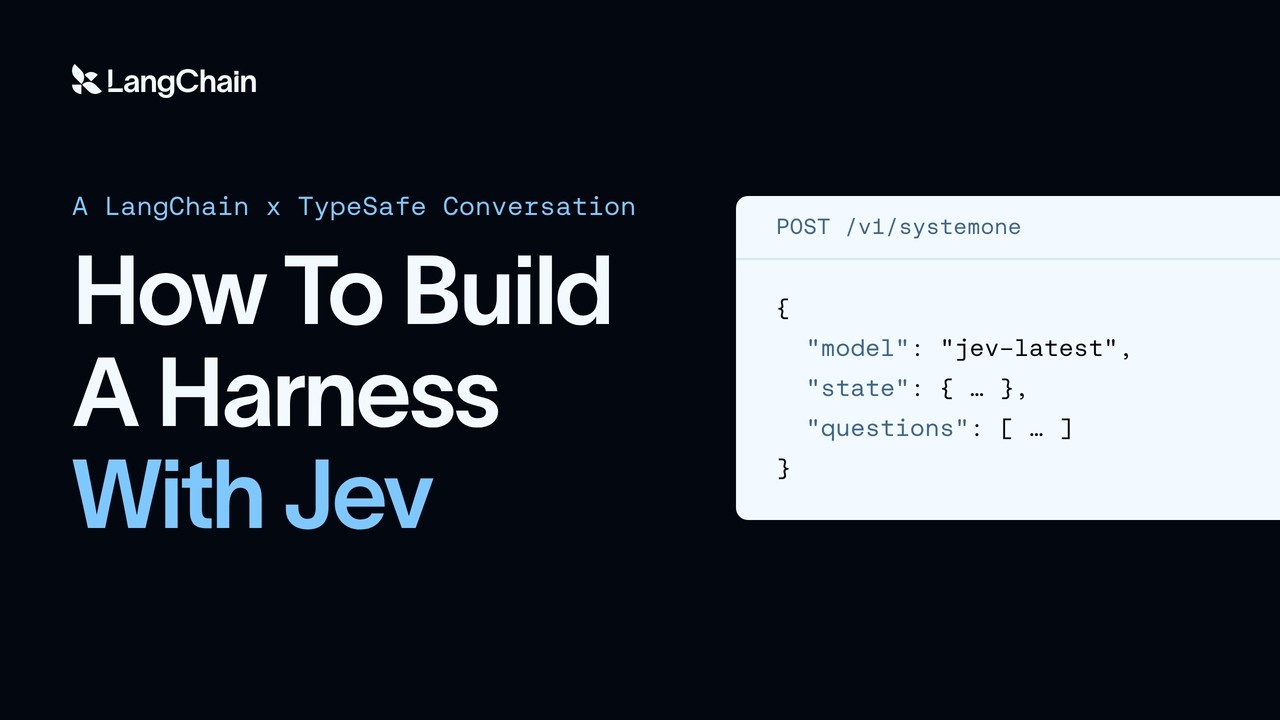
Why use a massive, expensive Large Language Model (LLM) just to decide if a customer email is 'angry' or 'calm'? For years, developers have used LLMs as hammers, treating every small decision like a complex reasoning problem.
The Simple Version
Imagine you are running a busy restaurant. You have a world-class Executive Chef who can create a 12-course tasting menu from scratch (this is your System 2 thinking, or a frontier LLM like GPT-4o). The Chef is brilliant, but they are slow and expensive.
Now, imagine a seasoned Host at the front door. The Host doesn't need to know how to cook a soufflé; they just need to know if a guest has a reservation or if a table is ready. They make these decisions in a split second based on a few simple rules. This is System 1 thinking.
Jev is that Host. It isn't designed to write poetry or code an entire app. As Allie Laabs from TypeSafe puts it, "Jev does not generate text. It is not a generative AI in that sense." It is a specialized model built purely for making fast, binary, or categorical decisions based on a specific schema.
How It Actually Works
Jev operates on the principle of 'machine-to-machine' communication. Instead of asking a model to 'think' and then output a paragraph that a programmer must then parse into JSON, Jev takes a state as input and returns a direct, type-safe answer.
The Three Question Types
Jev doesn't just 'chat.' It answers three specific types of structured questions:
- Choice: This is essentially a classifier. You provide a list of options (e.g., 'Billing', 'Technical', 'Sales'), and Jev picks the most dominant one.
- Score: This rates a state along a specific axis. Unlike a blind 1-10 scale, Jev uses semantic descriptions for each level (e.g., 0 = Calm, 1 = Frustrated, 2 = Very Angry).
- Noul: This is a Boolean check. It asks if a statement is true or false (e.g., 'Does this message convey urgency?'). While the answer is binary, the internal output is a continuous value from 0 to 1.
The 'Panel of Humans' Test
To know if a task is right for Jev, the speakers suggest a simple litmus test. If you could present the question to a panel of super-smart humans and they could answer it in five seconds without needing to perform multi-step reasoning, it is a System 1 task.
Technical Deep Dive
From an architectural perspective, Jev solves what the speakers call the 'prose bridge' problem. In traditional agentic loops, an LLM generates human-readable text (prose), which is then converted into a tool call or a JSON object via structured output modes. This process is computationally expensive and introduces latency because the model is spending tokens on language it doesn't actually need.
For context, this is similar to how early NLP moved from massive general-purpose models to smaller, specialized encoders like BERT for classification tasks. Jev takes this further by focusing on TypeSafe schemas. By removing the generative layer, the model focuses entirely on the mapping between the input state and the predefined categories.
Context Windows and Constraints
Developers often worry about the limits of these specialized models. Regarding context, Jev currently manages a 32K token limit for the combined state and the largest question, with a total cap of approximately 64K tokens for the state plus all questions. If your input exceeds this, you'll need to split the task into multiple calls.
It is also important to understand Model Jaggedness. As Allie notes, the model's accuracy can degrade if you provide a "huge amount of state" that isn't necessary. For example, in a demo where Jev played Doom, providing an overly granular array of every single bullet and damage point actually caused the overall intelligence to drop. Effective use requires context engineering: only providing the specific bits of data required for the determination.
Probability vs. Confidence
A common mistake is treating the returned 'confidence' score as a silver bullet. In Jev, confidence is a deterministic computation of the probability map. It measures how much there is a "distributed spread" in the answers. If you have three competing valid options, confidence will be low, even if the model is performing perfectly. Developers should experiment with different statistical approaches—like looking at the raw top probability or the gap between the first and second choice—rather than blindly applying a single threshold.
Why This Matters
The shift toward System 1 models represents a move toward 'smart software' rather than just 'chatbots.' By offloading simple decisions to a model like Jev, developers can drastically reduce the token spend and latency of their agents. This efficiency even unlocks real-time use cases, such as live chat filtering for massive streaming platforms like Twitch, where decisions must be made in under 150 milliseconds.
Furthermore, it solves a critical reliability issue. Generative models can 'hallucinate' their way through a classification task or fail to adhere to a JSON schema. Because Jev is built for type-safe outputs, the risk of a malformed response breaking a production pipeline is virtually eliminated.
Ultimately, this creates a more sustainable architecture for AI agents. By combining the fast intuition of System 1 (Jev) with the deep reasoning of System 2 (Frontier LLMs) and the deterministic nature of traditional code, developers can build agents that are both powerful and predictable.