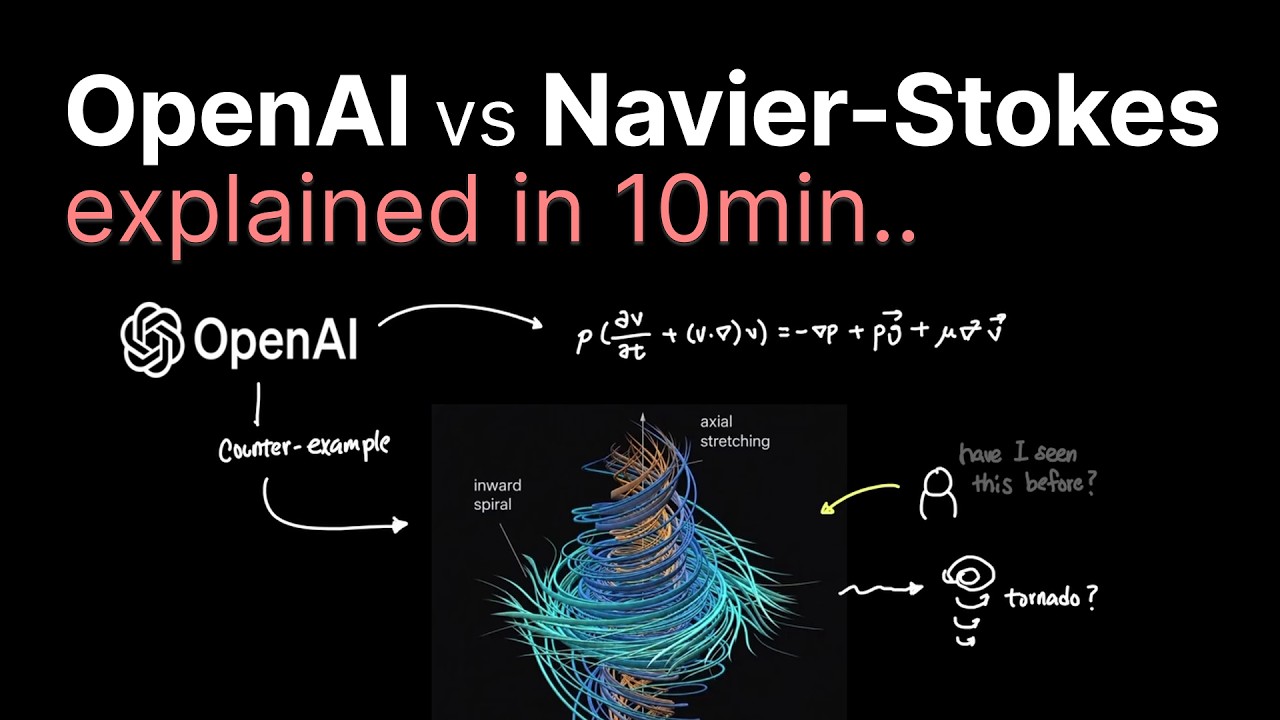
Imagine a math problem so difficult that solving it earns you a million dollars and instant legendary status in the scientific community.
That is the reality of the Navier-Stokes equations, and OpenAI is now stepping into the ring to try and crack it.
The Simple Version
The Navier-Stokes equations are the gold standard for describing how liquids and gases move. Whether it's air flowing over a wing or water swirling down a drain, these equations govern it all.
The problem is that we don't actually know if these equations always work perfectly, or if they occasionally 'break' and produce impossible results.
How It Actually Works
The Search for the 'Blow-Up'
In mathematics, a 'blow-up' happens when a solution to an equation suddenly becomes infinite. If OpenAI can prove this happens in a specific scenario, they find a counter-example to the idea that these flows stay 'smooth' forever.
The Euler Connection
To solve this, OpenAI looked at the Euler equations, which are essentially a simplified version of Navier-Stokes without the 'thickness' (viscosity) of the fluid.
By finding a way to make the Euler equations 'blow up' without any outside force, they've achieved something that previous human researchers, like Buckmaster and Alpoge, were striving toward.
Technical Deep Dive
From a technical perspective, OpenAI isn't just 'guessing' numbers. They are using AI to navigate the incredibly complex, high-dimensional space of fluid dynamics to locate singularities.
The challenge lies in existence and smoothness. The Millennium Prize problem asks if a solution always exists in 3D and if that solution remains smooth (no infinities) for all time.
By utilizing AI to generate counter-examples, OpenAI is essentially using the model as a heuristic search engine. It can test millions of boundary conditions and initial states far faster than a human mathematician could manually derive them.
Why This Matters
If AI can solve these types of problems, it proves that LLMs and their successors aren't just 'stochastic parrots' repeating text. It shows they can perform high-level symbolic reasoning and discover new mathematical truths.
Practically, mastering these equations leads to perfect weather forecasting, more efficient spacecraft, and a deeper understanding of turbulence, which is one of the last great unsolved mysteries of classical physics.
Key Takeaways
- Navier-Stokes are the core equations for fluid and gas motion.
- The Millennium Prize is awarded for proving if these solutions always stay 'smooth'.
- A 'blow-up' is a mathematical singularity where values become infinite.
- OpenAI focused on Euler equations (non-viscous fluids) to find a counter-example.
- AI is being used to explore mathematical spaces too vast for humans to map manually.
- The solution is currently undergoing institutional review to verify its validity.