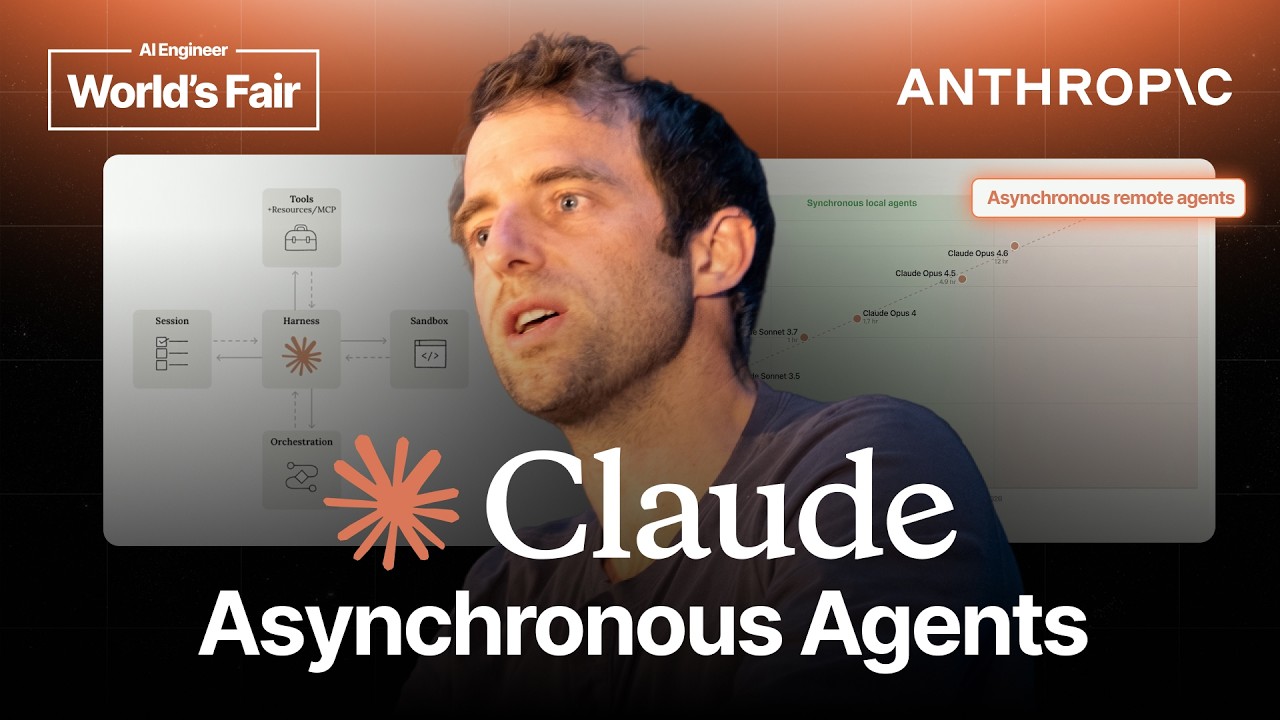
Ever wish an AI could tackle a week‑long project without getting lost? In this talk, Lance Martin reveals how Claude pulls off marathon tasks.
The Simple Version
Think of an AI as a chef who plans the whole meal, then cooks each dish step by step. Instead of juggling planning and cooking at once, Claude splits the brain (planner) from the hands (executor) so each can focus and improve.
How It Actually Works
Decoupling Brain and Hands
First, the planner creates a high‑level outline. Then a separate executor follows the outline, reducing errors.
Self‑Verification
Claude runs internal checks after each step to catch drift.
Self‑Learning
The system records successful patterns and tweaks future plans automatically.
Design for Evolving Harnesses
Architecture is built to swap in new tools or modules without breaking the whole pipeline.
Technical Deep Dive
Agent harnesses use a modular pipeline where each module implements a contract interface. The planner emits a JSON plan; the executor deserializes it and calls tool APIs. Verification layers use deterministic heuristics and Monte‑Carlo sampling to validate outputs.
Why This Matters
Long‑horizon AI unlocks workflows that currently need entire teams: automated research pipelines, complex software maintenance, and multi‑step scientific discovery. By making agents reliable, enterprises can offload repetitive planning work and focus on creativity.
Key Takeaways
- Separate planning from execution for clarity.
- Self‑verification catches errors early.
- Self‑learning updates plans automatically.
- Modular design lets you plug in new tools.
- Reliable agents enable complex real‑world automation.