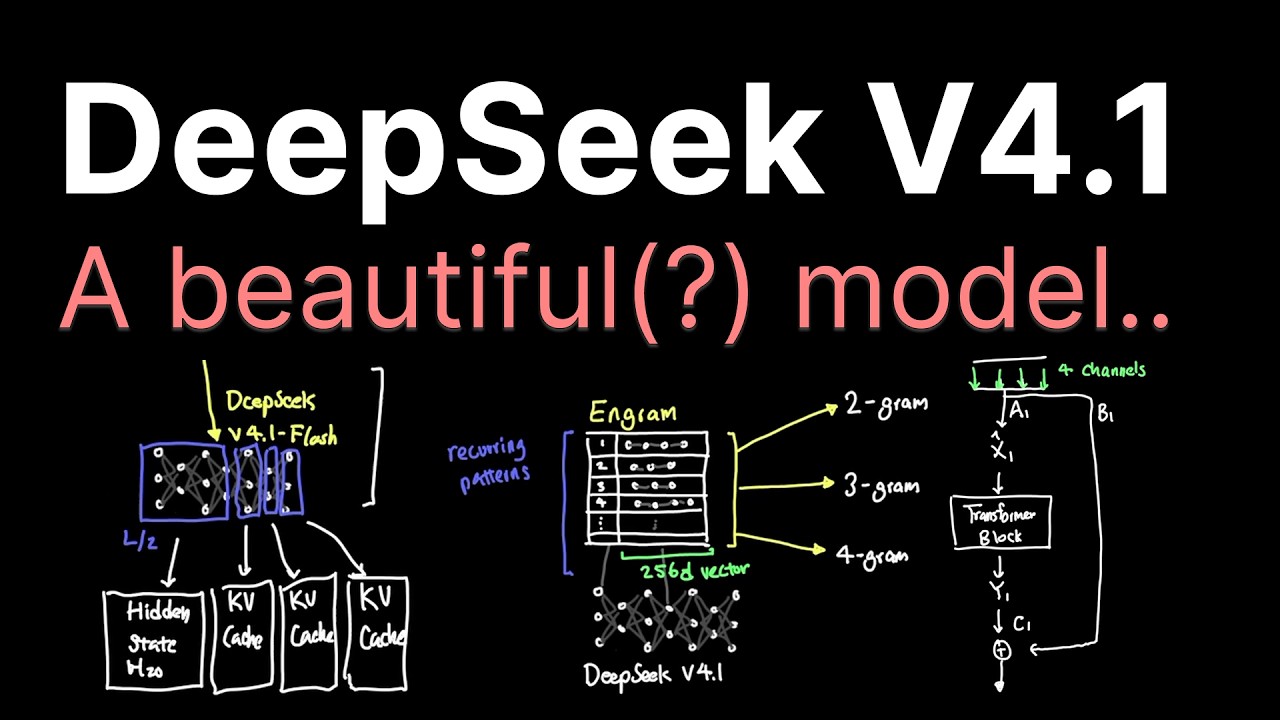
Imagine a model that can think faster, remember better, and use half the energy of its predecessors without losing its edge. That is exactly what DeepSeek is aiming for with the V4.1 Flash architecture.
The Simple Version
Most Large Language Models (LLMs) work like a student who has to reread every single page of a textbook every time they want to answer a question. As the book gets longer, the student slows down and eventually runs out of desk space to keep the pages open.
DeepSeek V4.1 Flash changes this strategy. Instead of rereading everything, it uses something called Engram, which acts like a set of high-speed sticky notes for immediate, short-term information.
Additionally, it doesn't use its entire 'brain' for every single word it generates. Through a system called CED and CSA2, the model selectively picks which layers of its architecture are actually needed for the task at hand.
How It Actually Works
To understand the brilliance of V4.1 Flash, we have to look at how it breaks away from the traditional Transformer blueprint. It focuses on two primary bottlenecks: memory (the KV cache) and compute (the number of layers processed).
Engram: The Recurrent Memory
In a standard Transformer, the model uses 'attention' to look back at all previous tokens. This is powerful but expensive. Engram introduces a way to store and retrieve short-term recurrent information separately from the main language backbone.
By separating this recurrent state, the model can maintain context without the linear increase in computational cost usually associated with longer sequences. It effectively creates a dedicated 'scratchpad' for the model to track the current state of the conversation.
CED and CSA2: Selective Processing
DeepSeek has implemented a Causal Encoder Decoder (CED). This architectural shift allows the model to be much more surgical about how it processes data.
When paired with CSA2, the model doesn't just run a linear sequence of all its layers. Instead, it can run approximately half of the model's layers by being selective about which ones are activated for a specific token.
Tackling the KV Cache
The KV (Key-Value) cache is where LLMs store the mathematical representations of previous tokens to avoid recalculating them. As the context window grows, this cache consumes massive amounts of VRAM, often becoming the primary bottleneck for serving models.
By using the CED and CSA2 mechanisms to limit the number of active layers, DeepSeek V4.1 Flash drastically reduces the amount of data that needs to be stored in the KV cache. This means more users can be served on the same hardware and tokens are generated with much lower latency.
Technical Deep Dive
For the developers and architects, the real magic of V4.1 Flash lies in the intersection of its mathematical structure and its hardware-level optimizations. The transition to a Causal Encoder Decoder (CED) allows for a more efficient flow of gradients and activations during the Prefill and Decode phases.
During the Prefill phase, the model processes the initial prompt. In V4.1 Flash, the selective layer activation managed by CSA2 ensures that the initial compute spike is dampened. During the Decode phase—where tokens are generated one by one—the reduced KV cache footprint minimizes the memory bandwidth bottleneck, which is typically the limiting factor for LLM throughput.
Single-Pass mHC
One of the most sophisticated additions is the Single-Pass mHC. In traditional attention mechanisms, the GPU often has to make multiple trips to memory to handle different attention heads (Multi-Head Attention).
Single-Pass mHC optimizes this by consolidating these operations. It allows the model to compute multiple heads in a single pass through the GPU kernels, reducing the 'memory wall' effect where the processor sits idle waiting for data to arrive from VRAM.
Kernel Optimization
DeepSeek didn't just change the math; they rewrote the low-level code. The model utilizes highly optimized kernels that are specifically tuned for the CED architecture. These kernels ensure that the selective layer skipping doesn't introduce overhead that would negate the compute savings.
By optimizing the way tensors are moved and multiplied at the CUDA level, DeepSeek ensures that the theoretical savings of running 'half the model' actually translate into real-world wall-clock speedups.
Why This Matters
The industry is currently in a race to make models 'smaller' and 'faster' without making them 'dumber.' DeepSeek V4.1 Flash represents a shift from simply shrinking models (distillation) to fundamentally changing how they execute (architectural efficiency).
For developers, this means the ability to deploy high-reasoning models in environments with limited VRAM. It opens the door for longer context windows—allowing the model to 'read' entire codebases or long documents—without the cost of inference skyrocketing.
Ultimately, this architecture proves that we can achieve 'Flash' speeds not just by using smaller models, but by being smarter about which parts of a large model we actually use at any given millisecond.