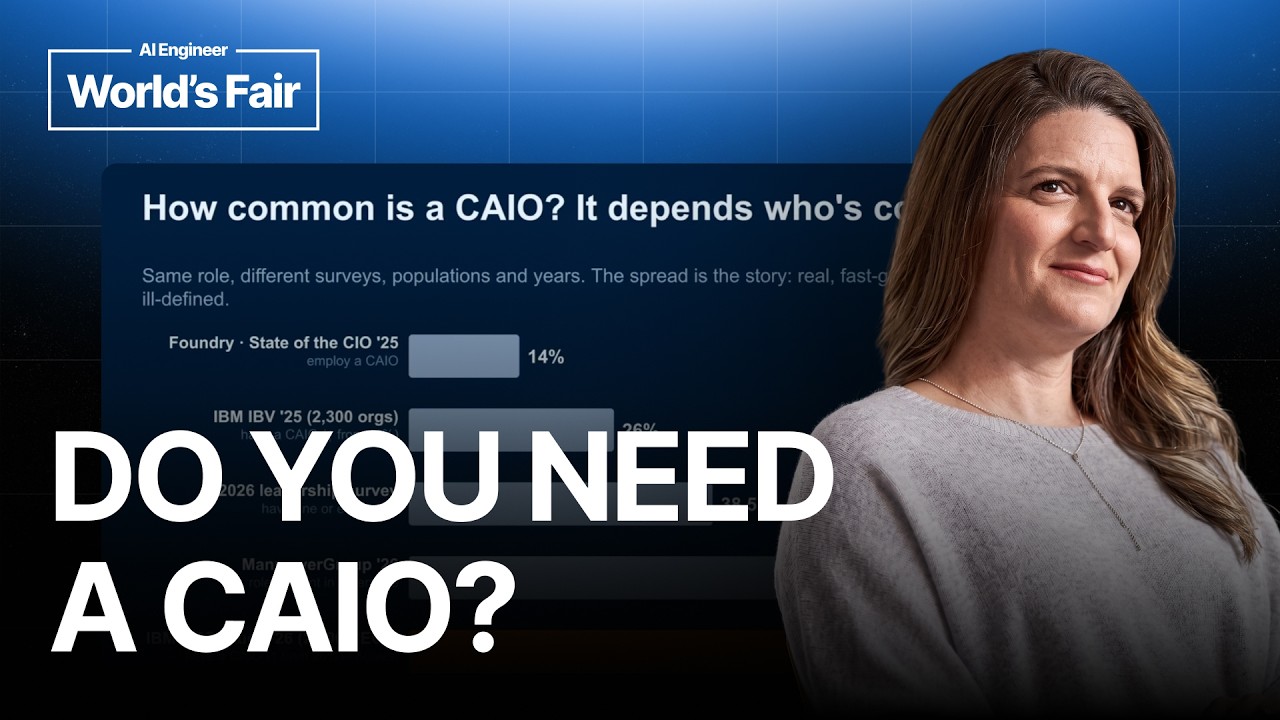
The role of the Chief AI Officer (CAIO) is exploding in popularity, but it remains one of the most ill-defined positions in the modern C-suite. As companies rush to integrate generative AI, the question isn't just 'do we need one?' but 'what exactly will they do?'
The Simple Version
Imagine you are hired to run a professional kitchen in a massive restaurant group. Depending on the restaurant, your job changes completely.
In a small, experimental pop-up, you are the Scientist, constantly testing new ingredients and recipes. In a massive global chain, you are the Architect, designing the supply chains and menus that work across hundreds of locations. In a cooking school, you are the Coach, teaching others how to master the craft.
The Chief AI Officer role works exactly the same way. As Rania Khalaf explains, the job depends on whether you are working for a software giant, a biotech startup, or a traditional manufacturing firm.
How It Works: The Three-Hat Framework
Because AI is "in everything," a CAIO can easily become overwhelmed by trying to do everything. To maintain discipline, Khalaf suggests categorizing the role into three distinct focus areas.
1. The Scientist
The Scientist focus is about exploration and experimentation. This involves building new algorithms, testing foundation models, and staying at the bleeding edge of research.
For a company like WSO2, Khalaf notes her time as a scientist is relatively low (around 20%), whereas in a research-heavy environment like IBM, this would be the primary driver.
2. The Architect
The Architect focuses on strategy and implementation. This involves deciding how AI integrates into the product roadmap, managing the data infrastructure, and ensuring AI can actually drive revenue.
For software companies, this means making products "agent-consumable." For non-software companies, it might mean using AI to optimize supply chains or internal workflows.
3. The Coach
Perhaps the most surprising pillar, the Coach is responsible for evangelism and education. This means teaching employees how to use AI effectively and helping customers understand the value of AI-driven products.
As Khalaf points out, "You can explain until you're blue in the face, but people don't believe it until they experience it." Coaching helps bridge that gap between technical capability and human adoption.
Technical Deep Dive
A critical part of the modern CAIO's toolkit is moving beyond simple metrics. Many leaders make the mistake of measuring token consumption to gauge AI progress, but Khalaf argues this is a flawed metric because it is "easily hackable." Instead, a sophisticated AI leader focuses on architectural readiness and ecosystem integration.
Agentic Readiness and MCP
In the shift toward an "agentic enterprise," the CAIO must ensure that products are not just human-facing, but agent-facing. This involves moving toward standards like MCP (Model Context Protocol) servers, providing specialized skills, and offering CLIs that allow LLMs to interact with software directly.
For a technical leader, this means rethinking the entire stack. It isn't just about adding a chatbot to a website; it's about ensuring the underlying APIs and identity management systems are robust enough to handle non-human users (agents) that require their own agent identity and governance.
Measuring Success Beyond Tokens
To truly understand the impact of AI, Khalaf suggests tracking several sophisticated dimensions:
- AI Fluency: Is AI knowledge centralized in a small "center of excellence," or are there builders distributed across marketing, engineering, and finance?
- GEO (Generative Engine Optimization): How visible is the company to LLMs? Can an agent find and understand your product documentation?
- Agent-Proof Pricing: Traditional SaaS pricing models often break when agents begin consuming massive amounts of data. CAIOs must help design consumption-based models that account for this shift.
Why This Matters
The rapid rise of the CAIO—with IBM studies showing interest jumping from 11% in 2024 to 76% in 2025—signals a massive shift in corporate structure. This isn't just a new title; it's a fundamental change in how companies manage technical debt and innovation.
However, the role's success is not guaranteed by technical brilliance alone. As Khalaf emphasizes, there is "no silver bullet." A CAIO requires strong backing from the CEO to navigate the friction that arises when AI reshapes existing departments, from Product to HR.
Ultimately, the role is fluid. Whether you end up as a researcher, a strategist, or an educator, the goal is to find the intersection of what the company needs and where your specific technical expertise can drive the most value.