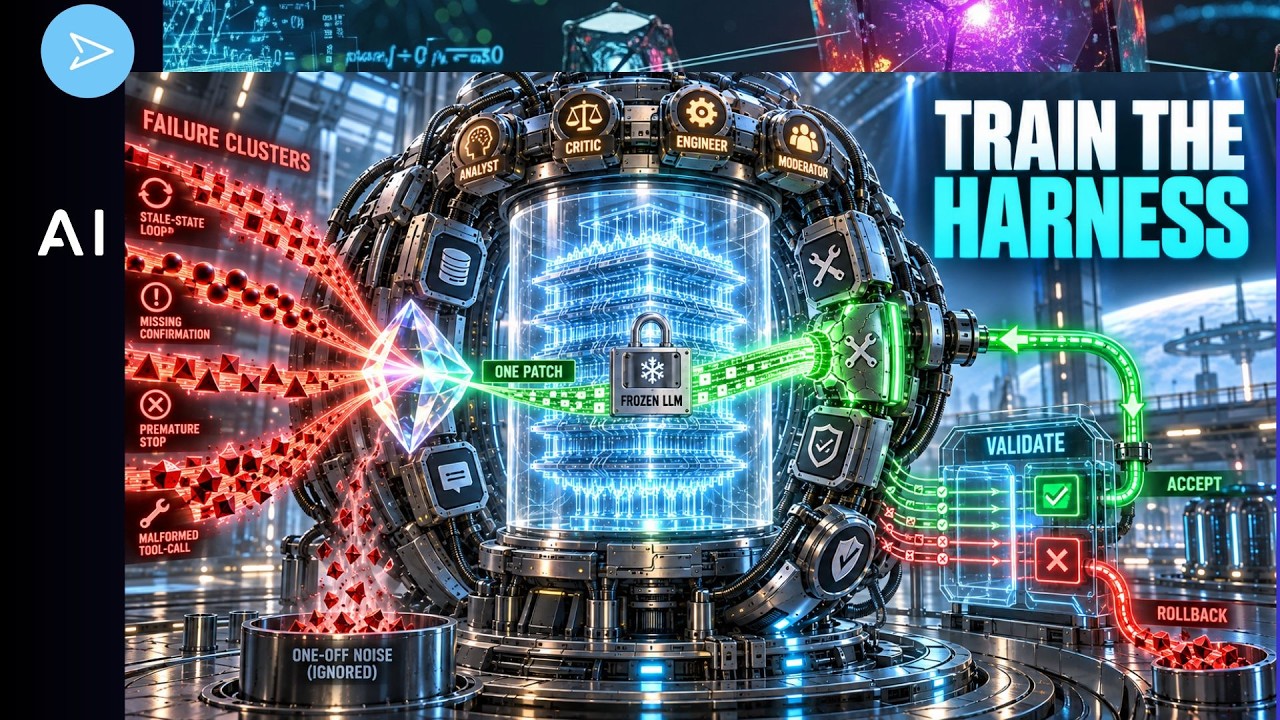
Imagine building a brilliant robot that can cook any meal, but the kitchen it's in has a broken stove and a leaky faucet. If the meal tastes terrible, is the robot a bad chef, or is the kitchen just broken?
The Simple Version
When we talk about AI agents, we usually focus on the Large Language Model (LLM)—the 'brain.' But the brain needs 'hands' to actually do things, like browsing the web or running code. These 'hands' are what researchers call the Runtime Harness.
The problem is that when an agent fails, it's hard to tell who is at fault. Did the AI make a logical mistake, or did the harness crash because of a bug in the code? If we keep 'fixing' the harness every time the AI fails, we end up with a system that is too specialized for one specific task and fails at everything else. This is called overfitting.
How It Actually Works
The researchers behind ECDYSIS wanted to create a way for AI to intelligently figure out if a failure belongs to the agent's reasoning or the system's infrastructure.
The Runtime Harness
A runtime harness is the software layer that wraps around an LLM. It handles the API calls, manages the file system, and parses the text output of the model into executable commands.
If the LLM says 'Search for the weather in Tokyo,' the harness is the part that actually talks to the weather API and feeds the result back to the model. If the API is down, the agent fails, even if the LLM's logic was perfect.
Systematic vs. Random Failures
Not all failures are equal. A random failure might be a one-time network glitch. A systematic failure, however, is a flaw in the harness that happens every time a certain action is taken.
ECDYSIS focuses on detecting these systematic failures. By identifying patterns in how the agent fails, the system can determine if the 'scaffolding' needs to be repaired rather than the 'prompt' being changed.
The Trap of Self-Evolution
Many modern agents use 'self-evolving' loops. They try a task, fail, analyze the error, and update their own code or prompts to fix it.
The danger here is that the agent might 'fix' a harness error by creating a weird, specific workaround. Over time, the harness becomes a mess of special cases that only work for the specific examples the AI has already seen, making it brittle and useless for new, unseen tasks.
Technical Deep Dive
From a developer's perspective, ECDYSIS introduces evidence-based runtime engineering. This moves the focus from purely improving the model's weights or prompts to improving the environment's reliability.
Failure Attribution Logic
The core technical challenge is attribution. In a complex agent loop, the error trace can be muddy. ECDYSIS seeks to isolate the failure point by gathering evidence from the runtime execution logs.
By comparing the expected output of a tool with the actual system response, the method can flag whether the error occurred during the action generation phase (LLM fault) or the action execution phase (Harness fault).
Preventing Overfitting in Harnesses
To stop the harness from overfitting, the system must avoid 'over-tuning.' This means instead of creating a patch for every single error, the system identifies the root cause of the systematic failure.
The name 'Ecdysis' refers to the process of a reptile shedding its skin. In this context, it implies a process of shedding inefficient or overfitted runtime configurations to evolve a leaner, more generalized environment that supports the agent more effectively.
The Engineering Loop
The workflow typically follows a cycle: Execution → Failure Detection → Evidence Gathering → Attribution → Targeted Harness Update. This ensures that the 'evolution' of the agent is grounded in actual system evidence rather than just trial-and-error prompting.
Why This Matters
As we move toward Autonomous Agents that can manage our emails, code our apps, and handle our finances, reliability is everything. We cannot have agents that 'hallucinate' a solution to a system bug by creating a fragile workaround.
By separating the 'brain' (LLM) from the 'tools' (Harness), developers can build more robust systems. It allows us to debug the infrastructure without accidentally breaking the AI's reasoning capabilities.
Ultimately, ECDYSIS paves the way for agents that can actually maintain themselves. Instead of a human engineer spending hours digging through logs to find a broken API wrapper, the AI can identify the systematic failure and suggest the exact fix needed for the harness.
Frequently asked questions
What is a runtime harness in AI?
It is the surrounding software infrastructure (APIs, code interpreters, file managers) that executes the commands generated by an LLM agent.
Why do self-evolving AI harnesses overfit?
They overfit when they create highly specific patches for individual errors rather than fixing the root systematic cause, making them fail on new tasks.
What makes ECDYSIS different from prompt engineering?
While prompt engineering changes how the AI thinks, ECDYSIS focuses on 'runtime engineering,' which improves the environment the AI operates in.
Sources
Source: “ECDYSIS: Solving Runtime Harness Failures in LLM Agents” on YouTube by Discover AI
Tags: LLM Agents, Runtime Engineering, AI Research, Software Architecture, ECDYSIS
Related articles
- Procedural Graphs: Giving AI a Blueprint for Complex Tasks
- Beyond Prompting: Paul Bakaus on Harness Engineering
- The 2026 Roadmap to Becoming a Top Agentic AI Engineer
- Building with Jev: TypeSafe's High-Speed Decision AI
- Wiki Foundation Model: Solving RAG Bottlenecks with Neural Graphs
- Controlling AI Agents with LangChain Managed Deep Agents Middleware