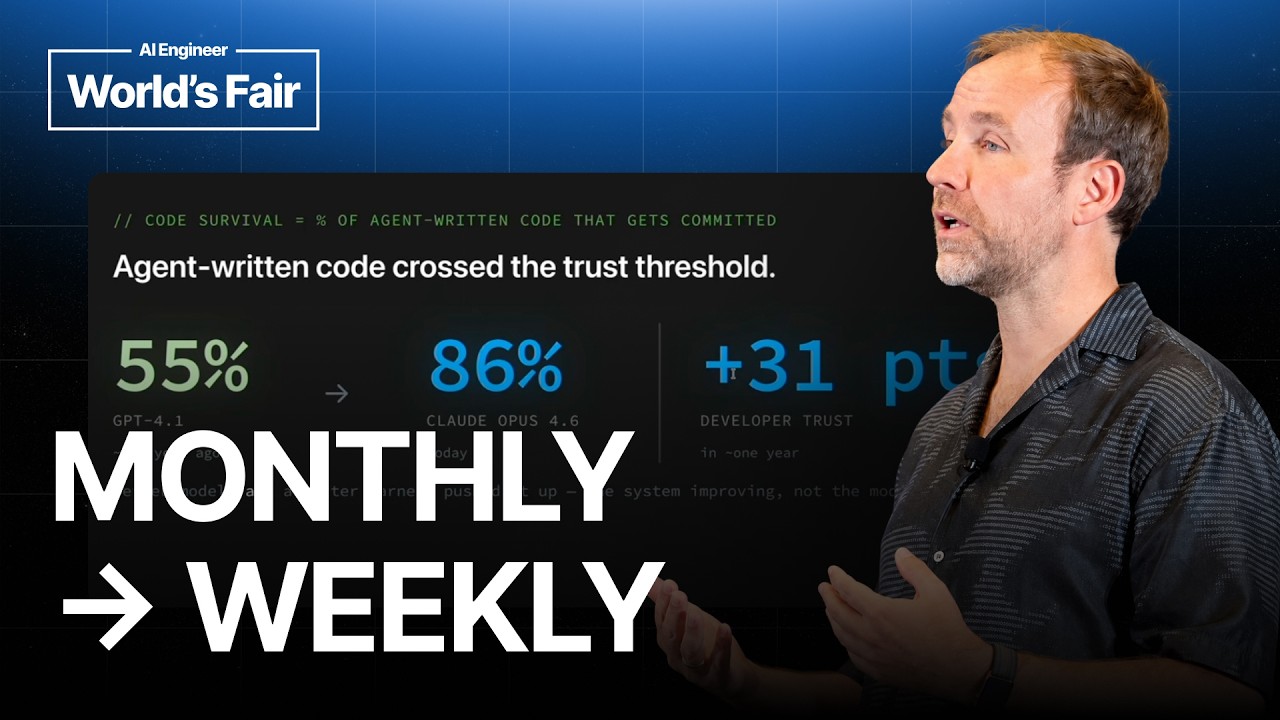
Imagine shipping updates to 50 million users every single week instead of once a month. For the VS Code team, this wasn't achieved by simply giving developers a better chatbot, but by rebuilding their entire engineering engine around AI agents.
The Simple Version
For ten years, VS Code followed a steady monthly heartbeat. They would build, test, and ship a major version once every four weeks. But as AI agents became capable of writing actual code, the bottleneck shifted from writing the code to reviewing and testing it.
If you just give 20 agents to a team, they will produce code faster than any human can read it. This creates a massive traffic jam at the finish line. To fix this, VS Code didn't just hire more reviewers; they automated the entire assembly line.
How It Actually Works
Harald Kirschner, Principal Product Manager at VS Code, explains that the transition required a three-pronged approach: shipping faster, holding quality, and learning faster.
1. Shipping Faster: Making the Codebase 'Agent-Ready'
The team realized that for agents to be effective, they needed a map. They implemented agents.mmd files—lightweight documents that provide agents with a structural map of the codebase. This prevents the AI from getting lost in the massive VS Code repository.
They also encoded expert knowledge into 'skills.' For example, instead of having one accessibility expert manually review every single UI change, they turned accessibility best practices into a reusable AI skill that any developer (or agent) can apply instantly.
2. Holding Quality: The Self-Correcting Loop
Shipping faster is dangerous if you're just shipping bugs faster. VS Code introduced a 'Component Browser' that automatically takes screenshots of every UI component whenever a change is made. This allows the team to spot 'ripple effects' where a change in one area accidentally breaks an icon or alignment elsewhere.
More impressively, they use Playwright to create a self-correcting loop. They developed a /launch skill that allows an agent to actually open VS Code, click through a specific scenario, and verify if a fix actually worked. As Kirschner puts it, "If your agent cannot use your application, your product directly to get this feedback loop... then that's a really big investment that pays off every time."
3. Learning Faster: VSC-Bench and Daily Sprints
To ensure the AI is actually improving, the team uses VSC-Bench. This is a custom evaluation harness where new developer scenarios are added via GitHub issues. This allows them to 'hill climb,' meaning they can mathematically prove that a new model or prompt is actually better than the last.
Technical Deep Dive
The most sophisticated part of this evolution is the automated telemetry-to-fix pipeline. VS Code processes roughly 51 billion telemetry events per day. Most companies would just alert a human when errors spike; VS Code uses a multi-stage AI pipeline to fix them autonomously.
First, raw telemetry is filtered down to error stacks containing full stack traces. These are then grouped via 'fingerprinting' to identify common bugs. Finally, an AI agent analyzes the stack, identifies the responsible symbol, and automatically opens a Pull Request (PR) with a proposed fix. The human developer's role shifts from 'detective' to 'approver.'
For context, this relies heavily on MCP (Model Context Protocol), an open standard that allows LLMs to connect to external tools and data sources. By using MCP, agents can interact with the local environment, read files, and execute commands without a human acting as the middleman.
The team also addressed a critical infrastructure bottleneck: CI/CD speed. When 20 agents hit a slow build system simultaneously, the lag compounds. By switching to TypeScript Go, they achieved a 10x improvement in build speeds, which is the difference between an agent getting feedback in 30 seconds versus 5 minutes.
Interestingly, the team discovered that token efficiency is non-linear. During a test with a simple 5-character 'hello world' file, they found that the most expensive model used 70x more tokens than others for the exact same task. This highlights that the 'harness' (how you wrap the prompt) is often more important than the model's raw reasoning power.
Why This Matters
This shift represents a fundamental change in software engineering. We are moving away from 'token maxing'—the idea that just using an AI chatbot more often makes you productive. Instead, we are seeing the rise of Systemic AI Integration, where the entire SDLC (Software Development Life Cycle) is redesigned for agentic workflows.
As Kirschner notes, "It's not about using more AI as you work day-to-day... It's about evolving the whole system, how you're shipping software to evolve to actually make better use of AI along the whole process." When the 'code survival rate'—the percentage of AI code actually committed—jumps from 55% (GPT-4.1) to 86% (Claude Opus 4.6), it proves that the environment is what unlocks the model's potential.
For the rest of the industry, the lesson is clear: if you want to ship faster, don't just buy more AI licenses. Fix your CI/CD bottlenecks, create machine-readable maps of your codebase, and build closed-loop feedback systems where the AI can see and use the product it is building.