Imagine an AI that doesn't just blindly accumulate information until it crashes, but instead actively cleans its own desk to stay sharp. That is the promise of the Context Language Model (CLM), a new architecture developed by researchers from the University of Washington, Meta Superintelligence Labs, MIT, and Trillium Labs.
The Simple Version
Most Large Language Models (LLMs) work like a legal notepad where you can only add lines to the bottom. As the conversation grows, the notepad gets too long, and the AI starts to get confused or runs out of memory.
To fix this, developers currently build a "harness" around the AI—a complex external control loop that manages databases, internet connectivity, and memory files to steer the AI's context. This harness acts like a clumsy assistant that periodically summarizes notes or rips out old pages, but it's an extra layer of complexity sitting outside the model's actual reasoning power.
The CLM aims to eliminate this external harness. Instead of a separate system managing the AI's inputs, the AI is given a "pencil and eraser," allowing it to decide exactly what to keep, what to summarize, and what to delete from its own working memory in real-time.
How It Actually Works
Context as a Programmable File
In a CLM, the context window is no longer just a stream of tokens; it is mapped directly to a programmable file. The model is granted standard access to modify this file, meaning it can use text processing tools to overwrite, delete, or append data to its own context between turns.
This allows the model to perform what the speaker calls "crystallization." For example, instead of keeping 800,000 broken web links in its memory, the model can use a subtask to compress that massive amount of data into only the successful, relevant links needed for the core task.
Learning to Edit via Gated GRPO
Teaching a model to edit its own memory is risky; if it deletes too much, it fails the task, but if it keeps too much, it wastes compute. The authors solve this using a modified Group Relative Policy Optimization (GRPO) with "success-gated efficiency advantages."
The system only rewards efficiency (shorter context) if the model actually succeeds at the task. As the speaker notes, if you reward shortness alone, the model might "aggressively delete crucial data," leading to total failure. By isolating successful trajectories, the model finds the cheapest possible memory strategy that doesn't sacrifice accuracy.
Technical Deep Dive
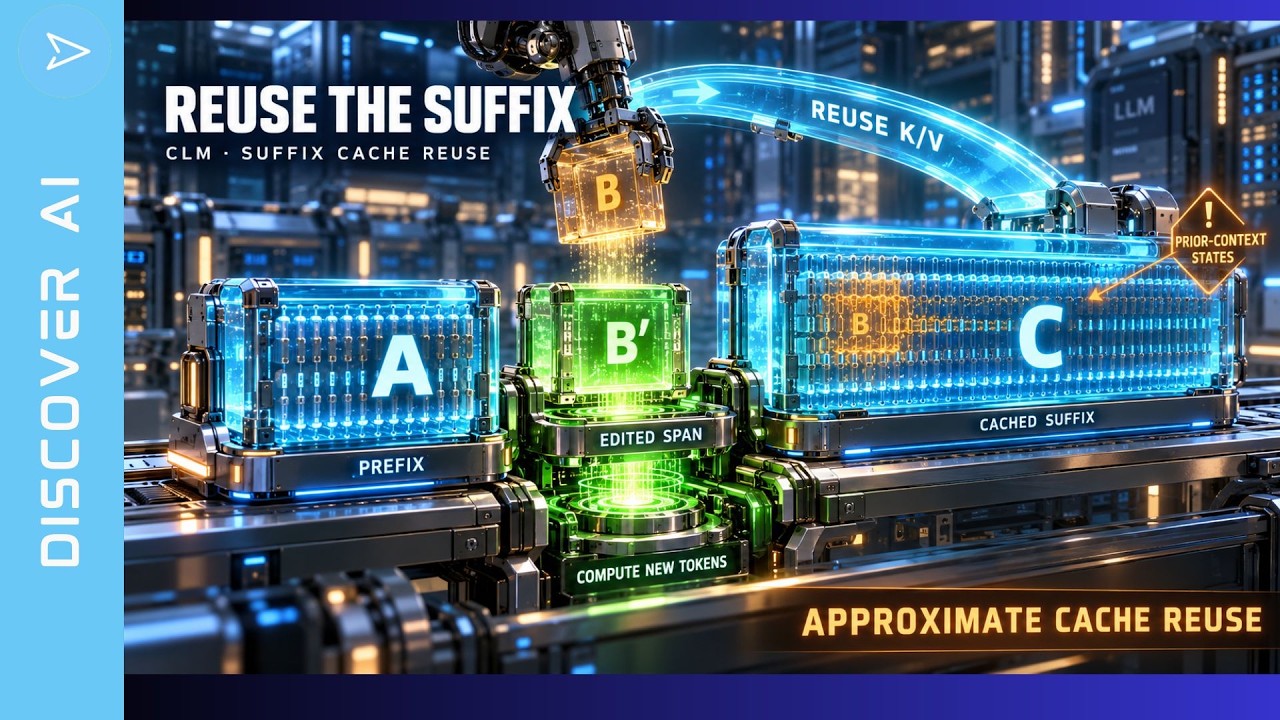
To make this editable memory computationally feasible, the researchers introduced SCR (Suffix Cache Reuse). To understand why this is necessary, we have to look at the KV (Key-Value) Cache and the concept of prefill.
In a standard Transformer, the server caches the key and value vectors for every token so it doesn't have to recompute them. Prefill is the process where the server runs input tokens through the model to compute this internal state. However, if you change a token in the middle of a prompt, the positional indices for every following token shift, causing a "prefix mismatch." This traditionally forces the system to discard the entire remaining cache and recompute everything.
SCR optimizes this by identifying the largest surviving spans of text after an edit. Specifically, it relocates up to K=20 of the largest surviving spans in memory. Because these tokens have shifted positions, SCR re-rotates the RoPE (Rotary Position Embeddings) of the cached keys and values to align them with the new sequence positions.
For context, RoPE is the mechanism most modern LLMs (like Llama) use to encode the positions of tokens in a high-dimensional space. By adjusting these rotations, CLM can reuse the old cache even after a mid-context edit. The researchers tested this on a Qwen 3.6 27B model utilizing linear attention, which helps manage long-horizon tasks by maintaining a fixed-size recurrent state.
Why This Matters
The immediate impact is financial and operational. Inference providers are heavily burdened by prefill costs. By proactively trimming its own context, the CLM reduced prefilled tokens from 75.8% to 41.8% in specific tests, leading to a 35% reduction in P-FLOPs per question.
Beyond cost, this enables "long-horizon viability" for AI agents. Agents performing deep research or coding for 24+ hours typically struggle with "garbage in, garbage out" as their context windows fill with stale plans. CLM allows the agent to maintain a clean, useful working state indefinitely.
However, there are limitations. The speaker warns that SCR is an approximation. As the speaker puts it, "the unchanged words can have changed contextual meanings." If a model edits a unit of measurement from Celsius to Fahrenheit, the subsequent data (the suffix) still exists in the cache but now has a different semantic meaning. While the authors claim this is "accurate enough" for most tasks, it remains a potential point of failure for high-precision scientific work.