We have all been there: you ask your smart speaker to play a specific song, and it confidently blasts a completely different track at full volume. Your immediate reaction is to shout over the music to make it stop, feeling a surge of frustration that the "smart" device is actually quite dim.
The Simple Version
Most AI developers spend all their time trying to make the AI "smarter" by increasing its accuracy. They treat the AI like a student taking a test, where the only goal is to get the right answer more often.
Amit Desai suggests we are turning the wrong knob. Instead of just focusing on accuracy, we should focus on behavior—specifically, what the AI does when it isn't 100% sure it's right.
How It Actually Works
Desai identifies two primary "knobs" that engineers can turn. The first is Accuracy, which involves improving the wake word detection, speech-to-text recognition, and natural language understanding layers.
The second knob is Decision Logic. This is the system's strategy for handling uncertainty. While most teams obsess over the first knob, the second one often provides a much faster path to a better user experience.
The Failure of Intuition
Consider a system with 79% accuracy. In a naive setup, the AI always acts on its best guess. If it's 60% sure you wanted "Bohemian Rhapsody," it just plays it. This leads to a high volume of "wrong song" errors.
To fix this, developers often add a confidence threshold. They might decide that the AI should only act if it is 65% sure. However, Desai found that human intuition is usually wrong about where to set this number. In his research, a seemingly "safe" 65% threshold was actually worse for the user than a much lower threshold of 43%.
The OUCH Heuristic
Why does intuition fail? Because it assumes all mistakes are equal. In reality, a "False Positive" (doing the wrong thing) is often much more painful than a "False Negative" (doing nothing).
Desai calls this the Outcome User Cost Heuristic (OUCH). Instead of maximizing accuracy, OUCH focuses on minimizing the total unit cost of pain. It assigns a numerical value to the frustration caused by different outcomes: the cost of a successful action, the cost of a refusal, and the cost of a wrong action.
Technical Deep Dive
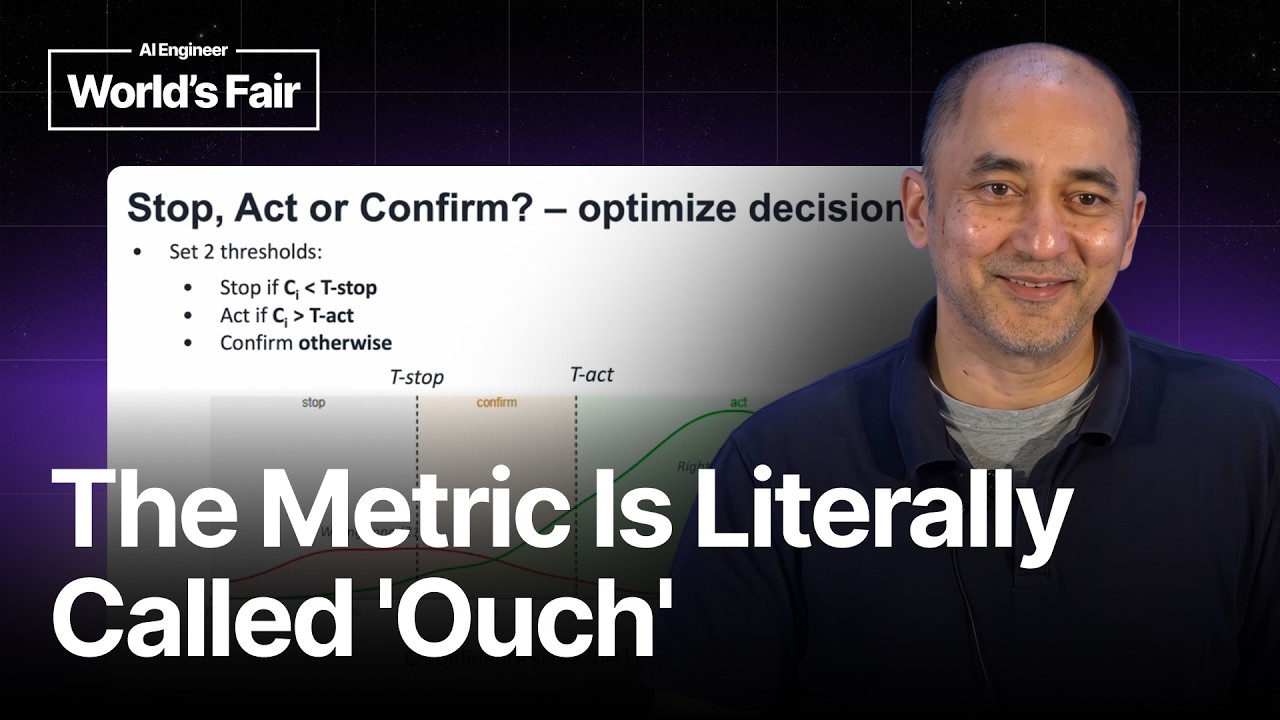
From an architectural perspective, the OUCH framework moves the AI from a binary decision (Act vs. Stop) to a tri-modal decision system. This splits the model's confidence score into three distinct regions governed by two thresholds.
The Three-Region Logic
1. The High-Confidence Zone (Act): When the model's confidence exceeds the upper threshold, the system executes the command immediately. This maximizes efficiency for clear requests.
2. The Mid-Confidence Zone (Confirm): When confidence falls between the two thresholds, the system enters a confirmation loop. It might say, "I think you wanted X, is that right?" This converts a potentially high-cost error (playing the wrong song) into a medium-cost interaction.
3. The Low-Confidence Zone (Stop): When confidence is below the lower threshold, the system simply declines, stating it didn't understand. This is the lowest-cost failure mode because it only costs the user a few seconds of time.
Calculating the Optimum
To find the ideal thresholds, developers must quantify the User Cost. For a voice assistant, the cost of a wrong action includes the time it takes for the user to realize the error, the effort to interrupt the AI (talking over it), and the time to re-issue the command.
The total cost function looks something like this: Total Cost = (P(Correct) * Cost_Success) + (P(Wrong_Act) * Cost_Error) + (P(Refusal) * Cost_Stop)
By minimizing this equation, Desai found that the "optimum" behavior often shifts toward being more cautious. Interestingly, this logic changes based on the hardware. On a television, the cost of confirmation drops significantly because the AI can display a list of options on the screen, allowing the user to pick the right one with a single click rather than a verbal exchange.
Why This Matters
This shift in thinking is critical as we move toward Embodied AI. When AI is trapped in a chatbot, a hallucination is a nuisance. When AI is in a wearable device, a home robot, or a car, a wrong action can be physically disruptive or even dangerous.
By prioritizing the "cost of failure" over the "percentage of accuracy," developers can create systems that feel more reliable and respectful of the user's time. It proves that a system doesn't have to be perfect to be delightful; it just has to be smart about when it admits it's confused.