Imagine telling your AI agent to book a five-star hotel in Tokyo for next Tuesday, and instead of giving you a list of links to click, the agent simply says, "Done. Your room is booked and paid for."
This isn't a futuristic dream; it's the shift toward Agentic Commerce, where the AI handles the entire transaction lifecycle from discovery to settlement.
The Simple Version
Right now, when you buy something online, you are the "operator." You find the item, enter your card, and click buy. In agentic commerce, the AI agent becomes your personal shopper and payment proxy.
But there is a massive security problem: you don't want to give your raw credit card number to an LLM, and merchants don't want the liability of handling sensitive data inside a chat window.
PayPal Enterprise Payments acts as the secure vault. They take your real card, swap it for a "safe" token, and give that token to the agent to hand to the merchant. The merchant then trades that token back to PayPal to get the money.
How It Actually Works
Sam Parsons, a senior staff engineer at PayPal, explains that there are three primary paths for merchants to accept these AI-driven payments. Each offers a different balance of user experience and merchant control.
Path 1: Instant Checkout in ChatGPT (ACP)
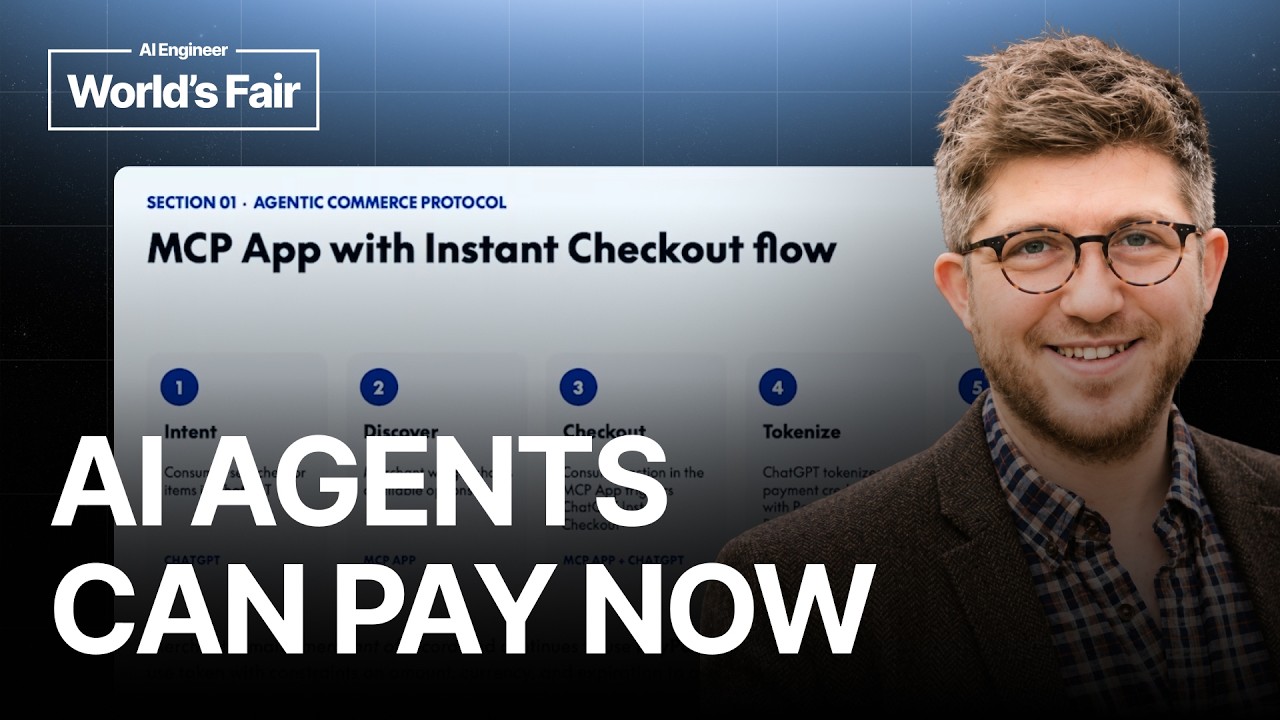
This method uses the Agentic Commerce Protocol (ACP) and relies on MCP apps. An MCP app is essentially a server that can embed its own UI—using HTML and JavaScript—directly inside the agent's interface.
In this flow, the merchant controls the "Discovery" phase. They can show product cards or hotel options inside ChatGPT. When the user clicks "Proceed to Checkout," the MCP app triggers an instant checkout experience provided by the host (ChatGPT), which then handles the tokenization via PayPal.
Path 2: Google AI Mode (UCP)
Google uses the Universal Commerce Protocol (UCP). Unlike the ChatGPT path, this is much more "invisible" for the merchant. There is no UI to build; the merchant simply provides endpoints and a well-known JSON file.
This JSON file tells Google Pay that the transaction should be processed through PayPal Enterprise Payments and includes the merchant's ID and client key. Google Pay handles the tokenization, and the merchant simply receives a call to their UCP checkout session endpoint to complete the charge.
Path 3: MCP Apps with External Checkout
For merchants who want total control over the branding and payment options, they can use an MCP app to handle discovery but hand the user off to an external checkout page for the final payment.
While this introduces more friction—since the user has to leave the chat—it allows for a wider variety of payment methods and a fully custom checkout flow. Once the payment is finished on the external site, the MCP app updates automatically to show the order status.
Technical Deep Dive
To understand why this works, we have to look at the Model Context Protocol (MCP) and the mechanics of tokenization. MCP is an open standard that allows LLMs to connect to external data and tools. By extending MCP into "apps," merchants can inject a stateful UI into a stateless chat conversation.
The most critical technical component here is the constrained token. As Sam Parsons puts it, "tokenization means where the user exchanges a real payment credential... for a token that can then be passed around without increasing PCI scope."
For context, PCI DSS (Payment Card Industry Data Security Standard) is a rigorous set of security requirements. If a merchant's server touches a raw credit card number, they are subject to intense audits. By using tokens, the merchant's server only ever sees a random string of characters, effectively removing them from the high-risk PCI scope.
These tokens aren't just random; they are constrained. PayPal limits these tokens in four specific ways:
- Merchant Bound: The token can only be processed by the specific merchant it was intended for.
- Amount Capped: The token is tied to a maximum dollar value, preventing an agent from accidentally (or maliciously) spending thousands.
- Currency Locked: It is restricted to a specific currency to avoid exchange rate errors.
- Expiration Date: The token is short-lived, meaning it cannot be reused weeks later.
From an architectural standpoint, the Universal Commerce Protocol (UCP) is designed for interoperability. By using a well-known JSON configuration, Google and PayPal create a standardized handshake. The agent creates a session, Google Pay tokenizes the payment, and the merchant executes the charge via a secure API call to PayPal's backend.
Why This Matters
This represents a fundamental shift in the e-commerce funnel. For decades, the journey has been Search → Click → Landing Page → Cart → Checkout. Agentic commerce collapses this into Intent → Purchase.
By removing the "click-and-scroll" fatigue, conversion rates for merchants could potentially skyrocket. However, this also puts a massive premium on trust. Users must trust the agent to pick the right product and trust the payment provider to keep their data safe.
As Sam Parsons notes, "PayPal Enterprise Payments is building the bridges for merchants to be able to accept payments from many different places." This infrastructure ensures that no matter which agent wins the "AI war"—whether it's ChatGPT, Claude, or Gemini—the underlying financial rails remain secure and standardized.