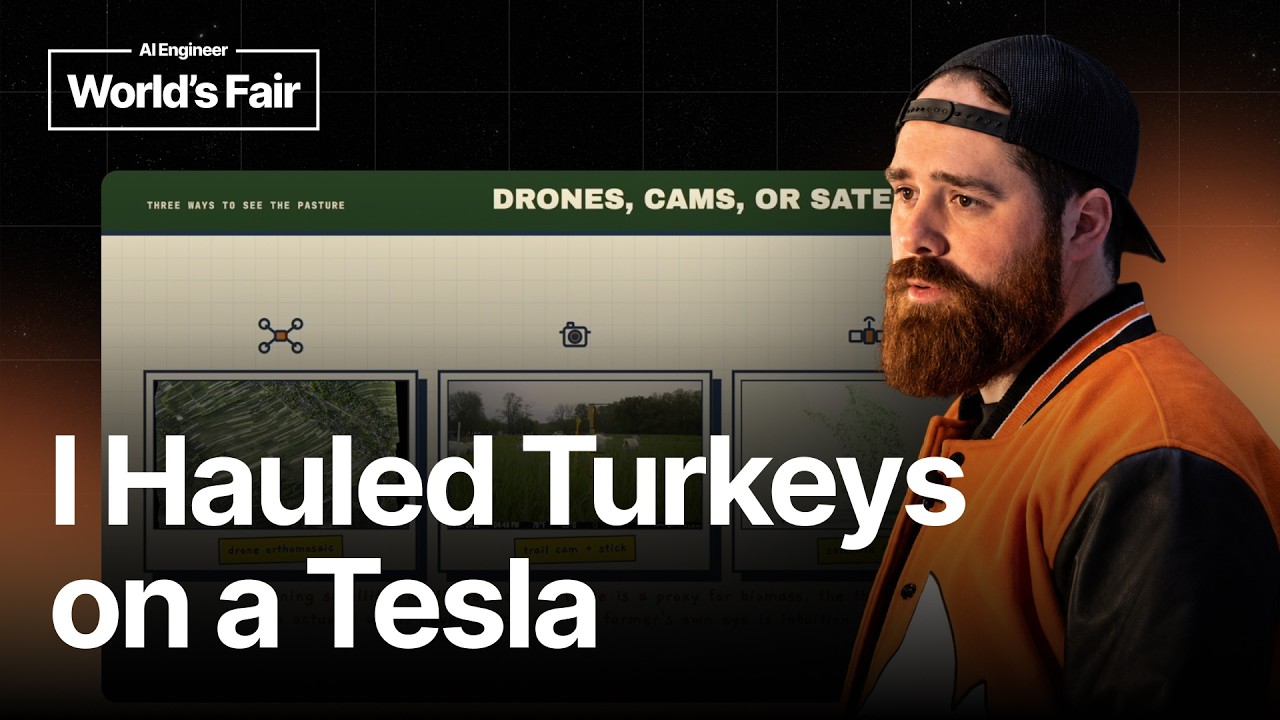
Cody Menefee once drove three hours to a processor with ten turkeys strapped to the roof of his Tesla, discovering that a windbreak of birds significantly reduces EV range. This absurd image serves as the starting point for a much larger conversation: why the AI industry is too focused on building software for other software developers while the physical world's most critical systems remain broken.
The Simple Version
Raising livestock on grass is better for the animals, the land, and the consumer. However, doing it correctly requires rotational grazing, where farmers move herds into small sections of land (paddocks) and shift them every single day to let the grass recover.
The problem is that this is incredibly labor-intensive. A farmer has to constantly check the grass height and health to decide where to move the herd next. If they move too early, the animals don't eat enough; if they move too late, the grass is overgrazed and takes forever to grow back.
How It Actually Works
Current technology, such as GPS collars from companies like Halter and No Fence, can create virtual boundaries. These tools handle the movement of the animals, but they don't handle the decision of where they should go.
Replacing the "Eyes on the Ground"
To automate the decision-making process, Menefee suggests dropping a Large Language Model (LLM) into the loop. The AI would act as the farmer's eyes, analyzing several data streams to suggest the next best paddock for a human to confirm.
The system relies on three primary data sources for imagery:
- Drones: High-fidelity images, but limited by regulatory hurdles and a lack of jurisdictions allowing autonomous flights.
- Satellites: Using companies like Planet, which provides 1-meter resolution imagery of the entire globe daily.
- Trail Cams: A low-cost solution involving a camera pointed at a measuring stick to track grass height relative to a fixed object.
The Knowledge Base and Firecrawl
An LLM can't make these decisions without deep domain expertise. Much of the best farming knowledge isn't in textbooks; it's locked in YouTube videos from experienced farmers in states like Missouri, Tennessee, and Kentucky.
Menefee is using Firecrawl, a web data API tool, to scrape these videos and research papers to build a specialized knowledge base for his Open Pasture project. As Menefee puts it, he is a "vibe coder" who uses AI agents to build these systems without needing to memorize syntax.
Technical Deep Dive
From a technical perspective, automating grazing is not a deterministic problem. You cannot write a simple if/then script because the variables—drought conditions, soil compaction, and biomass growth—are non-linear and multivariate.
The proposed architecture is a Multivariate Analysis Agent. Instead of a hard-coded algorithm, the system uses a Retrieval-Augmented Generation (RAG) pattern. The agent retrieves specific grazing strategies from the Open Pasture knowledge base and applies them to real-time telemetry from GPS collars and satellite imagery.
A critical technical gap remains in the Visualization Layer. The AI needs to be able to distinguish between biomass (the total amount of foliage available) and biodiversity (the variety of grass and legume species). In a professional agricultural context, this usually requires multispectral imaging to detect chlorophyll levels and plant stress, which is why 1-meter satellite data is a starting point but not a complete solution.
Finally, there is a hardware API bottleneck. Current collar manufacturers lock their software, preventing outside developers from pushing new coordinates to the collars. Menefee is calling for open-source collars with open APIs so that the software layer can be optimized independently of the hardware.
Why This Matters
The scale of the opportunity is massive. Currently, only 3% of cattle are finished on pasture, while 97% are finished in feedlots. Solving the labor bottleneck through AI could fundamentally shift the global food system toward more sustainable, regenerative practices.
Beyond cows, this system allows for "stacking species." For example, companies like Pasture Bird use automated chicken coops that move across the land. When chickens follow cows, they eat parasites from the cow droppings and provide nitrogen-rich fertilizer for the grass, reducing the need for chemical interventions.
Ultimately, this project highlights a broader critique of the current AI boom. Menefee argues that the industry spends too much time building "software for people who build software for people who build software." By applying LLMs to non-deterministic, physical-world problems, AI can move beyond the screen and into the soil.