Running large language models (LLMs) at the scale of Meta isn't just about having the biggest GPUs; it's about managing a chaotic, distributed web of moving parts. As AI moves from research experiments to foundational infrastructure, the complexity is exploding faster than any workload in history.
The Simple Version
Imagine you are running a massive global pizza delivery empire. In the early days, you just needed a good chef (the model) and an oven (the GPU). If more people ordered, you just bought more ovens.
But as you grow into a global giant, the problem changes. Now, you have to worry about which driver is closest, whether the dough is already pre-made (caching), how to group multiple orders into one delivery run to save gas (batching), and what to do if a driver gets a flat tire halfway through a delivery (reliability).
In the AI world, the "chef" is the model, but the "delivery empire" is the orchestration layer. As Nishant Gupta explains, we are currently seeing the orchestration layer emerge in real time to handle the massive complexity of modern AI workloads.
How It Actually Works
To understand why AI inference is so much harder than traditional web services, we have to look at the fundamental shift in how requests work.
From Stateless to Stateful
Traditional microservices are mostly stateless. If a server crashes, you just spin up another one and keep going. LLM inference, however, is deeply stateful because of the KV cache.
The KV cache stores the mathematical context of a conversation so the model doesn't have to re-process everything from scratch every time a new token is generated. As the speakers note, "the KV cache... is very expensive to build and even more expensive to throw away." This makes every request feel less like a simple function call and more like a distributed transaction.
The Seven Axes of Scheduling
In the old days of cloud computing, a scheduler only had to worry about a few things, like CPU and RAM. For AI, a scheduler has to juggle at least seven different dimensions simultaneously:
- GPU Generation: Managing a mix of hardware like H100s, H200s, or B200s.
- Memory Headroom: Ensuring there is enough VRAM available.
- KV Cache State: Knowing if the context is already sitting in a specific GPU's memory.
- Weight Warmth: Whether the model weights are already loaded or require a slow "cold start."
- Tenant Priority: Handling different users with different service level agreements (SLOs).
- Latency Budget: How much time is left before the user experience breaks.
- Workflow Context: Knowing if a request is the first step of a task or the final step of a long, expensive reasoning chain.
Technical Deep Dive
The most profound technical insight from Meta's engineers is the concept of tight coupling. In traditional systems, layers like routing, caching, and autoscaling are relatively independent. In AI inference, they are inextricably linked.
A single decision at the routing layer—such as sending a request to a specific region—can change the cache hit rate. This change in hit rate alters the batch composition (how many requests are grouped together), which in turn changes GPU utilization, which ultimately triggers a different response from the autoscaler. Everything is entangled.
The Four Quadrants of Optimization
To manage this complexity, Gupta proposes a framework for optimization that categorizes every technique into one of four quadrants:
- Avoid the work: Using prefix caching or semantic caching to skip computation entirely.
- Share the work: Using continuous batching or speculative decoding to make better use of compute cycles.
- Move the work: Routing requests to a smaller, cheaper model or a different geographic region.
- Delay the work: Using admission control to queue requests based on priority and deadlines.
This framework highlights why the industry is moving toward an inference control plane. Much like Kubernetes emerged to manage the complexity of virtual machines, an inference control plane is needed to treat models, KV caches, and GPUs as unified, schedulable resources.
Why This Matters
For developers and companies building AI agents, the takeaway is clear: the bottleneck is no longer the model; it is the orchestration. As agentic workflows become more common—where a single user prompt might trigger hundreds or even thousands of model calls—the cost and reliability of the underlying infrastructure become the primary drivers of product success.
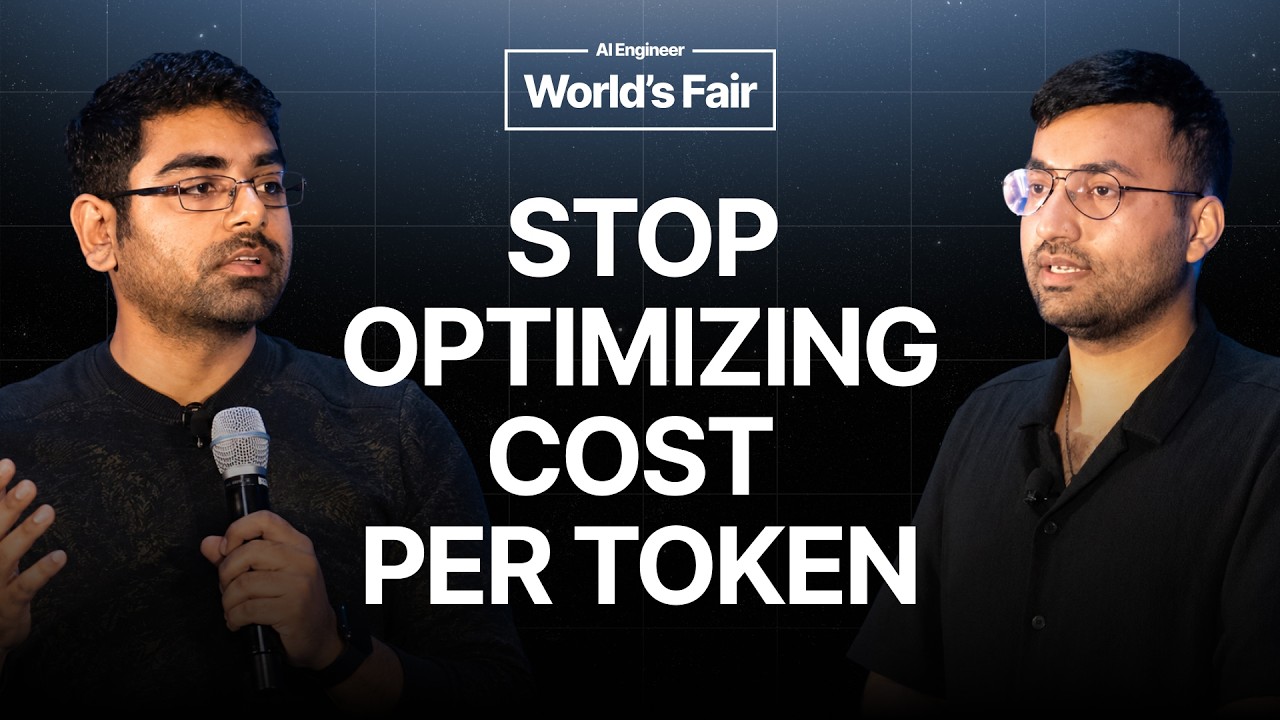
Meta's engineers argue that we must stop optimizing for the wrong metric. "It's not important to optimize just cost per token or cost per request," Gupta emphasizes. "We have to optimize cost per successful task." If a system is fast and cheap but fails halfway through a complex reasoning chain, it has provided zero value to the user.
As we move into the era of autonomous agents, the winners won't just be those with the smartest models, but those with the most sophisticated control planes to manage the massive, stateful, and highly coupled dance of distributed inference.