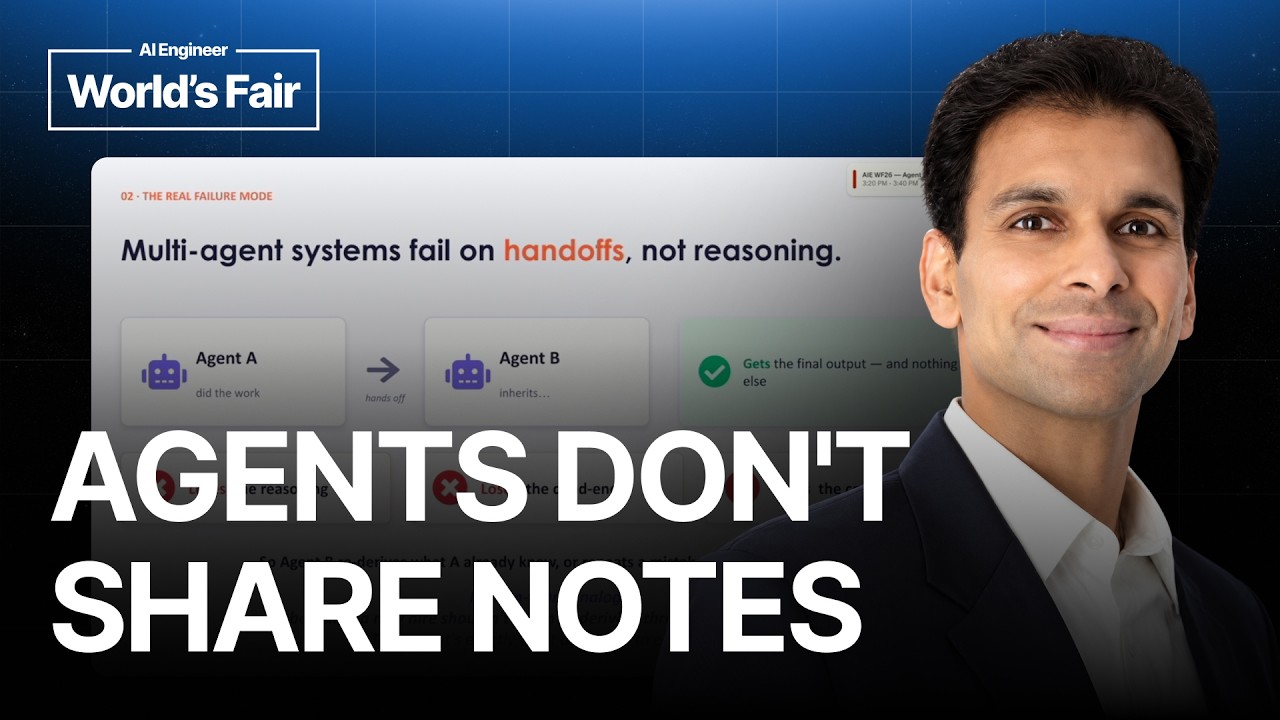
We've spent the last year perfecting how a single AI agent remembers a conversation, but we've ignored the much harder problem: how a team of agents learns together.
The Simple Version
Imagine a group of architects working on a massive skyscraper. If Architect A finishes a blueprint and just hands a PDF to Architect B, Architect B sees the final lines but has no idea why certain beams were placed there or which structural designs failed during testing.
Architect B then spends hours re-calculating everything from scratch, essentially wasting time and resources. In the AI world, this is exactly what happens when one agent hands off a task to another; the second agent receives the output but loses the 'why' behind it.
As Karthik Ranganathan, co-founder of Yugabyte, explains, this leads to 'burning tokens' as the next agent is forced to re-derive the entire reasoning process from the ground up.
How It Actually Works
The Handoff Problem
Current AI workflows suffer from a 'new-teammate problem.' When a human joins a project, they aren't just given a pile of documents; they are given the history, the context of past failures, and the reasoning behind current decisions.
When agents only pass outputs (like MD or PDF files), they lose the 'dead ends'—the valuable information about what didn't work. This makes the handoff inefficient and expensive.
Moving from Memory to Learning
There is a massive distinction between an agent having a memory and a group of agents having shared knowledge. Most current solutions fall into common traps that Ranganathan identifies as major misconceptions:
- More memory is not learning: Simply adding more storage just makes things more expensive.
- Shared state is not shared knowledge: Sharing a file isn't the same as sharing understanding.
- RAG is not quality: Throwing everything into a Retrieval-Augmented Generation (RAG) pipeline often just creates a 'garbage in, garbage out' loop.
- Bigger context windows are a trap: Increasing window size is an expensive way to fail because context 'rots' over time.
Technical Deep Dive
To solve these issues, Yugabyte developed Meko, an agent-native persistence layer. Unlike traditional databases that treat AI data as static rows, Meko is designed to handle the fluid nature of agentic reasoning.
The Data Pack Architecture
The core primitive in Meko is the data pack. Instead of a monolithic database, a data pack acts as a container for various data types—vector, graph, relational, and NoSQL—specifically organized around a project or a workflow.
This architecture allows for a sophisticated lifecycle of information:
- Private Memory: An agent can store its internal reasoning, trial-and-error, and specific session context in a private space.
- Supervised Promotion: A human or a high-level agent can 'promote' specific pieces of high-quality context from the private space into a shared space.
- Traceable Context: Every piece of information in a data pack is traceable back to its source—be it a specific conversation, a person, or a raw data file.
Optimizing the RAG Pipeline
Ranganathan shared specific benchmarks from Yugabyte's internal struggle to build effective agents. By moving away from a standard distributed RAG pipeline and focusing on one variable at a time, they achieved massive efficiency gains.
Initially, their pipeline achieved only 14% faithfulness on MD benchmarks and 20% on PDFs. By tuning the pipeline to focus on precision and high-quality context, they boosted faithfulness to 82%. Most importantly, they reduced the required context size from over 7,000 chunks to approximately 1,000 chunks—a 7x reduction in token consumption.
Why This Matters
This shift from 'per-agent memory' to 'collective intelligence' changes the economics of AI. When agents can tap into a shared, promoted data pack, they don't need to re-process the same information, which drastically lowers the cost of complex, multi-step workflows.
Furthermore, the 'human-in-the-loop' becomes a training signal. When a human promotes a piece of memory, they are essentially labeling high-quality data. As Ranganathan puts it, 'Human promotions today kind of equal the training signal for self-improving orchestration tomorrow.'
This creates a feedback loop where the system doesn't just get bigger, it gets smarter, capturing 'tribal knowledge' that would otherwise be lost in the gaps between individual AI sessions.