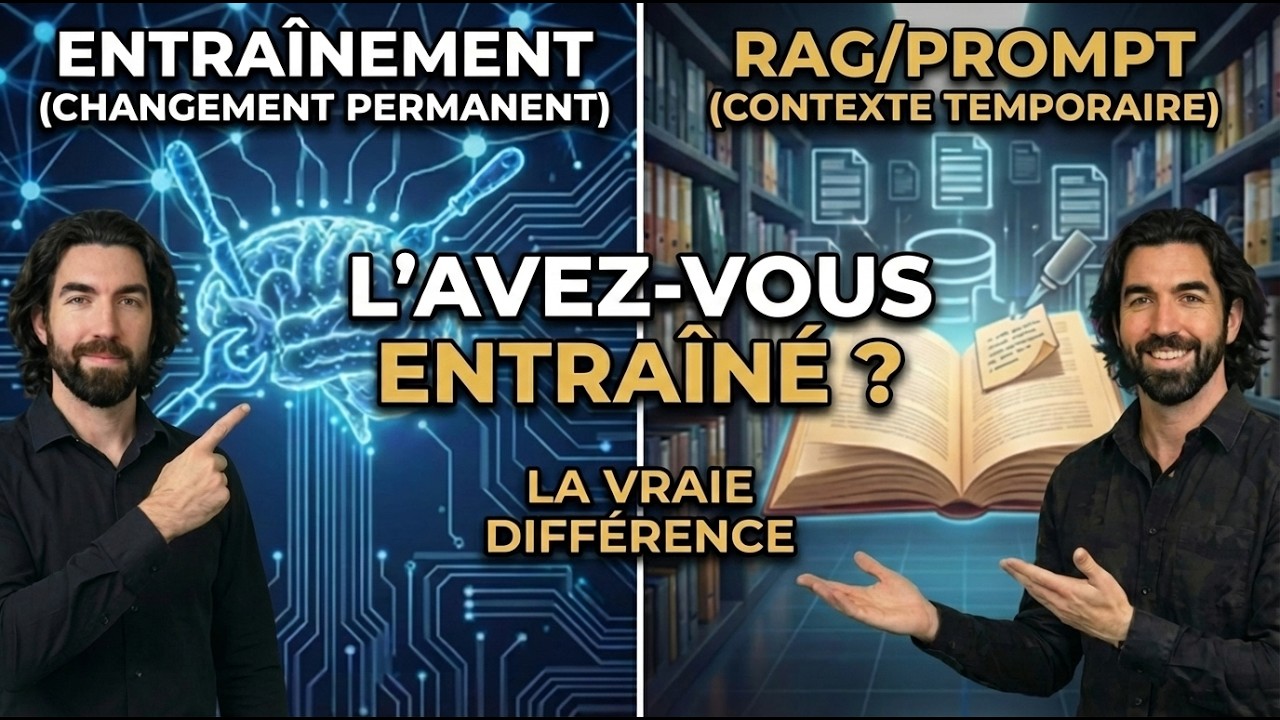
Ever worried that pasting a secret project into ChatGPT means the whole world will know your secrets tomorrow? It's a common fear, but the reality of how LLMs work is much more reassuring.
The Simple Version
When you paste text into a chat, you aren't "teaching" the AI a new skill. You are simply giving it a reference sheet to look at while it answers your specific question.
How It Actually Works
The Context Window
Every LLM has a context window, which acts like a digital scratchpad. Everything you paste into the chat lives here temporarily.
Once the conversation ends or the window gets too full, the AI "forgets" that specific data. It was never integrated into the model's core knowledge.
The Frozen Brain
The actual "knowledge" of an AI is stored in its weights. These are billions of mathematical connections determined during a massive, expensive training process.
During a normal chat, these weights are frozen. No matter how much data you paste, the underlying mathematical structure of the model remains exactly the same.
Technical Deep Dive
From a developer's perspective, what we are seeing is In-Context Learning (ICL). During the inference phase, the model performs a forward pass through the transformer architecture using your input as part of the prompt tensor.
Unlike Fine-Tuning or Pre-training, there is no backpropagation happening. No gradients are calculated, and no weights are updated via stochastic gradient descent (SGD) while you are chatting.
If you want to provide the AI with permanent knowledge without retraining, you use RAG (Retrieval-Augmented Generation). RAG dynamically fetches relevant documents from a vector database and injects them into the context window, keeping the core model frozen while providing updated facts.
Why This Matters
Understanding this distinction is huge for data privacy. While you should still be careful about the data you share with AI providers (as they may log chats for human review), your data isn't instantly becoming part of the public model's "knowledge."
It also changes how you optimize your prompts. Instead of trying to "teach" the AI over several days, you should focus on providing the most relevant context in a single, well-structured prompt.
Key Takeaways
- Pasting is not training: Your data stays in the prompt, not the model's weights.
- Context Window: This is the AI's temporary short-term memory.
- Frozen Weights: The AI's "brain" is locked after the training phase is complete.
- In-Context Learning: The process of the AI using provided data to inform a specific response.
- RAG: The professional way to give AI "knowledge" without expensive retraining.
- Inference vs. Training: Chatting is inference (reading); training is learning (writing).