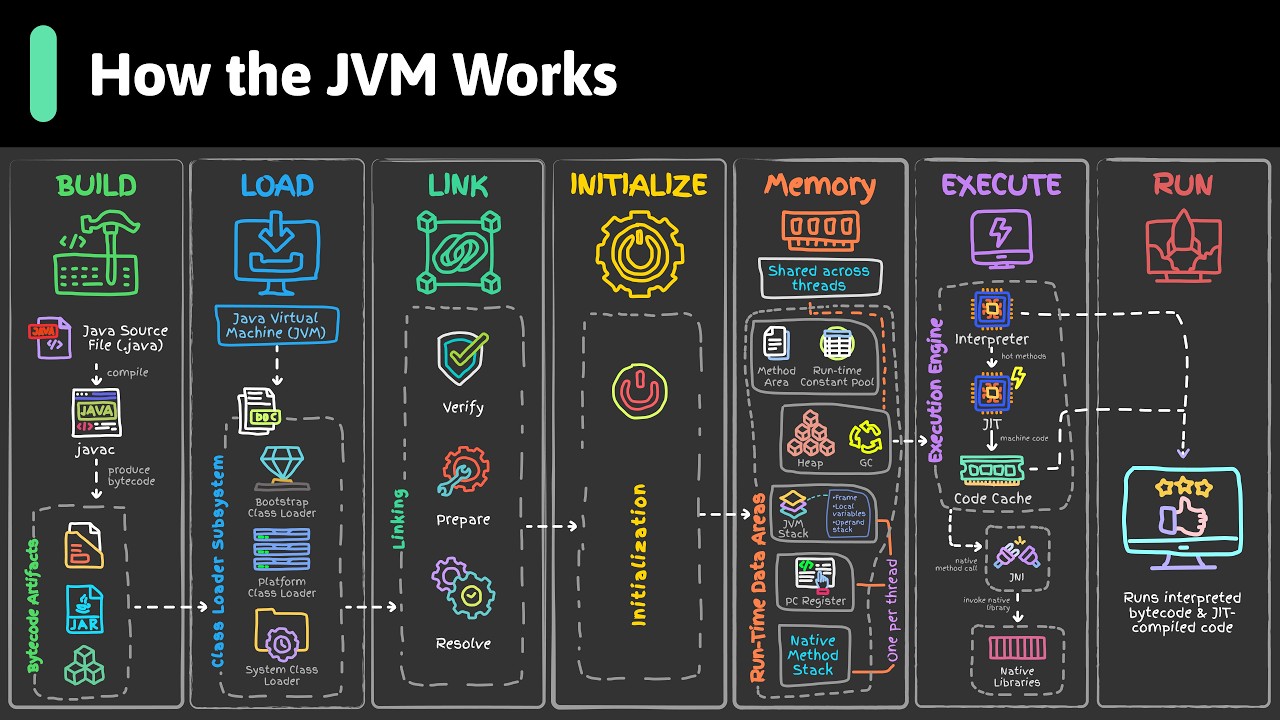
Ever wondered what really happens when you run a Java program? The JVM is the unsung hero that makes it all possible.
The Simple Version
The JVM reads Java bytecode, turns it into actions, and manages resources like memory and threads. Think of it as a translator and manager rolled into one.
How It Actually Works
Class Loading
The JVM starts by loading the classes your program needs. It finds the right .class files and prepares them for execution.
Bytecode Execution
Once loaded, the JVM reads the bytecode instructions. It either interprets them directly or compiles them to native code for speed.
Runtime Data Areas
The JVM allocates memory regions for different purposes such as the heap for objects and the stack for method calls. These areas keep everything organized.
Technical Deep Dive
Just‑In‑Time Compilation
The JIT compiler monitors hot methods and compiles bytecode to native code on the fly. This boosts performance after an initial warm‑up period.
Garbage Collection
Java’s GC automatically reclaims unused objects. Different collectors trade latency for throughput, letting developers pick the right one.
Thread Management
The JVM maps Java threads to native threads. It handles scheduling, synchronization, and thread‑local storage.
Security Manager (historical)
Older JVMs included a SecurityManager to enforce sandbox policies. Modern JVMs rely on OS permissions instead.
Why This Matters
Understanding the JVM helps developers write faster, more reliable Java applications. It explains why performance tuning matters and how memory issues surface.
Knowledge of the JVM also aids in debugging native crashes and optimizing garbage collection pauses.
Overall it bridges the gap between high‑level Java code and the low‑level hardware that actually runs it.
Key Takeaways
- The JVM loads, verifies, and executes Java bytecode.
- It uses class loaders, bytecode interpreters, and JIT compilers.
- Memory is split into heap, stack, and metaspace for different tasks.
- Garbage collection reclaims unused objects automatically.
- Thread handling maps Java threads to native OS threads.
- Performance hinges on JIT optimizations and GC tuning.
- Security once relied on a SecurityManager, now depends on OS permissions.