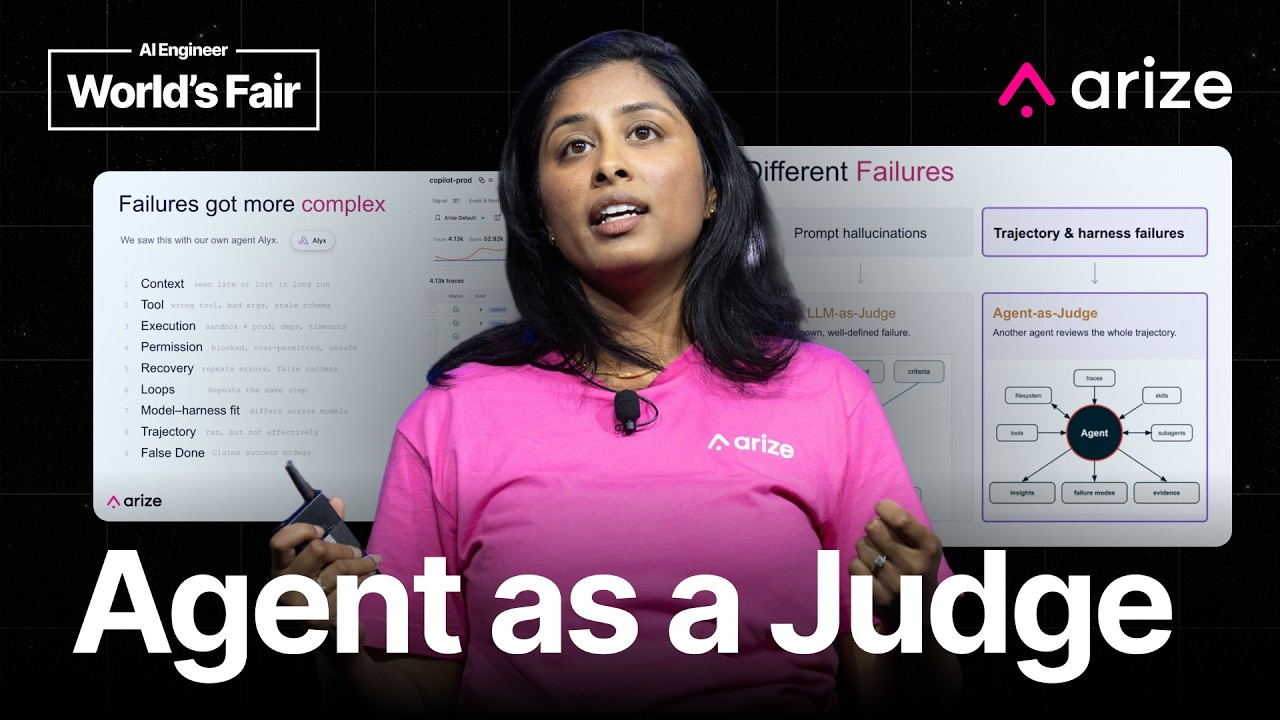
Ever wondered how we’ll keep AI agents honest as they get smarter? In this video, Aparna Dhinakaran shows the next leap in evaluation: an agent grading another agent.
The Simple Version
Think of evaluation like a referee for a game. Early on, the referee used fixed rules. As the game got complex, we needed a smarter referee that can reason.
How It Actually Works
Deterministic Checks
These are hard‑coded rules that catch obvious failures.
LLM as a Judge
Here we let a language model evaluate outputs using its own reasoning.
Agent as a Judge
The newest step has one AI agent review another’s work, looking for hidden failure modes.
Technical Deep Dive
Evaluation pipelines now chain multiple model calls, tool usage, and loops, demanding dynamic checks.
Tools like Arize’s Phoenix track these changes and surface drift in agent behavior.
Agent‑as‑judge can generate pull‑request style feedback, automatically suggesting fixes for uncovered bugs.
Why This Matters
As AI systems move from static models to autonomous agents, traditional static testing falls short.
Automated, self‑correcting evaluation becomes essential for production reliability.
Companies that adopt agent‑based evals can ship updates faster while maintaining quality.
Key Takeaways
- Evaluation must evolve as fast as the agents it grades.
- Deterministic checks handle defined failures; LLM judges add reasoning.
- Agent‑as‑judge spots failures we never anticipated.
- It can auto‑generate fixes, turning evals into a development aid.
- Adopting this shift is critical for scaling trustworthy AI.