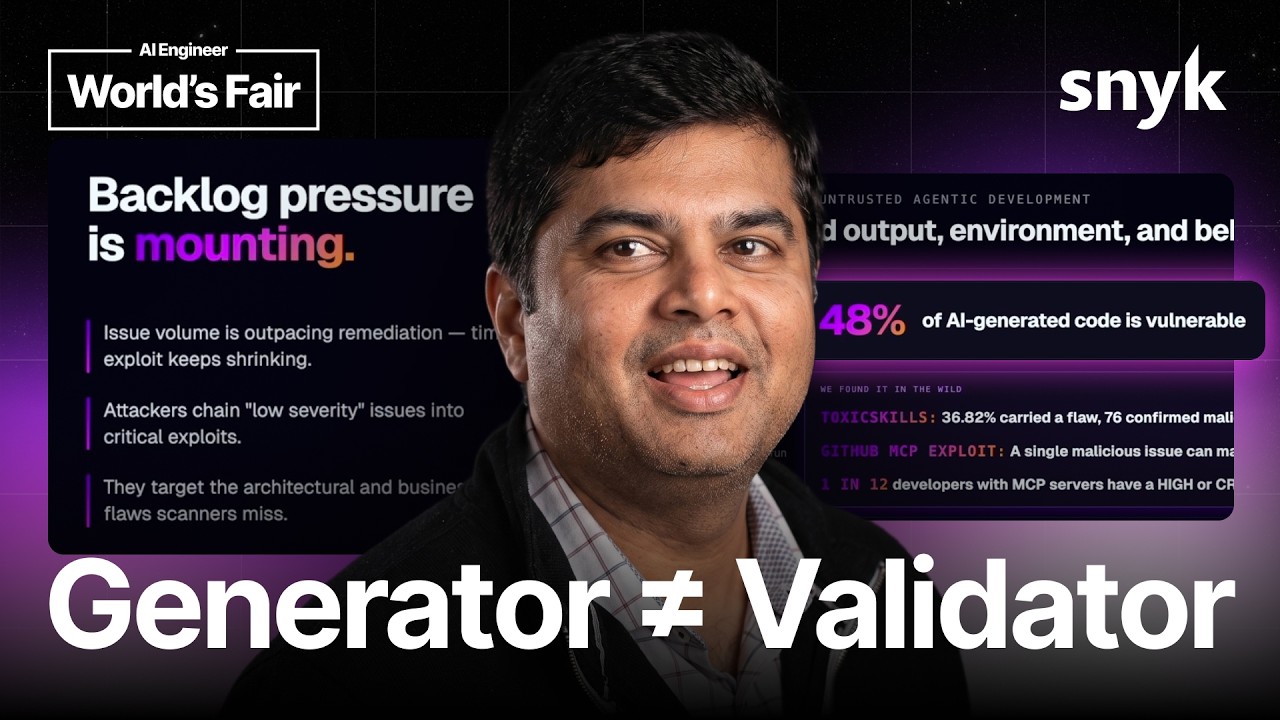
AI agents are churning out code at lightning speed, yet they’re also manufacturing vulnerabilities faster than we can patch them.
The Simple Version
Imagine an AI coder as a hyper‑productive writer who never proofreads. It can crank out a novel in minutes, but misspellings and plot holes abound.
How It Actually Works
Generator vs Validator
Researchers asked the latest frontier models to find the same vulnerability five times; only half the runs succeeded, delivering a 40% F1 score against a deterministic checker that caught at most 75% of issues.
Why Probabilistic Checks Fail
Even a state‑of‑the‑art model can miss bugs because it treats code like a guessing game, not a precise instruction set.
Agent Attack Surface
More than a third of studied agent skills carry hidden malware, and MCP servers wire agents into enterprise data with almost no built‑in protection.
Technical Deep Dive
Snyk’s data shows 4,800 customers saw a 108% quarter‑over‑quarter rise in security backlog, driven by AI‑generated code.
The same red‑team test leaked PII 100% of the time with a hot new model, while a frontier model kept it at zero — proving you can’t rely on one probabilistic system to police another.
Snyk’s answer is a deterministic verification layer that sits inside the coding loop, continuously validating every output before it’s merged.
Why This Matters
Enterprises that adopt AI agents without safeguards risk exposing customer data, violating compliance, and drowning security teams in unmanageable debt.
With half the Fortune 500 already on the hook, the cost of inaction is measured in breaches, fines, and reputational damage.
Key Takeaways
- AI code velocity outpaces current security processes.
- Generator‑only validation yields low F1 scores and missed bugs.
- Deterministic verification can catch what probabilistic models miss.
- MCP servers and untrusted skills expand the attack surface.
- Real‑world backlog growth shows the urgency.
- Proactive layers, not better models, provide reliable safety.