For a long time, the AI world has been split into two camps: massive, closed-source 'frontier' models that live in the cloud and smaller, local models that struggle with complex reasoning. The gap is finally closing, not just through larger parameter counts, but through smarter orchestration.
The Simple Version
Imagine you are tasked with writing a 50-page market research report. If you try to do everything yourself—searching the web, reading every PDF, analyzing spreadsheets, and writing the final draft—you will likely get overwhelmed and miss key details.
Instead, imagine you are the manager of a small, elite research team. You don't do the grunt work; you simply assign tasks. You tell one person to find the data, another to verify the numbers, and a third to synthesize it all into a final document.
This is exactly how Apodex 1.1 mini operates via the FrontierAgent harness. Rather than relying on one giant prompt to do everything, it breaks the problem down into a team effort, ensuring that the model stays focused and doesn't get 'confused' by too much information at once.
How It Actually Works
The magic isn't just in the 35B model itself, but in the FrontierAgent harness that wraps around it. This system transforms a standard LLM into a sophisticated research organization.
The Coordinator and the Workers
At the top of the hierarchy is the coordinator. When a user submits a task, the coordinator doesn't start solving it immediately. Instead, it acts as a project manager, splitting the work across multiple specialized agents.
As David Ondrej explains, "Some search the web, others read the data, and other agents run the analysis code." This division of labor prevents the model from trying to juggle too many different cognitive modes—like searching and coding—simultaneously.
The Single-Owner Principle
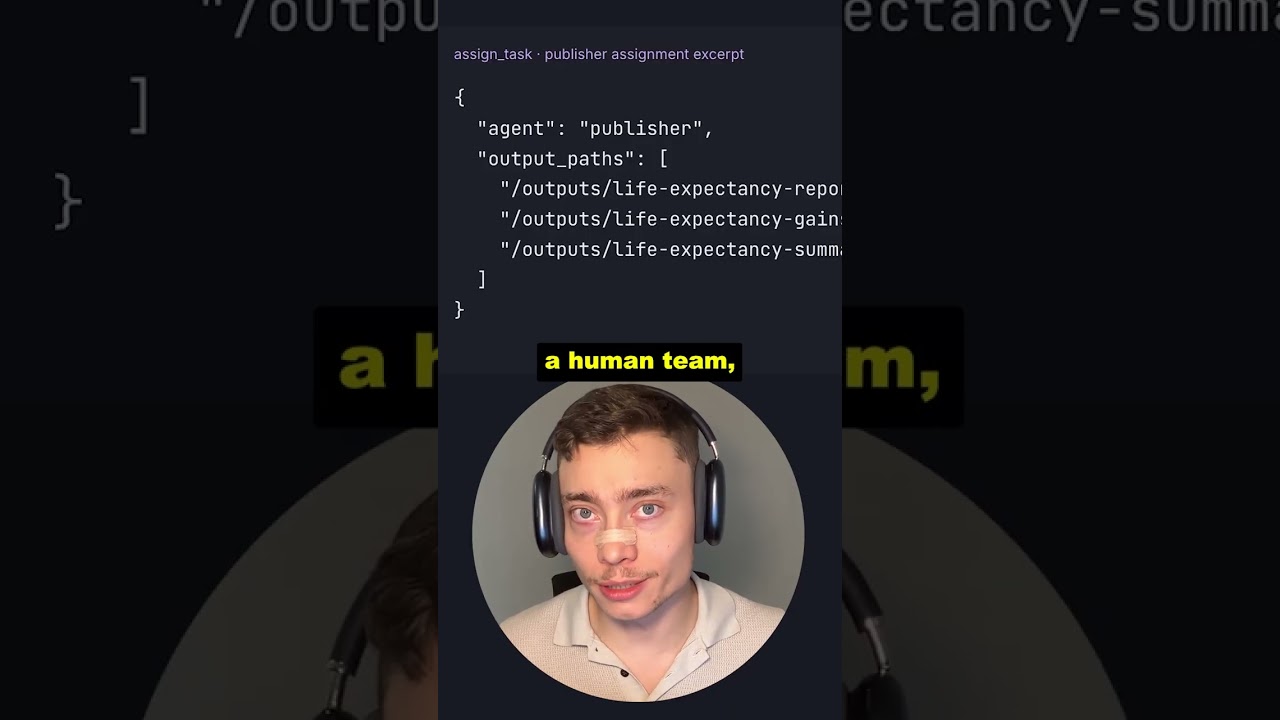
One of the biggest failures in multi-agent systems is 'diffusion of responsibility,' where agents overwrite each other's work or create contradictory reports. FrontierAgent solves this by designating a single agent to handle the final output.
As the video notes, "only one agent is ever responsible for writing the final report." By ensuring every outcome has one clear owner, the system eliminates the confusion that typically occurs when multiple agents try to merge their findings into a single document.
The Run Log Memory System
Most LLMs have a 'context window'—a limit on how much text they can remember at one time. If you feed an agent ten different web pages, the context window fills up, and the model starts forgetting the original instructions.
FrontierAgent bypasses this by using a run log. Instead of loading every tool result into the active memory, the system stores them in a log and lets agents retrieve only the specific sections they need. This significantly reduces memory usage and keeps the model's focus sharp.
Technical Deep Dive
From a technical perspective, the choice of a 35B parameter model is a strategic 'sweet spot.' For context, models in the 8B range often lack the nuanced reasoning required for complex coordination, while 70B+ models are too slow and memory-intensive for many local deployments.
A 35B model, when quantized to 4-bit or 8-bit, can typically fit into the VRAM of high-end consumer GPUs (like the RTX 3090 or 4090), making 'frontier-level' reasoning accessible without a massive server farm.
Multi-Agent Orchestration vs. ReAct
Standard agents often use a ReAct (Reason + Act) loop, where a single model thinks, takes an action, observes the result, and repeats. While effective for simple tasks, ReAct loops often collapse under the weight of long-term projects because the prompt becomes bloated with 'observation' text.
FrontierAgent evolves this by implementing a Distributed Agent Architecture. By decoupling the 'Coordinator' from the 'Workers,' it creates a hierarchical state machine. The coordinator maintains the high-level state (the goal), while workers maintain local states (the specific data point being searched).
Context Window Optimization
The 'run log' mentioned in the video is essentially a form of external memory management. In a traditional LLM call, the prompt looks like this: [System Prompt] + [History] + [Tool Result 1] + [Tool Result 2]...
As the number of tool results grows, the 'Attention' mechanism of the Transformer architecture struggles, leading to the 'lost in the middle' phenomenon where the model ignores information in the center of the prompt. By using a run log, FrontierAgent implements a retrieval-based approach, ensuring the model only attends to the most relevant tokens for the current sub-task.
Why This Matters
This approach shifts the focus from model size to system design. It proves that you don't need a trillion-parameter model to perform high-level research if you have an efficient way to organize the work and manage memory.
For developers and researchers, this means the ability to run sophisticated, autonomous research pipelines locally. This ensures data privacy—since the 'run log' and the model stay on your hardware—and eliminates the recurring API costs associated with frontier models like GPT-4o or Claude 3.5 Sonnet.
Ultimately, the combination of Apodex 1.1 mini and FrontierAgent demonstrates that the future of AI isn't just about bigger brains, but about better teamwork.