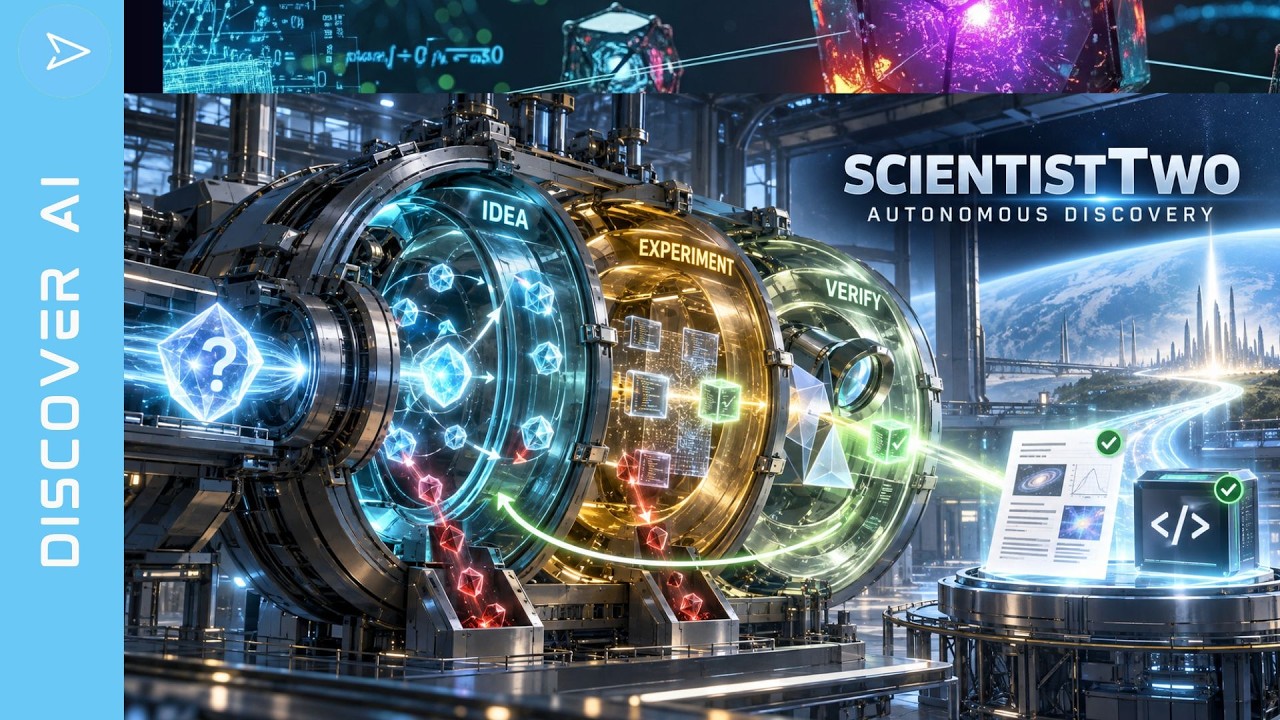
Imagine a world-class research university where the professors, post-docs, and lab technicians are all replaced by specialized AI agents. No humans, no coffee breaks—just a relentless, 24/7 cycle of hypothesis, experimentation, and verification.
The Simple Version
At its core, ScientistTwo is not just a chatbot that reads papers; it is a digital laboratory. Instead of one giant AI trying to do everything, Google built a "swarm" of specialized agents that check each other's work.
Think of it like a high-stakes corporate boardroom where the goal is to find a flaw in a product. You have the Visionary (Idea Generator), the Skeptic (Critique Agent), the Builder (Coder), and the Auditor (Integrity Audit). If the Visionary suggests a wild idea, the Skeptic tries to tear it apart, and the Builder proves it with code.
Google intentionally introduces "friction" into this pipeline. By pitting different agents against each other, the system is forced into what the video describes as a "ruthless continuous peer evaluation by other agents." Nothing gets published unless every single "department" agrees it is a legitimate breakthrough.
How It Actually Works
ScientistTwo operates through a rigorous, looping process designed to eliminate the "hallucinations" and "reward hacking" that often plague autonomous AI. It focuses on "system state optimization," meaning it optimizes the process of discovery rather than just the model's weights.
1. Limitation Extraction and Idea Generation
The process begins when a human provides a scientific problem. The system uses a Limitation Extractor agent to scan current state-of-the-art human papers to find "cracks in the foundation"—bottlenecks humans haven't solved.
Once a flaw is verified, an Idea Generator creates hypotheses to fix it. These are filtered by a Novelty Checker using Google Search to ensure the idea isn't already on GitHub or in a journal.
2. Sandbox and Full-Scale Evaluation
To save compute resources, the system doesn't start with a supercomputer. A Subset Coder implements the idea on a tiny fraction of data. If the Critique Agent sees a performance boost, it's scaled up to a full benchmark.
The threshold for success is strict; as the video notes, "if the performance is substantial worse well no way to go." Only the survivors move to full-scale testing.
3. Idea Evolution and Ablation
If an idea fails, an Idea Evolver analyzes error logs to mutate the reasoning and try again. This creates a loop of nested experimental hypothesis selection.
Once a success is found, the system performs an ablation study. An Ablation Planner systematically rips out parts of the code to see if the breakthrough was a fluke or a real innovation, ensuring the system isn't just "cheating" to get a higher score.
4. Peer Review and Integrity Audit
The AI subjects its findings to a simulated gauntlet. Peer Review Agents act as ruthless critics, giving scores and demanding more proof. If the score is too low, a Rebuttal Team runs new experiments and updates the manuscript.
Before publication, a final Integrity Audit verifies score accuracy, specification compliance, and method-code alignment. This ensures the mathematical formulas in the paper match the Python/C++ code exactly.
Technical Deep Dive
The architecture of ScientistTwo is a hybrid multi-agent system leveraging "frozen" LLMs. According to the video, Google uses Gemini 1.5 Flash (referred to as 3.6 Flash in the transcript) for high-level reasoning, criticism, selection, and orchestration. For heavy lifting—specifically code generation and ablation studies—it utilizes Claude 3.5 Sonnet (referred to as Claude Code with Opus 4.6/4.8 in the transcript).
For context, "frozen" LLMs are models whose weights are not updated during the process. This is a critical design choice: the intelligence gain comes from the agentic workflow (the 24-agent loop) rather than training a larger model. This is what the speaker calls "system state optimization."
This design pattern is known as Multi-Agent Orchestration (MAO). By separating the "reasoning" model from the "coding" model, Google mitigates the risk of a single model's biases infecting the entire pipeline. However, the video highlights a significant risk: if the creator and the evaluator share the same architecture, they may share the same "blind spots" or thematic limitations.
The system also implements a Recursive Self-Improvement (RSI) loop. By analyzing reasoning traces and execution logs, the agents refine their own hypotheses without human intervention. This treats scientific discovery as a search problem over a space of possible algorithmic implementations, effectively simulating the exact peer review and testing standards of human academia.
Why This Matters
The implications for the speed of discovery are massive. Google claims ScientistTwo outperformed humans in simulations, scoring 7.0 to 7.6 compared to a human average of 6.8 to 6.9 on specific benchmarks. With a reported cost of roughly $3,800 per task and a cycle time of 2.5 days, the cost of scientific discovery is plummeting.
More importantly, this represents a paradigm shift. As the speaker puts it, "massive scientific discovery will not just only come from building better smarter foundation models... but it will come from placing those EI model... inside some rigorous self-correcting RSI multi-agent society." Instead of waiting for a "Fable 6" or a larger Gemini, we can achieve breakthroughs by optimizing how existing models interact.
While some researchers, such as those behind the Sage process from Nanjing University, argue that more agents don't necessarily equal more intelligence, Google's approach suggests that intentional friction is the key. By forcing AI to argue with itself, we move from AI as a tool for scientists to AI as the scientist itself, potentially accelerating discovery in materials science, chemistry, and deep learning optimization.