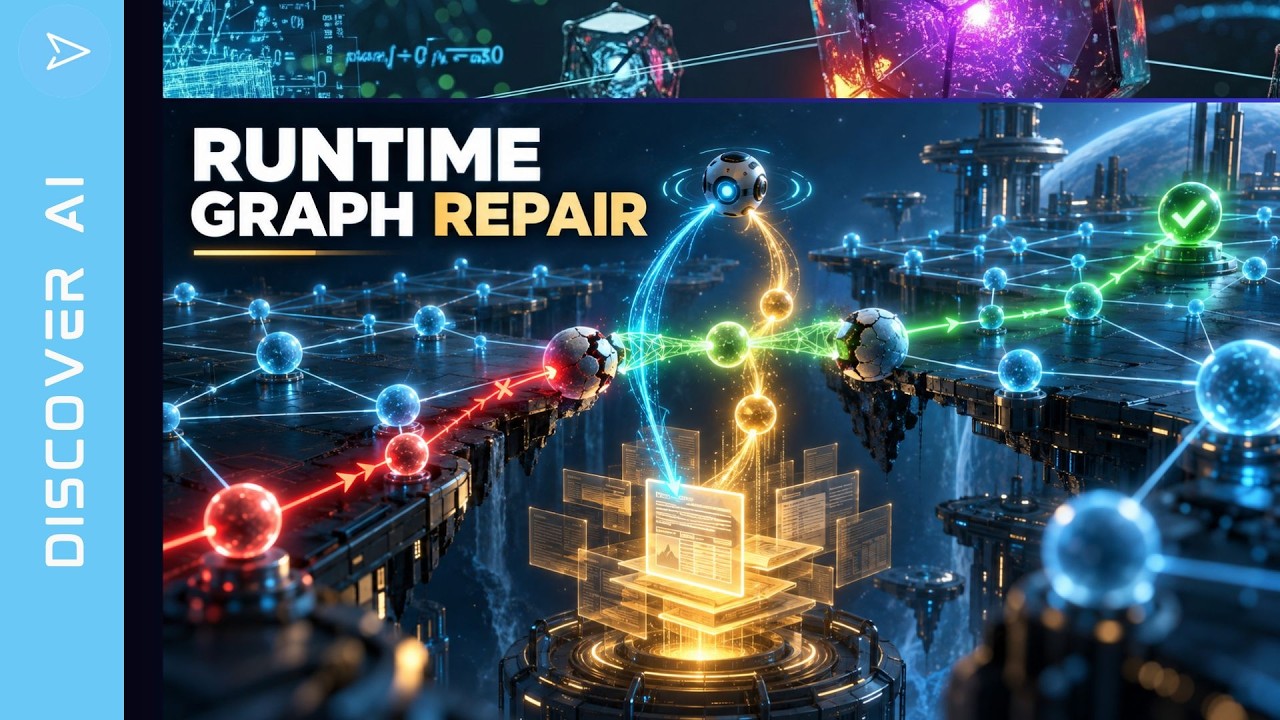
Imagine trying to navigate a massive, ancient library where the maps are constantly changing and half the hallways are missing.
This is the exact challenge researchers are facing as we move beyond basic retrieval-augmented generation toward truly intelligent agentic systems.
The Simple Version
Standard RAG (Retrieval-Augmented Generation) is like looking up a specific fact in an encyclopedia. You ask a question, the system finds the right page, and reads it to you.
GraphRAG takes this a step further by building a map of how different facts connect, like a web of knowledge. However, even these maps have holes, incorrect connections, or outdated information.
The new research, Cognition on Graph, introduces a way for the AI to act like a detective. Instead of just reading the map, the AI realizes when a connection is missing and 'repairs' the map in real-time.
How It Actually Works
The Scale of the Knowledge Space
The researchers aren't just working with small datasets. They are tackling information spaces containing 5 billion words in text form and 1.4 billion edges in a graph representation.
At this scale, traditional indexing methods break down. You cannot simply scan everything every time a question is asked; the system needs a way to navigate the 'topology'—the shape and structure—of the data.
Bidirectional Graph-Text Synergy
Most systems work in one direction: they turn text into a graph, or they use a graph to find text. This research proposes a bidirectional synergy.
The system uses the text to understand the meaning (semantics) and the graph to understand the relationships (topology). By looking at both simultaneously, the agent can spot when the text implies a relationship that the graph hasn't captured yet.
Cognitive Cycles and Runtime Repair
The 'Agentic' part of this 4th generation RAG comes from cognitive cycles. The AI doesn't just perform a single search and stop.
It performs a loop: it searches, evaluates the quality of the information found, identifies gaps in the knowledge graph, and then performs Runtime Graph Repair to fill those gaps before answering the user.
Technical Deep Dive
For developers and AI researchers, the core innovation here is the transition from static retrieval to dynamic topology management.
In traditional GraphRAG, the Knowledge Graph (KG) is often treated as a static foundation. Once the graph is built from the corpus, it is considered 'truth.' If the graph is incomplete, the RAG system will consistently fail to answer complex, multi-hop queries that require those missing links.
The Cognition on Graph framework treats the graph as a living entity. It utilizes semantic pattern searching to identify clusters of information that *should* be connected but aren't. This involves analyzing the latent space of the text embeddings and comparing them to the existing adjacency matrix of the graph.
When the agent detects a discrepancy—such as a high semantic similarity between two nodes that lack a direct edge—it triggers a repair mechanism. This mechanism can involve:
- Edge Insertion: Creating new links between existing entities based on textual evidence.
- Node Refinement: Updating entity descriptions to better reflect the current corpus.
- Structural Re-alignment: Adjusting the global topology to prevent 'hallucinated' connections.
This creates a feedback loop where the Graph-Text Synergy ensures that the structural integrity of the graph matches the semantic reality of the underlying 5-billion-word corpus.
Why This Matters
We are moving away from the era of 'Chatbots' and into the era of 'Reasoning Agents.' Current LLMs are brilliant at language but struggle with long-term structural memory and complex relational reasoning.
By implementing runtime graph repair, we solve the 'stale knowledge' problem. As new information enters a system, the agent doesn't just add it to a list; it integrates it into the very fabric of its understanding, repairing its mental model as it goes.
This has massive implications for industries like legal discovery, medical research, and intelligence analysis, where the connections between data points are often more important than the data points themselves.