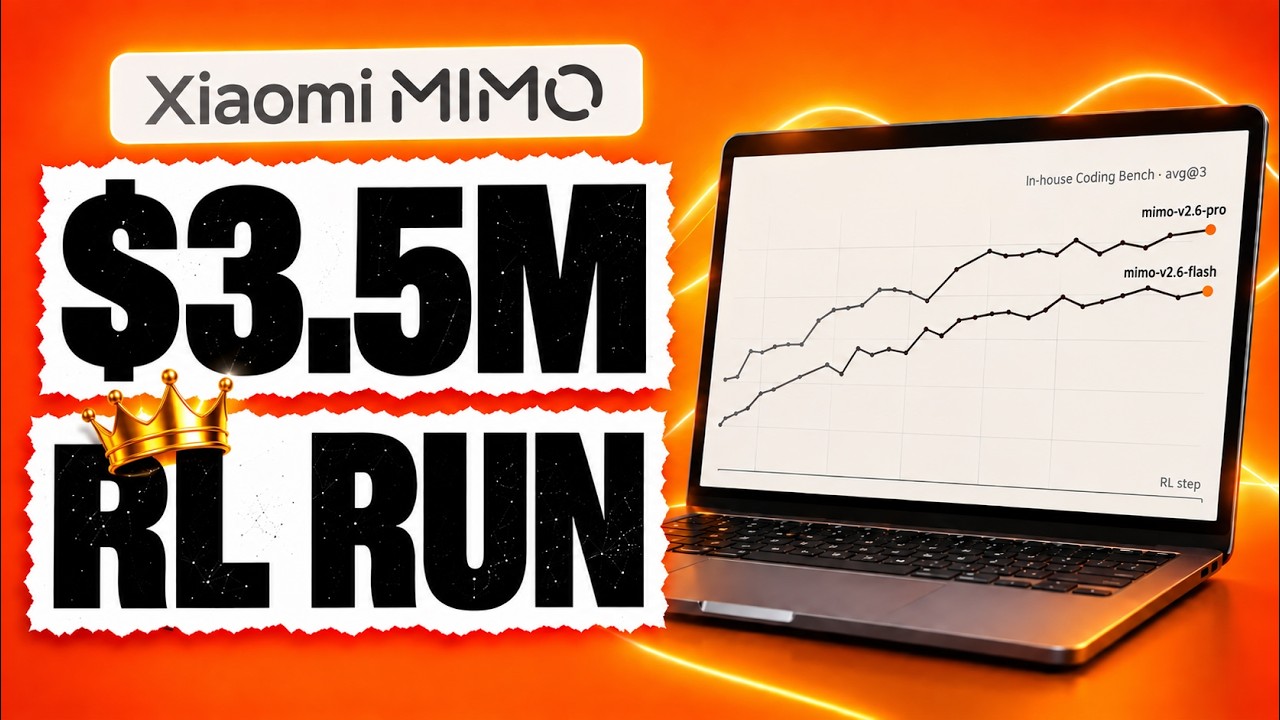
The gap between closed-source frontier models and open-weights is effectively vanishing. Xiaomi has just stepped into the ring with MiMo v2.6, a model that doesn't just compete—it currently leads the open-source pack on the Artificial Analysis index.
The Simple Version
Imagine you have a massive company with 1,000 employees, but for every single task, you only wake up the 2 or 3 people who are actual experts in that specific topic. That is essentially how the MiMo v2.6 Pro model works.
Instead of running every single single 'neuron' for every word it generates, it uses a Mixture of Experts (MoE) architecture. This allows it to have the vast knowledge of a trillion-parameter giant while maintaining the speed and efficiency of a much smaller model.
Xiaomi didn't just release the model weights; they shared the training code and even livestreamed the Reinforcement Learning (RL) process. As the video notes, "They actually live streamed their entire RL run and it cost them about $3 million," though the final figure is cited as $3.5 million.
How It Actually Works
The Pro and Flash Split
Xiaomi released two primary versions of MiMo v2.6 to cater to different needs: the Pro and the Flash. The Pro version is the powerhouse, designed for maximum intelligence, while Flash is optimized for speed and lower resource consumption.
The Pro model is a beast with 1 trillion total parameters, but only 2 billion are active at any given time. The Flash model is more modest, with 310 billion total parameters and 15 billion active parameters.
Agentic Coding and Verification
One of the standout features of MiMo v2.6 is its performance in agentic loops. Unlike a standard chatbot that gives a one-shot answer, an agentic loop allows the model to write code, test it, see the error, and fix it in a cycle of self-verification.
In tests using the DeepSeek harness, MiMo v2.6 Pro demonstrated an ability to conduct self-research and build a landing page. During this process, it consumed 45 million tokens, but achieved a 98% cache rate, significantly reducing the computational overhead.
Beyond Text: 3D and Science
The model isn't limited to code and text. It can generate 3D assets using Blender and create procedural scenes using Three.js. While the speaker notes that some models like DeepSeek 4.1 Flash might still edge it out in specific Three.js tasks, MiMo's versatility is impressive.
Even more surprising is its capability in scientific research. The model can solve mathematical formulations using Lean and assist in biochemistry and material science research without needing domain-specific RL training.
Technical Deep Dive
To understand why MiMo v2.6 is a technical milestone, we have to look at the Mixture of Experts (MoE) architecture. In a dense model, every parameter is used for every token. In an MoE model, the network is divided into 'experts,' and a gating network decides which experts are best suited for the current input.
For the Pro model, having 1 trillion parameters provides a massive 'knowledge base' (the weights), but using only 2 billion active parameters keeps the FLOPs (floating-point operations) per token low. This is how it achieves "GPT 5.6 soul level performance" without requiring the compute of a dense trillion-parameter model for every single word.
However, the VRAM (Video RAM) requirement remains a massive hurdle for local deployment. Even with MoE, the entire model weights must typically reside in memory. For context, a 1 trillion parameter model stored in FP16 (16-bit) would require 2 Terabytes of VRAM just for the weights.
Even with quantization—the process of reducing the precision of weights (e.g., to 4-bit)—the memory footprint is enormous. This is why the speaker explains that you would likely need 8 H100 GPUs to run the Pro version in full quantization. For the Flash model, two DGX packs are suggested.
Another critical technical detail is the KV (Key-Value) Cache. As the context window grows (up to 128,000 tokens for MiMo), the model stores the mathematical representations of previous tokens to avoid recomputing them. This cache consumes additional VRAM, meaning that the more you talk to the model, the more memory it requires beyond the initial weight load.
Why This Matters
The release of MiMo v2.6 signals a shift in the AI power balance. For a long time, the 'frontier' was guarded by closed-source companies. Now, open-weight models are hitting the Pareto frontier—the point where you get the best possible performance for the lowest possible cost.
By releasing the training code and livestreaming the RL run, Xiaomi is providing a blueprint for how to build high-reasoning models. This transparency helps the entire ecosystem understand the actual cost of intelligence; in this case, $3.5 million for a world-class RL run.
Ultimately, the move toward scientific research (Lean, biochemistry) suggests that open models are moving beyond being 'fancy autocomplete' and are becoming actual tools for discovery. If these models remain open, the acceleration of scientific research could move from a linear pace to an exponential one.