Imagine firing your entire finance department and replacing them with a digital team that never sleeps and never misses a penny. It sounds like sci-fi, but with Claude Code, we can now build autonomous systems that handle the heavy lifting of business accounting.
The Simple Version
Most people use AI like a Swiss Army knife—one tool trying to do everything. But for complex tasks like finance, you need a specialized team.
Instead of asking one AI to 'do my taxes,' you build a digital office where one agent only cares about income, another only cares about expenses, and a third summarizes it all.
How It Actually Works
The Shared Map
For AI agents to work together, they need a shared context. This means organizing your data in a strict folder structure that every agent can access.
When every agent sees the same 'map' of the business, they don't hallucinate different numbers. They all reference the same single source of truth.
The Specialist Agents
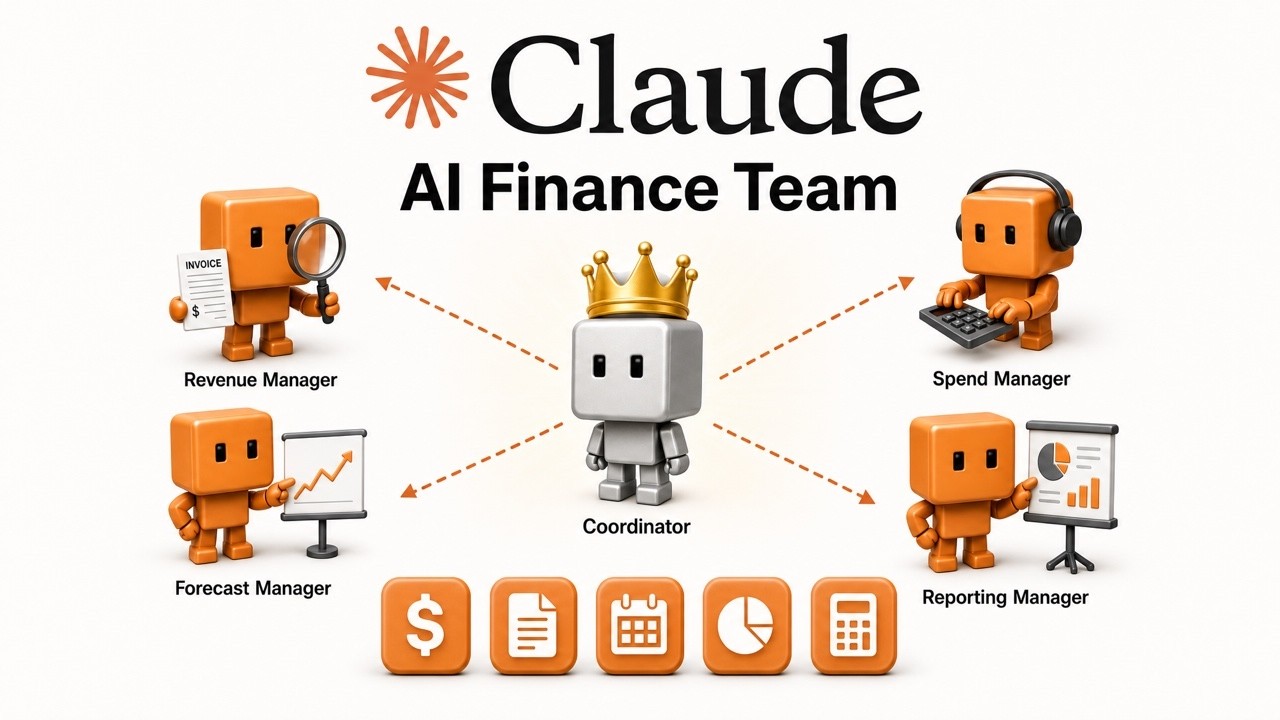
The system is broken down into specific roles. The Revenue Manager hunts for missing money or duplicates, while the Spend Manager tracks every cent leaving the building.
Then, the Forecast Manager looks at historical trends to predict the future, and the Reporting Manager turns those numbers into a readable format.
The Coordinator
The secret sauce is the Coordinator Agent. This agent doesn't do the math; it manages the people (or agents) who do.
The Coordinator ensures the Revenue Manager's output is handed off correctly to the Reporting Manager, acting as the glue for the entire workflow.
Technical Deep Dive
This architecture relies on an Agentic Workflow rather than a single prompt. By decoupling the tasks, you minimize the 'noise' in the context window, which significantly reduces hallucinations.
From a developer's perspective, this is essentially a modular pipeline. Each agent is a function with a specific system prompt and a defined input/output schema.
The 'Trust Test' mentioned in the build is a form of adversarial verification. By intentionally introducing errors or asking the AI to find flaws in its own logic, you create a feedback loop that hardens the system's accuracy.
Why This Matters
This shifts the human role from 'the doer' to 'the reviewer.' Instead of spending ten hours in a spreadsheet, a business owner spends ten minutes reviewing a finished report.
It democratizes high-level financial intelligence. Small startups can now have the analytical power of a Fortune 500 CFO without the six-figure salary.
Ultimately, it proves that AI is most powerful not as a chatbot, but as a system of coordinated agents.
Key Takeaways
- Specialization wins: Break complex workflows into small, role-based AI agents.
- Context is king: Use a rigid folder structure so all agents reference the same data.
- The Coordinator pattern: Use a lead agent to manage handoffs between specialists.
- Verify with Trust Tests: Always challenge the AI to find its own mistakes to ensure accuracy.
- Modular Prompting: Use simple, one-line prompts for specialists to keep them focused.
- System over Chat: Stop thinking about 'prompting' and start thinking about 'architecting' workflows.