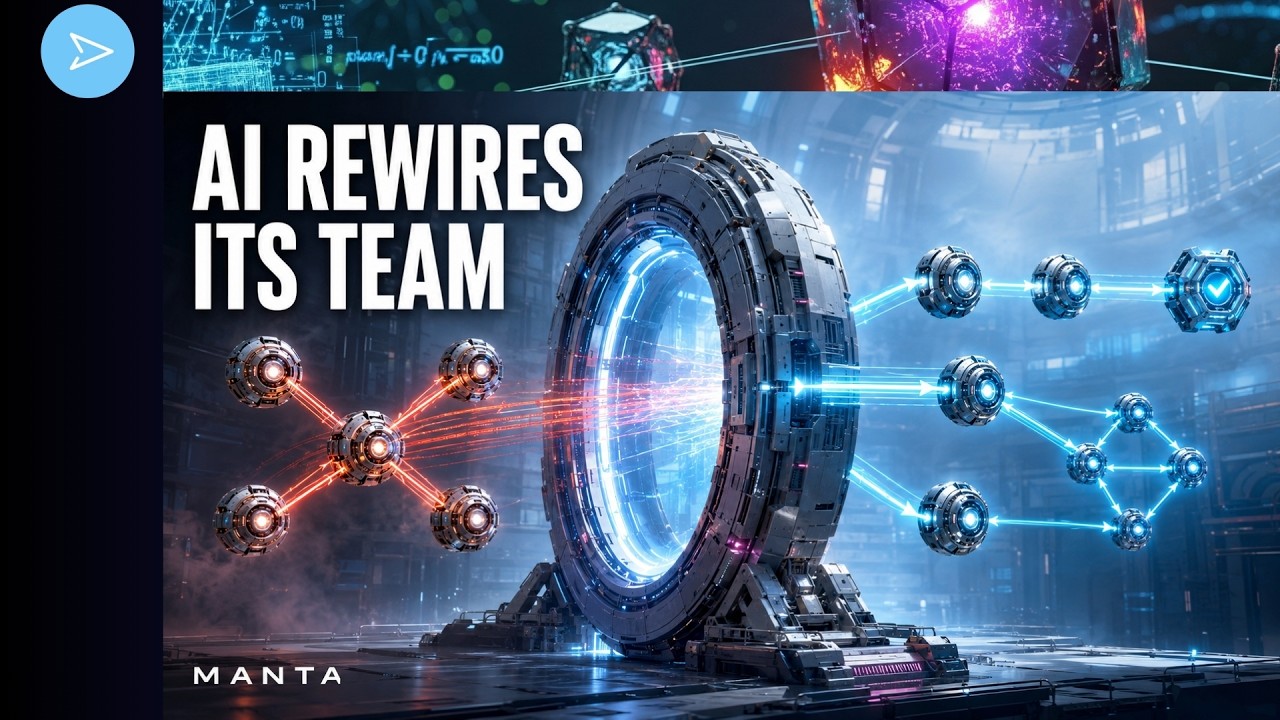
Imagine a team of experts who can instantly change who they report to and how they collaborate the moment a problem shifts. That is the magic behind MANTA, a new approach to how AI agents work together.
The Simple Version
Most multi-agent AI systems are like a rigid corporate org chart. Agent A always talks to Agent B, who then reports to Agent C.
MANTA turns this rigid chart into a flexible 'flash mob.' The agents can decide on the fly who needs to talk to whom to get the job done fastest.
How It Actually Works
Breaking the Fixed Topology
In standard systems, the topology (the map of connections) is set during design. This means the AI uses the same communication path regardless of whether the task is simple or complex.
Dynamic Adaptation during Inference
MANTA introduces Topology Adaptation. This happens during inference, which is the 'thinking' phase when the AI is actually generating an answer.
The system evaluates the task and 'rewires' the connections between agents. It creates new shortcuts or cuts unnecessary noise to optimize the flow of information.
Technical Deep Dive
MANTA (Multi-Agent Network Topology Adaptation) moves away from static graphs. It treats the agent network as a self-evolving system.
From an architectural standpoint, this involves a mechanism that can modify the adjacency matrix of the agent network during the forward pass. This allows the system to minimize communication overhead while maximizing information gain.
By evolving the topology during inference, the system avoids the bottlenecks of 'all-to-all' communication. It effectively implements a sparse, dynamic graph that adapts to the specific semantic requirements of the prompt.
Why This Matters
This is a massive leap toward General Intelligence. Real-world problems aren't linear; they require different 'team shapes' at different stages of a project.
By reducing redundant communication, we get faster response times and lower compute costs. It allows AI to handle massive, complex workflows without getting bogged down in its own bureaucracy.
Key Takeaways
- Dynamic Topology: Agents can change their connection map on the fly.
- Inference-Time Evolution: The rewiring happens while the AI is solving the problem.
- Efficiency: Reduces noise and unnecessary communication between agents.
- MANTA Framework: A self-evolving approach to multi-agent systems.
- Flexibility: Enables AI to adapt its 'organizational structure' to the task at hand.
- Scalability: Makes large-scale agent swarms more manageable and effective.