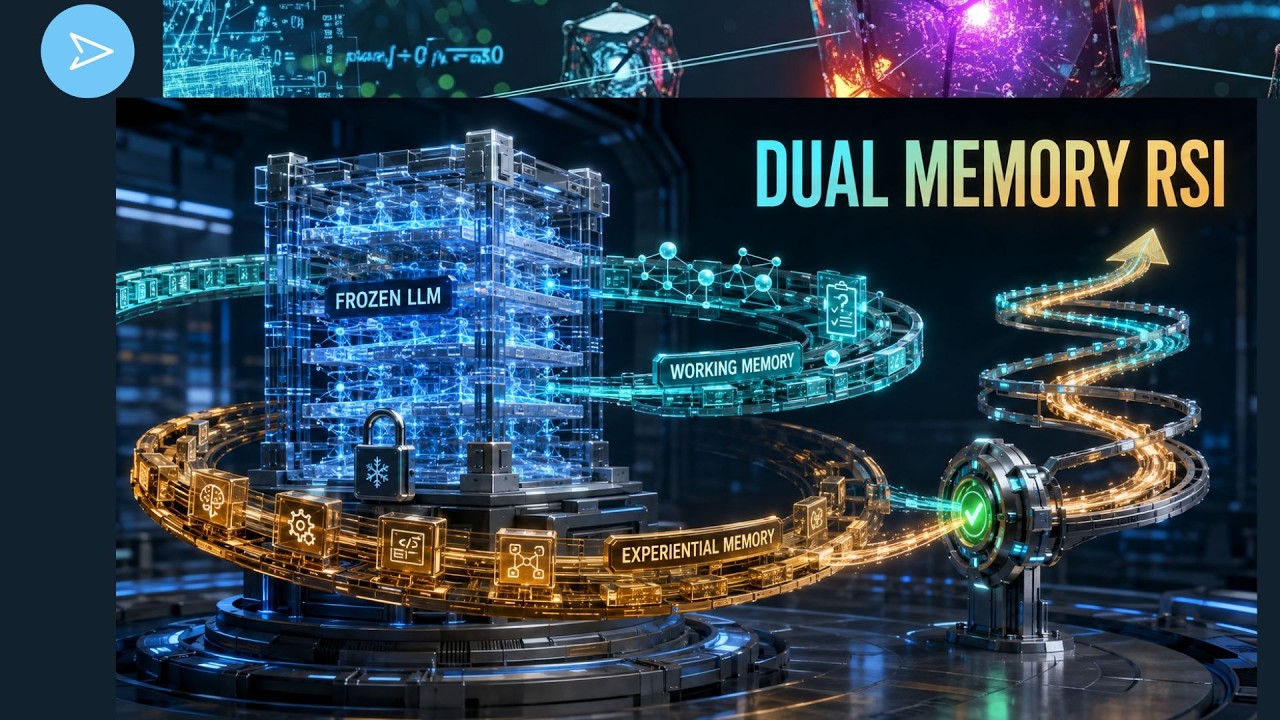
Imagine an AI that learns from every mistake the way a gamer masters a level after each defeat.
The Simple Version
Think of memory as a notebook that an AI writes in while solving problems. Dual-Memory RSI gives the AI two notebooks: one for raw experiences and another for refined skills.
How It Actually Works
Memory Architecture
The system splits memory into experiential and working stores.
Self-Rewrite Loop
When an agent fails, it tags the failure, extracts lessons, and writes them into the skill notebook. Over time the skill notebook becomes richer.
Technical Deep Dive
At the core is a Recursive Experiential–Working Memory Evolution module that updates gradients internally.
Agents back-propagate reward signals through both memory streams, allowing parameter-free adaptation.
Implementation uses a torch.nn.Module that merges ExperienceBuffer and SkillCache with attention weighting.
Why This Matters
Traditional AI needs costly human-labeled fine-tuning to pick up new tricks. Dual-Memory RSI removes that bottleneck, cutting development time and compute.
For developers, it means building agents that can continually level up in the wild, adapting to new tasks without a new training run.
Key Takeaways
- Dual-Memory separates raw experience from refined skill storage.
- Agents rewrite their own skill memory after each failure.
- No external fine-tuning is required for skill acquisition.
- Architecture supports recursive, self-referential updates.
- Reduces compute cost and speeds up deployment.
- Opens the door to truly autonomous, lifelong-learning agents.
- Applicable to robotics, game AI, and personalized assistants.