Imagine an AI agent trying to upload a file by literally retyping it character by character. That is what Jeremiah Lowin calls the 'world's most expensive copy-paste operation,' and it's a massive bottleneck in AI workflows.
The Simple Version
Usually, an AI agent is like a middleman. If you want a chart, the agent describes the chart in text, and you have to imagine it or use another tool to see it.
Generative UI changes this. Instead of the agent describing a tool, the tool sends a real, clickable interface directly to your screen.
How It Actually Works
Bypassing the Agent
In the standard Model Context Protocol (MCP), the agent handles everything. This creates a bottleneck when moving large amounts of data.
MCP apps are a protocol extension. They allow a tool's result to skip the agent entirely and arrive at the user as a rendered interface.
The Prefab Pipeline
Most enterprise developers love Python but hate writing React or JavaScript. Prefab solves this by creating a Python DSL (Domain Specific Language).
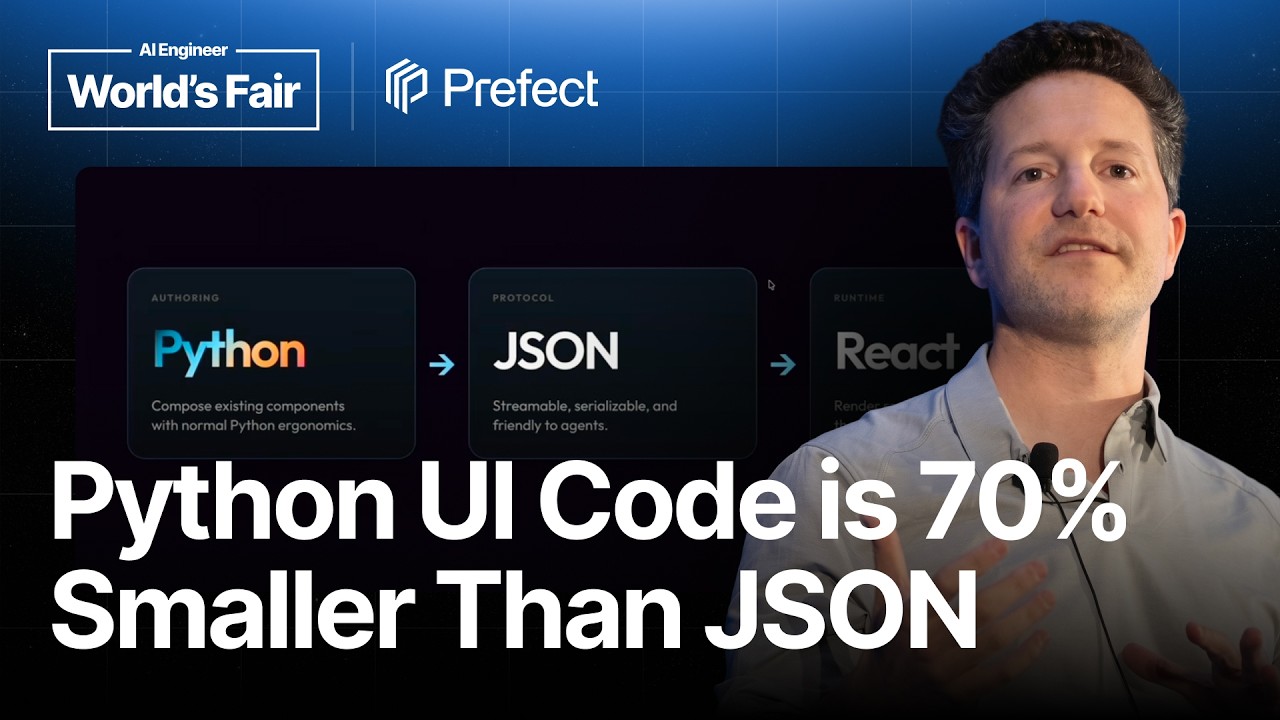
The pipeline works in a specific sequence: Python code is converted into a declarative representation, which becomes a JSON protocol, which finally renders as a React app.
Technical Deep Dive
The real magic of Prefab lies in its use of nesting context managers. By wrapping components in Python context managers, developers can define the structure of a UI (like tables, forms, and charts) purely in Python.
The core architectural goal is a serializable UI. Because the interface is represented as JSON, it isn't just a static page; it's a data structure that an LLM can generate, receive, or edit in real-time.
Interestingly, the team found that streaming the UI as Python code is roughly 70% smaller than streaming it as JSON. To maintain security and stability, they now send the Python over the wire and convert it within a sandbox on the client side.
Why This Matters
This shifts AI from being a 'chatbot' to being an 'app generator.' We are moving away from simple text prompts toward dynamic interfaces that adapt to the task at hand.
For the enterprise, this means Python engineers can build sophisticated internal tools—like data dashboards and interactive forms—without needing a dedicated frontend team.
It effectively removes the friction between the AI's reasoning and the user's ability to interact with the resulting data.
Key Takeaways
- MCP Apps stop the 'expensive copy-paste' by sending UIs directly to the user.
- Prefab allows Python developers to compose frontends using a Python-based DSL.
- Serializable UI means the interface is JSON, allowing agents to modify the UI programmatically.
- Context Managers are used to define the visual hierarchy of the interface.
- Efficiency: Sending Python code over the wire reduces payload size by ~70% compared to JSON.
- Focus: The system prioritizes functional components like tables, charts, and forms over branded consumer design.