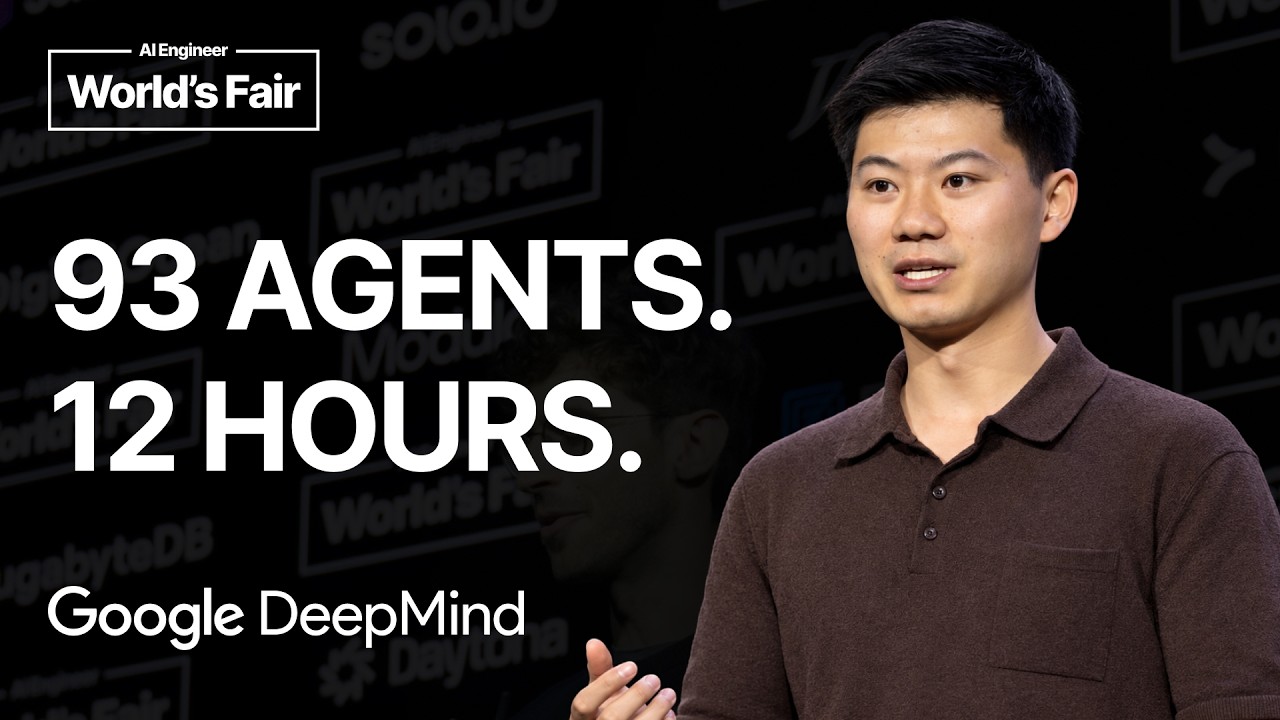
Imagine telling an AI to build an entire operating system from scratch, and then watching it actually happen. That is exactly what Google DeepMind achieved with Antigravity, an agentic coding platform designed to move beyond simple autocomplete and into the realm of autonomous software factories.
The Simple Version
For a long time, AI coding tools were like high-tech spellcheckers—they suggested the next word or wrote a small function. Antigravity 2.0 changes this by treating the AI not as a tool, but as a manager of a specialized team.
Instead of one giant model trying to do everything, Antigravity creates a 'swarm' of smaller, specialized agents. One might be the lead architect, another a backend specialist, and another a QA tester. They collaborate, check each other's work, and execute tasks in parallel to solve massive problems.
How It Actually Works
Kevin Hou, engineering lead for Antigravity, describes the philosophy as "Give Messi the ball and get the heck out of the way." This means building a product that removes human-imposed constraints so the model's intelligence can scale naturally.
The /teamwork Command
The core of the new experience is the /teamwork command. When triggered, a lead agent—specifically Gemini 3.5 Flash—takes over. This lead agent doesn't just write code; it orchestrates a team of arbitrary size, dynamically generating subagents for specific roles like infrastructure or design.
Dynamic Subagents
These subagents are not static templates. They are generated on the fly, seeded with specific prompts and configurations by the lead agent. They can operate independently in secure sandboxes or remote execution systems, allowing them to test and iterate without crashing the main environment.
Generative UI
Rather than forcing the user to read thousands of lines of logs, Antigravity uses Generative UI. The system renders custom interfaces—like Kanban boards, timelines, or interactive reports—on the fly. As Hou notes, this replaces the "fixed in plastic" buttons of traditional software with interfaces that adapt to the current task.
Technical Deep Dive
From an architectural standpoint, Antigravity 2.0 represents a shift from deterministic tools to agentic orchestration. In 2022, tools relied on syntax tree parsing and embeddings; by 2026, the focus is on dynamic graphs of agents.
The "Doom OS" run is a primary example of this scaling. To achieve this, the system managed 93 subagents over 12 hours. The lead agent (Gemini 3.5 Flash) handled the high-level decomposition of the OS kernel requirements, while subagents executed the low-level C or Assembly implementation and debugging. This required 15,000 requests and 2 billion tokens, yet remained cost-effective (under $1,000) due to the efficiency of the Flash model.
For context, this architecture leverages a Sidecar Protocol. A sidecar is a long-lived utility process that allows the agent to "listen" to the outside world via webhooks, cron jobs, or GitHub PRs. This transforms the agent from a reactive chatbot into a proactive system that can trigger actions based on external events.
The efficiency is further boosted by Gemini 3.5 Flash's throughput, which Hou claims clocks in at nearly 900 tokens per second. This speed is critical for Generative UI, as it allows the system to render complex interactive elements almost instantaneously, avoiding the lag that usually plagues LLM-generated interfaces.
Why This Matters
This shift marks the transition from "AI-assisted coding" to "AI-led software engineering." When researchers at DeepMind used this to automate 90% of their evaluation analysis, they didn't just get a summary; they got 100 parallel hypothesis agents drilling into data deltas. This removes the "Jupyter notebook elbow grease" and replaces it with high-level intent.
Compared to existing agents that operate in a linear loop (Plan → Act → Observe), Antigravity's team-based approach allows for massive parallelism. By decoupling the Agent Manager from the IDE, Google is betting that the future of development isn't writing code in an editor, but managing a software factory that produces code.
The primary limitation remains the "human in the loop" requirement. While the agents can build an OS, the human still defines the mission and validates the final output. However, as the "paro curve" of intelligence, speed, and cost continues to shift, the role of the developer moves from "writer" to "orchestrator."