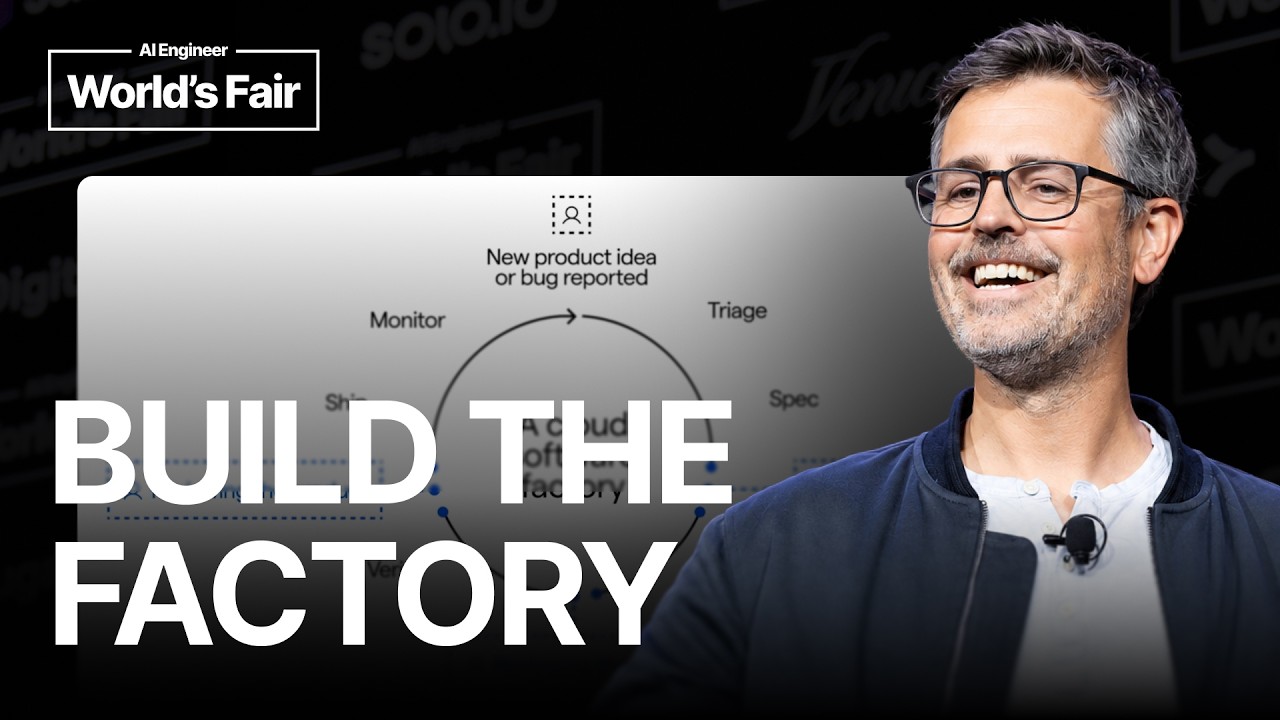
Zach Lloyd, the founder of Warp and former principal engineer at Google, has a startling confession: he is still shipping software frequently, but he hasn't written a single line of code in six months.
The Simple Version
For decades, software engineering has been like artisanal woodworking. A developer sits down, thinks through a problem, and manually carves out the logic line by line. It's a high-skill, manual process where the value is in the act of writing the code.
Lloyd suggests we are moving toward a factory model. In this world, the engineer doesn't carve the wood; they design the assembly line. They build the machines (agents) that do the carving, the quality control sensors that check for errors, and the feedback loops that make the machines faster and more accurate.
How It Actually Works
The core of this transition is the 'software factory loop.' This is a systemic automation of the entire Software Development Life Cycle (SDLC), moving beyond simple AI autocomplete tools like GitHub Copilot or Cursor toward fully autonomous agents.
The Factory Floor Workflow
Lloyd describes the process as a graph of steps where ideas flow in and finished features flow out. It starts with Triage, where an agent analyzes incoming issues from Slack, task trackers, or monitoring systems to decide if they are simple enough for immediate implementation or require a deeper plan.
For complex tasks, the factory employs Spec-Driven Development. An agent first writes a 'product spec' to define the intended behavior (the invariance) and then a 'tech spec' to outline the architecture and code shape. Only after these are reviewed by a human does an implementation agent create the actual code diff in a cloud sandbox.
Verification and Monitoring
The loop doesn't end at the pull request. Lloyd emphasizes a Verification step, which can include 'computer use'—where an agent actually interacts with the UI, producing videos and screenshots to prove the feature works. Finally, Monitoring agents observe the shipped code for crashes or usage patterns, feeding that data back into the top of the factory to start the cycle again.
Technical Deep Dive
To scale a software factory, Lloyd outlines a three-tier architecture consisting of a control plane, an execution plane, and a data plane.
The Control Plane acts as the orchestrator, determining how work is distributed across the factory floor and which agents are triggered for specific tasks. The Execution Plane provides the isolated environments—cloud sandboxes—where agents can run code, execute tests, and iterate on diffs without risking the main codebase.
The Data Plane is the most critical for long-term improvement. It serves as the collective memory of the factory, allowing agents to remember past failures and successful patterns. This builds the foundation for Skill-Improvement Loops.
For context, these loops function similarly to Reinforcement Learning from Human Feedback (RLHF). Lloyd explains that 'observer agents' watch how human seniors correct the work of 'worker agents.' If a senior engineer consistently corrects a code review agent's comments, the observer agent identifies the pattern and updates the review agent's instructions to prevent the same mistake in the future.
As Lloyd puts it, "you're not just building the product, but you're building the thing that builds the product." This moves the technical challenge from algorithmic implementation to meta-engineering—the optimization of the agentic system itself.
Why This Matters
This shift is driven by a harsh economic reality: software is becoming cheap to build and trivial to clone. When AI can replicate a feature set in hours, a great product is no longer a sufficient moat. Competitive advantage now shifts toward distribution, brand, and ecosystem.
This is why Warp, which has over 800,000 active developers and 60,000 GitHub stars, decided to open-source after five years of closed development. By building a 'public factory' (via build.warp.dev), they create a community-driven ecosystem that is much harder for a competitor to clone than the code itself.
For engineers, this means the 'joy' of the job is shifting. While those who love the act of writing syntax may find this daunting, those who love shipping products have more leverage than ever. The role of the developer is evolving into a mix of product manager, system architect, and process engineer.