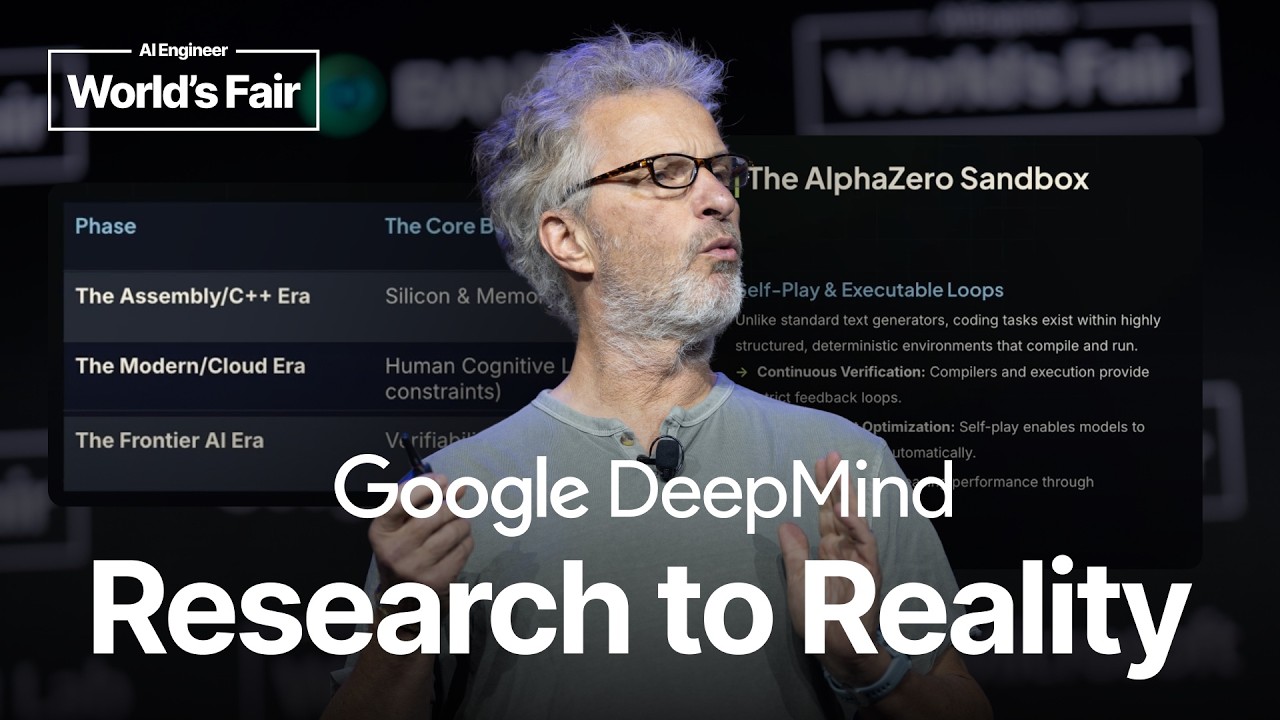
Ever wondered how AI will rewrite the rules of coding itself? In this keynote, Benoit Schillings reveals the next frontier of AI reasoning and code generation.
The Simple Version
Think of today's code as a recipe where the AI already knows the ingredients. The real challenge is deciding which dish to cook and making sure it's safe to eat.
How It Actually Works
Self‑Play Training
Guardrails & Security
Technical Deep Dive
DeepMind is shifting from pure token prediction to inductive architectures that can plan multi‑step solutions. These models generate sub‑tasks, verify each step, and iteratively refine the output.
Evaluation benchmarks are expanding beyond pass@k to include reasoning depth, code correctness, and safety checks. The team is also integrating security scans directly into the generation loop.
Why This Matters
The economics of software are flipping: writing code becomes cheap, but reviewing, securing, and maintaining that code becomes the scarce skill.
In science, AI‑driven experimentation can accelerate drug discovery or materials design by orders of magnitude, unlocking breakthroughs that were previously impossible.
For developers, mastering AI‑augmented workflows will become as essential as learning a programming language.
Key Takeaways
- Syntax generation is solved; the bottleneck moves to architecture and validation.
- Self‑play lets models create and test their own challenges, pushing performance limits.
- Guardrails and security must be baked into AI‑generated code from day one.
- Inductive models plan, decompose problems, and transfer knowledge across domains.
- AI will accelerate research in chemistry, biology, and other scientific fields.
- Engineering economics shift toward reviewing, securing, and maintaining AI output.
- Future engineers will need strong reasoning and safety‑first mindsets.