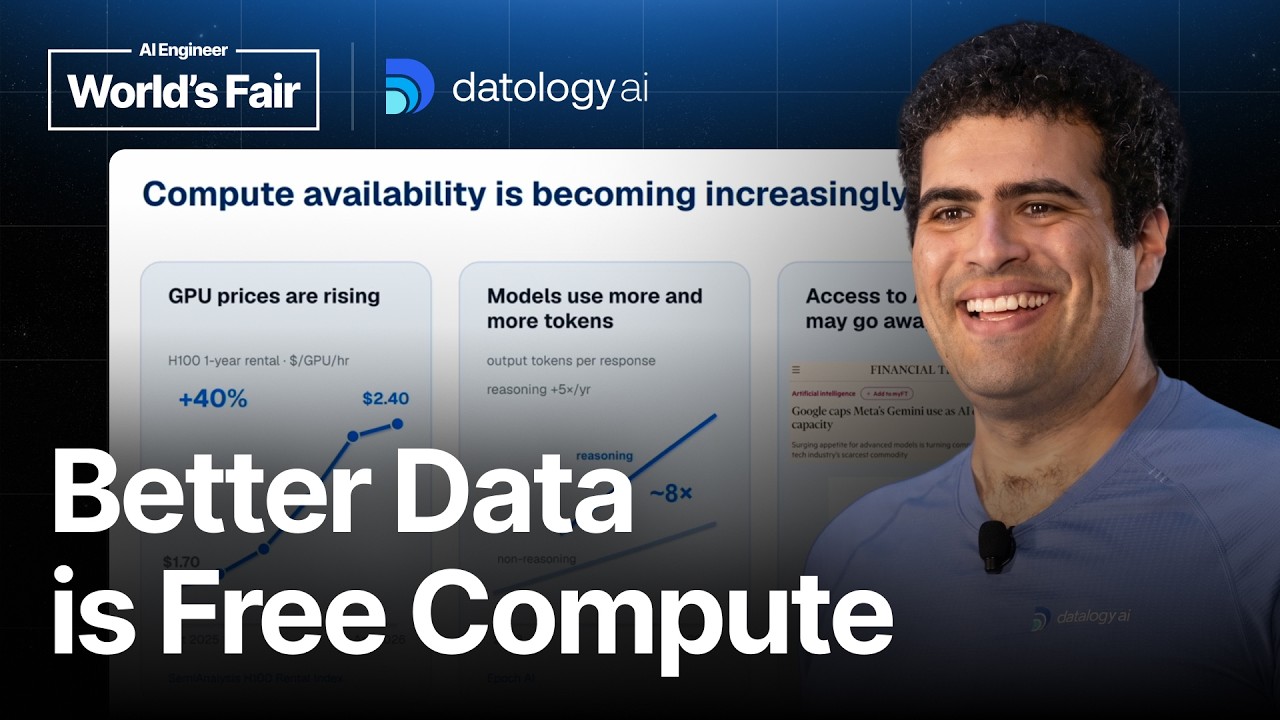
Ever wonder why the next breakthrough in AI might come from better data, not more compute? In this video, Ari Morcos makes a bold case that data quality is the real compute multiplier.
The Simple Version
Think of training a model like brewing coffee. Using clean, rich beans (high‑quality data) gives a stronger brew without needing a bigger pot (more compute).
How It Actually Works
Scaling Curve Swap
Spending the same dollars on cleaner data moves you up the scaling curve, delivering more performance per FLOP.
Signal per Token
The scarce resource now is not how many tokens you have, but how much useful signal each token carries.
Technical Deep Dive
DatologyAI applies a pipeline of quality classifiers, deduplication, and synthetic generation, each step tuned to extract maximum signal.
Sequencing matters: first clean raw data, then filter with classifiers, then augment with synthetic examples that target weak spots.
Customer proof: Thomson Reuters boosted mid‑training performance on proprietary legal data, while Arcee’s Trinity reached frontier levels using only public data after curation.
Cost-wise, manufacturing high‑quality data is cheaper than buying extra compute instances, especially at scale.
Why This Matters
Better data reduces the need for massive clusters, making state‑of‑the‑art models accessible to smaller teams.
It also speeds up inference, because a model that reaches target quality faster can serve more requests per GPU hour.
Industries ranging from legal to multilingual AI can now differentiate themselves with curated datasets rather than raw token counts.
Key Takeaways
- Data quality can outperform raw compute on the scaling curve.
- Cleaning and curating data is often the most under‑invested part of training.
- Synthetic data, when guided by good classifiers, can fill gaps without extra token volume.
- Real‑world customers already see performance jumps from better data.
- Signal per token is the new scarce resource to optimize.
- Investing in data pipelines yields higher ROI than buying more hardware.
- Future model breakthroughs will likely be credited to data engineers, not just hardware designers.