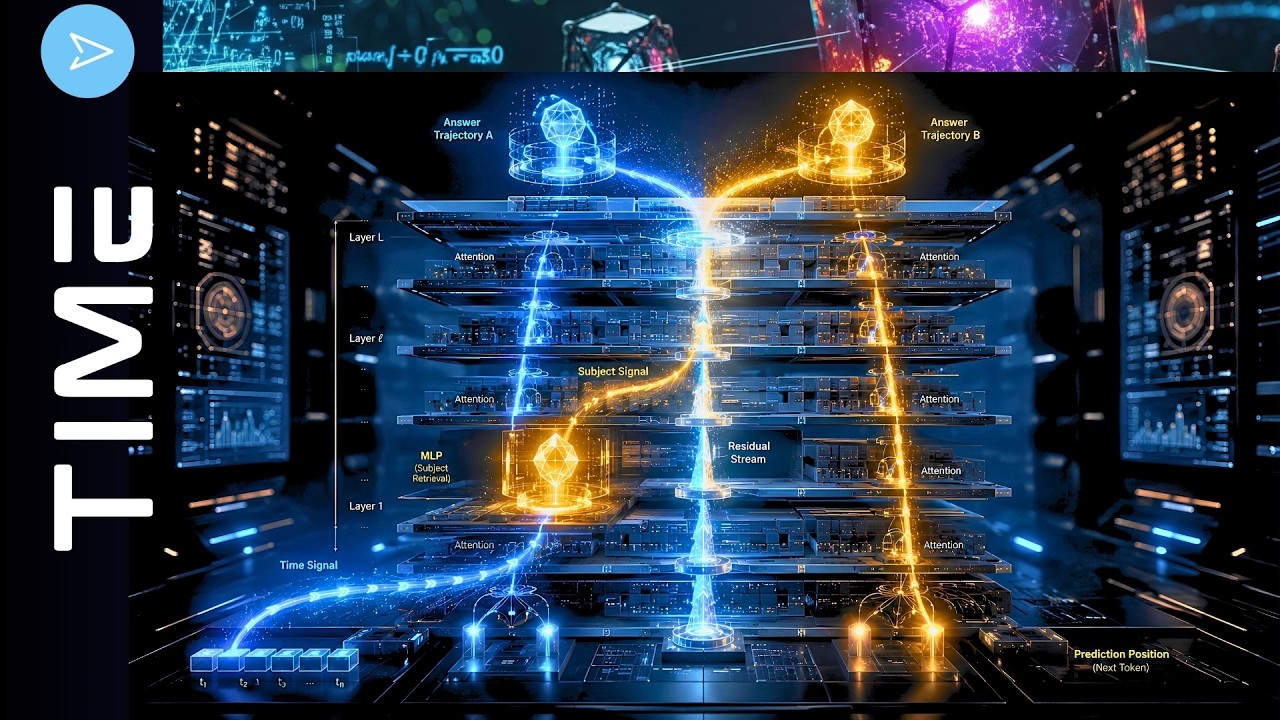
Ever wonder how a language model seems to keep track of ‘when’ something happened, even though it has no clock?
The Simple Version
Think of a symphony orchestra. Each musician (token) plays at a specific moment, and the conductor (the model) adjusts the volume of each instrument based on when it enters.
How It Actually Works
Residual Stream Basics
The residual stream is the hidden pathway that carries updates from one layer to the next.
Layer‑by‑Layer Interaction
Every layer adds its own “signal” to the stream, and later layers read that combined signal to decide what to output.
Technical Deep Dive
Mathematically, the residual stream at layer l is h_l = x_l + f(h_{l-1}), where x_l is the input token embedding and f is the layer’s function.
When a token is processed, the model injects a positional encoding that subtly shifts the embedding in the residual stream, creating a time‑dependent pattern that downstream layers can detect.
These shifts are not stored as an explicit timestamp; instead they manifest as tiny changes in activation values that encode relative order.
Why This Matters
Understanding temporal dynamics helps engineers design better architectures that can handle streaming data, long‑range dependencies, and real‑time inference without extra clock modules.
It also explains why some fine‑tuned models struggle with time‑sensitive tasks, as the residual stream’s subtle cues can be disrupted by training changes.
Key Takeaways
- Residual streams carry contextual updates across layers.
- Positional information is baked into subtle activation shifts, not a separate timer.
- Later layers read these shifts to infer order and relative timing.
- Disruptions to the stream can cause LLMs to “lose” their sense of time.
- This insight guides future model designs for streaming and multimodal applications.
- Fine‑tuning methods like LoRA can alter the stream’s dynamics, affecting temporal awareness.
- Researchers can leverage these dynamics for more efficient temporal reasoning.