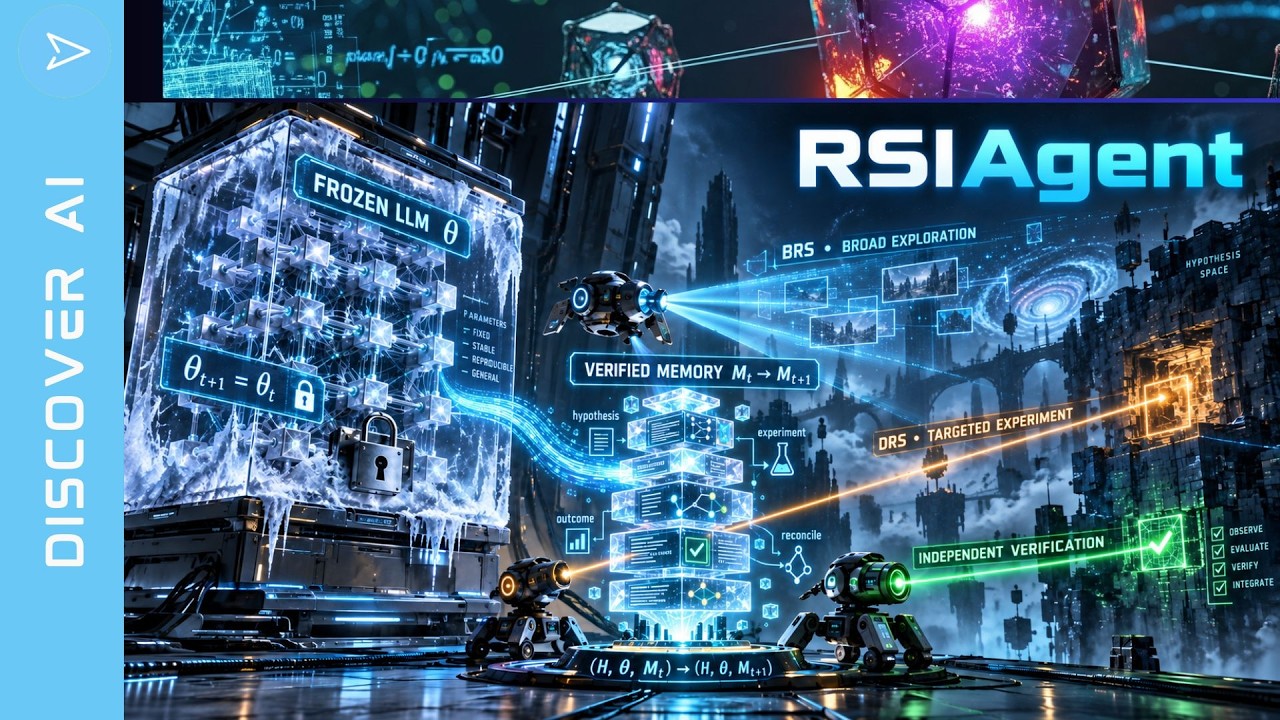
Imagine an AI that doesn't just wait for a human to give it a better dataset, but actually goes out into the digital world to find its own weaknesses and fix them.
This is the core ambition behind the RSIAgent framework, a breakthrough in how we think about model evolution.
The Simple Version
Most AI models today are like students who study a fixed textbook. Once the textbook is finished, the student stops learning unless a teacher gives them a new book.
RSIAgent changes this by turning the AI into a curious explorer. Instead of just reading, it actively experiments with new tasks and environments to see where it fails.
When it hits a wall, it analyzes the failure, learns the solution, and then updates its own internal logic so it doesn't make that mistake again.
How It Actually Works
The RSIAgent framework shifts the paradigm from static training to a dynamic, agentic loop. It doesn't just process data; it interacts with environments to generate its own training signals.
Autonomous Exploration
The agent is designed to seek out "new environments." These are scenarios or tasks that the model hasn't encountered in its initial training set.
By pushing itself into unfamiliar territory, the agent creates a natural feedback loop of trial and error.
The Recursive Improvement Loop
Once the agent identifies a failure point in a new environment, it enters the Recursive Self-Improvement (RSI) phase.
It uses its reasoning capabilities to diagnose why it failed and generates a corrected path or a new strategy to solve the problem.
This new knowledge is then integrated back into the model's operational logic, effectively "upgrading" the agent for the next round of exploration.
Environmental Adaptation
The framework emphasizes the importance of "New Environments." This prevents the model from simply memorizing answers (overfitting) and forces it to develop generalizable reasoning skills.
By constantly shifting the goalposts, the RSIAgent ensures that its self-improvement is robust and applicable to a wide range of real-world problems.
Technical Deep Dive
From an architectural standpoint, RSIAgent leverages the massive reasoning power of state-of-the-art models like Kimi K3 and GLM-5.3. These models act as the "central nervous system" or the controller for the agentic loop.
In traditional supervised fine-tuning (SFT), humans provide the gold-standard answers. RSIAgent replaces this with an autonomous discovery process where the environment provides the ground truth.
The technical challenge here is the bootstrap problem: a model must be smart enough to recognize its own errors before it can fix them.
Kimi K3 and GLM-5.3 provide the high-level cognitive capacity required to perform meta-reasoning. This allows the agent to not only solve a task but to reason about the process of solving the task.
The recursive nature of the system implies a loop of: Exploration → Error Detection → Synthetic Data Generation → Model Update. This cycle effectively creates a synthetic pipeline of high-quality, hard-case examples that are far more valuable than random web-scraped data.
Why This Matters
This research marks a critical step toward Artificial General Intelligence (AGI). We are moving away from the era of "frozen" models that are static from the moment they finish training.
If an AI can autonomously identify its gaps and fill them, the speed of intelligence growth becomes exponential rather than linear. We no longer need to wait for humans to curate the next massive dataset.
While this raises questions about safety and alignment—specifically how to ensure an AI doesn't "self-improve" in a direction that ignores human values—the potential for scientific discovery and software engineering is staggering.