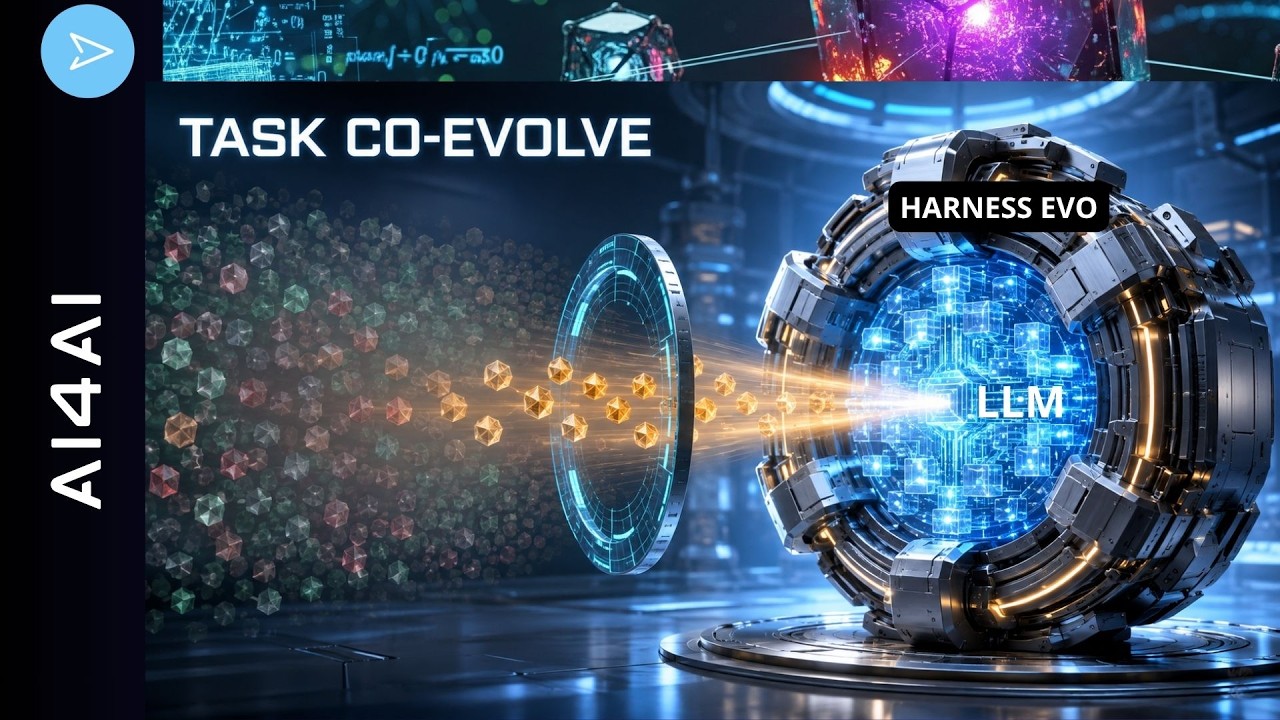
Most AI models spend way too much time taking tests they've already passed. What if they could just skip the easy stuff and focus on where they are actually failing?
The Simple Version
Imagine a student preparing for a massive final exam. Instead of re-reading the entire textbook every single day, they only study the chapters they keep getting wrong on practice quizzes.
This is exactly what Task-Coevolve does for AI. It optimizes the 'harness'—the set of tests used to measure the AI—so the model only spends energy on the hardest, most useful challenges.
How It Actually Works
Adaptive Validation Task Selection
Standard AI training often uses a fixed set of benchmarks. The problem is that many of these tests become 'noise' once the AI masters them.
Adaptive Selection allows the system to dynamically pick which tasks to evaluate. By ignoring the 80% of tests that no longer provide useful feedback, the AI iterates much faster.
The Concept of the 'Harness'
The 'harness' is the environment that defines how an AI is tested and validated. If the harness is too rigid, the AI stops improving because it has 'solved' the environment.
By evolving the harness alongside the model, the AI is constantly pushed into new, unexplored territories of reasoning.
Technical Deep Dive
From an architectural standpoint, Task-Coevolve shifts the evaluation loop from a static process to a dynamic one. This reduces the computational overhead of the validation phase, which is often a bottleneck in Large Language Model (LLM) training.
The research suggests a shift away from simple next-token prediction. It proposes that true reasoning might stem from the AI's ability to recognize 'what is missing'—a gap between its current output and the goal.
This leads us to Recursive Self-Improvement (RSI). When an AI can optimize its own evaluation harness (AI4AI), it creates a feedback loop where the AI designs the very tests it needs to become more intelligent.
Why This Matters
Compute is the most expensive resource in AI. If we can cut evaluation waste by 80%, we can train more capable models in a fraction of the time.
More importantly, this moves us closer to Autonomous AI. A model that knows how to test itself is a model that can learn without human hand-holding.
It changes the definition of intelligence from 'having the right answer' to 'knowing how to find the missing piece.'
Key Takeaways
- Efficiency: Adaptive validation removes redundant tests to save compute.
- Task-Coevolve: The process of evolving the test environment as the AI grows.
- Beyond Tokens: Reasoning may be about identifying gaps in knowledge, not just predicting the next word.
- AI4AI: The potential for AI to build its own optimization tools.
- RSI: Recursive Self-Improvement is the ultimate goal of this architectural shift.
- Signal vs. Noise: Success comes from focusing on high-signal failures rather than low-signal successes.