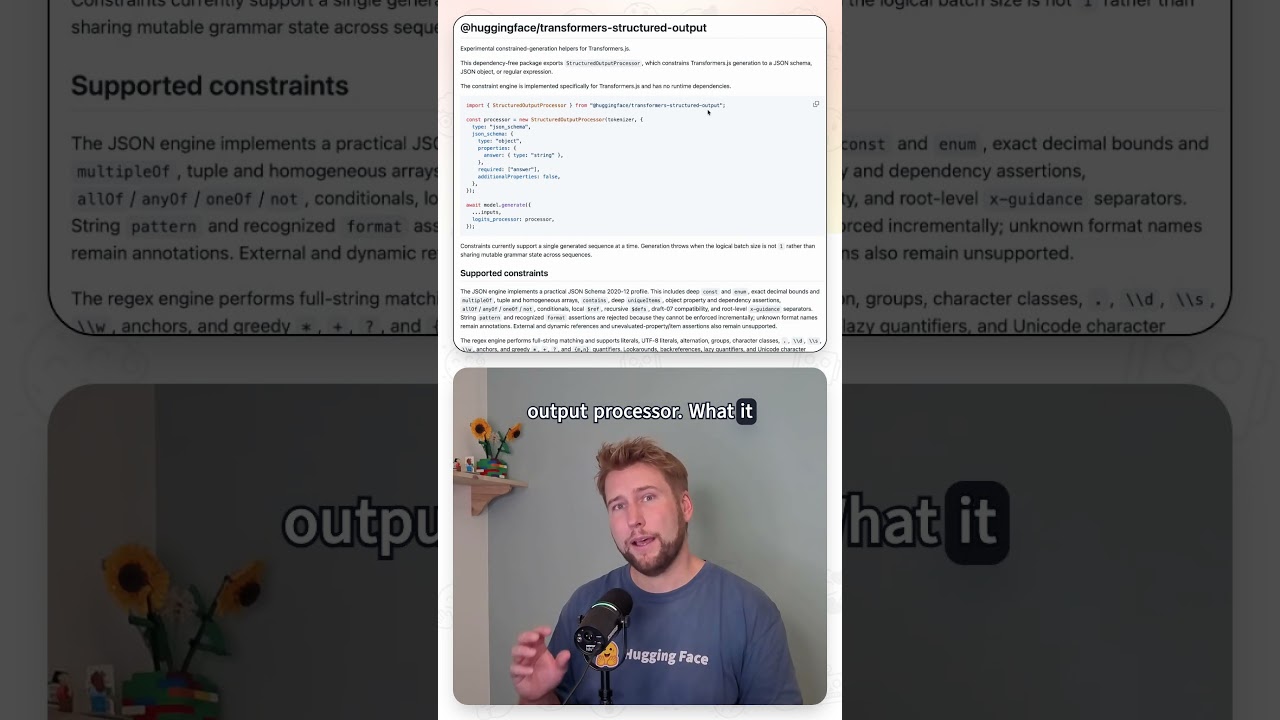
Imagine asking an AI for a list of users in JSON format, only for it to add a conversational "Sure, here is the list:" at the beginning, breaking your entire application. For developers building browser-based AI apps, this unpredictability has been a constant headache.
The Simple Version
Most Large Language Models (LLMs) are essentially high-tech autocomplete engines. They guess the next most likely word (or token), which means they can easily drift off-track or add unnecessary chatter when you just want a clean data object.
Structured output acts like a set of guardrails for the AI. Instead of letting the model guess any possible token, the system checks the rules you've set—like a specific JSON format—and forbids the model from picking any token that would break those rules.
How It Actually Works
The core of this update is the new @huggingface/transformers-structured-output package. This isn't just a post-processing filter that cleans up text after the AI is done; it is integrated directly into the heart of the generation loop.
Token-Level Intervention
As the video explains, the package "hooks into the generation process of new tokens." In a standard LLM, the model produces a probability distribution for every possible token in its vocabulary.
The structured output processor intercepts this distribution. If the next character must be a quote mark to start a JSON key, the processor sets the probability of all non-quote tokens to zero. The model is then forced to choose from the remaining valid options.
Defining the Constraints
Developers can now guide the model using two primary methods: JSON Schema and Regular Expressions (regex). This ensures that the output is not just "mostly correct," but mathematically guaranteed to be parsable by your code.
Technical Deep Dive
To understand why this is significant, we have to look at Logit Bias and Constrained Beam Search. In traditional LLM deployments, developers often tried to achieve structure through "prompt engineering"—begging the model to "only output JSON." However, this is unreliable because the model can still hallucinate characters.
The Transformers.js 4.3 implementation likely utilizes a technique called logit masking. When the generation loop reaches a step, the structured output processor evaluates the current state of the generated string against the provided JSON Schema or regex. It then creates a mask—a binary filter—that is applied to the logits (the raw prediction scores) before the final sampling step.
For context, this brings the browser experience closer to what tools like Guidance or Outlines do for Python-based LLM deployments. By moving this logic into the browser via JavaScript, Hugging Face is enabling complex, reliable agentic workflows that run entirely on the client's hardware using WebGPU, reducing server costs and improving privacy.
As the Hugging Face team puts it, this feature "makes sure that every new token actually follows the structure that we want," effectively eliminating the need for fragile try-catch blocks around JSON.parse()._Why This Matters_
This is a massive win for Edge AI. Until now, running a model in the browser often meant sacrificing the reliability of the output. With structured output, developers can build fully functional local dashboards, data extractors, and automated tools that interact with other APIs without fear of a "hallucinated" comma breaking the pipeline.
Furthermore, this reduces the need for expensive cloud-based "Guardrail" services. By enforcing the schema locally on the user's GPU, the application becomes more responsive and significantly more robust. It transforms the LLM from a creative writer into a reliable software component.