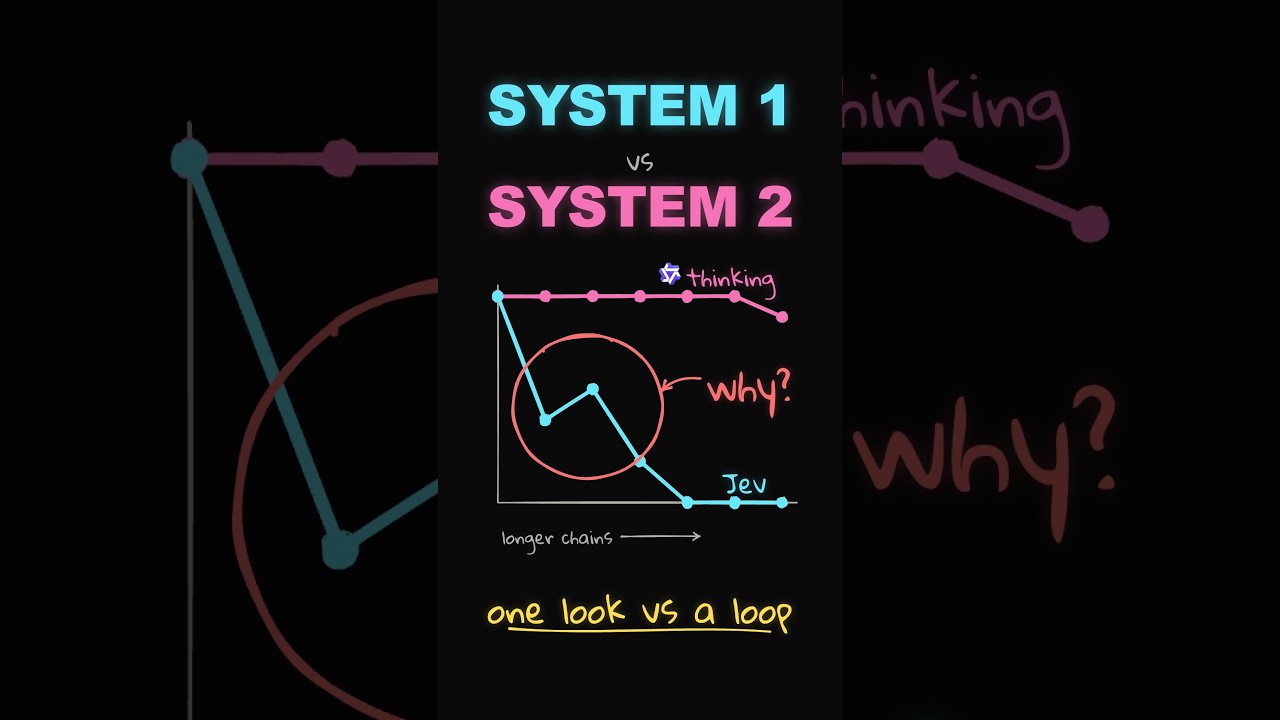
Imagine the difference between a reflex and a research project; one happens in a blink, while the other requires a notebook and a lot of patience.
The Simple Version
At its core, the difference between System 1 and System 2 AI is about how many times the model 'looks' at the problem before giving you an answer. A System 1 model is like a fast-twitch muscle; it sees the input and immediately produces the output in one single motion.
A System 2 model, however, is more like a student solving a math problem on a chalkboard. It doesn't just guess the answer; it writes down a step, looks at that step, and then decides what the next step should be.
How It Actually Works
The Single Pass of System 1
In a System 1 model, such as Jev, the process is linear. The prompt enters the neural network, passes through the layers once, and the tokens are generated sequentially based on the initial context.
As the video explains, "Your question goes in one pass through the days and the answer comes straight out." This makes it incredibly efficient for tasks that don't require deep logic, such as sentiment analysis or basic classification.
The Iterative Loop of System 2
System 2 models, like Qwen 3.8, operate differently. Instead of a straight line, they function as a loop. The model generates a thought, appends it to a 'scratchpad' or internal monologue, and then reads that entire history to determine the next move.
The speaker describes this as "the same brain running in a loop," where every pass allows the model to write a note and build upon it. This allows the model to handle 'chains' of questions that would otherwise overwhelm a standard LLM.
Technical Deep Dive
To understand why System 2 is more robust, we have to look at the concept of Compute-Optimal Scaling. Standard Transformers (System 1) have a fixed amount of computation per token. No matter how hard the question is, the model spends the same amount of 'energy' processing the input.
System 2 models implement what is known as Test-Time Compute. By allowing the model to generate a 'Chain of Thought' (CoT) before providing the final answer, the system effectively increases the number of floating-point operations (FLOPs) dedicated to a single query. This is why the speaker notes that while Jev "falls off a cliff" as chains get longer, the thinking model "is barely move[ing]" in terms of performance degradation.
For context, this architecture mirrors the 'System 1 and System 2' framework from psychologist Daniel Kahneman. System 1 is fast, instinctive, and emotional; System 2 is slower, more deliberative, and logical. In AI, this is achieved by forcing the model to output its reasoning steps into the context window, which then serves as additional input for the next token generation.
Why This Matters
The critical takeaway is that System 2 isn't strictly "better" than System 1—it's just different. For simple tasks, like asking "Is this ticket about billing?" or "Is the message urgent?", a System 1 model is superior because it is faster and cheaper.
However, for complex engineering, coding, or mathematical proofs, System 1 models fail because they try to jump to the conclusion without doing the work. If a problem requires intermediate results to reach a final answer, System 2 is the only viable path.
As we move toward more autonomous AI agents, the ability to switch between these two modes—using System 1 for routine tasks and triggering System 2 for complex reasoning—will be the key to creating efficient, human-like intelligence.