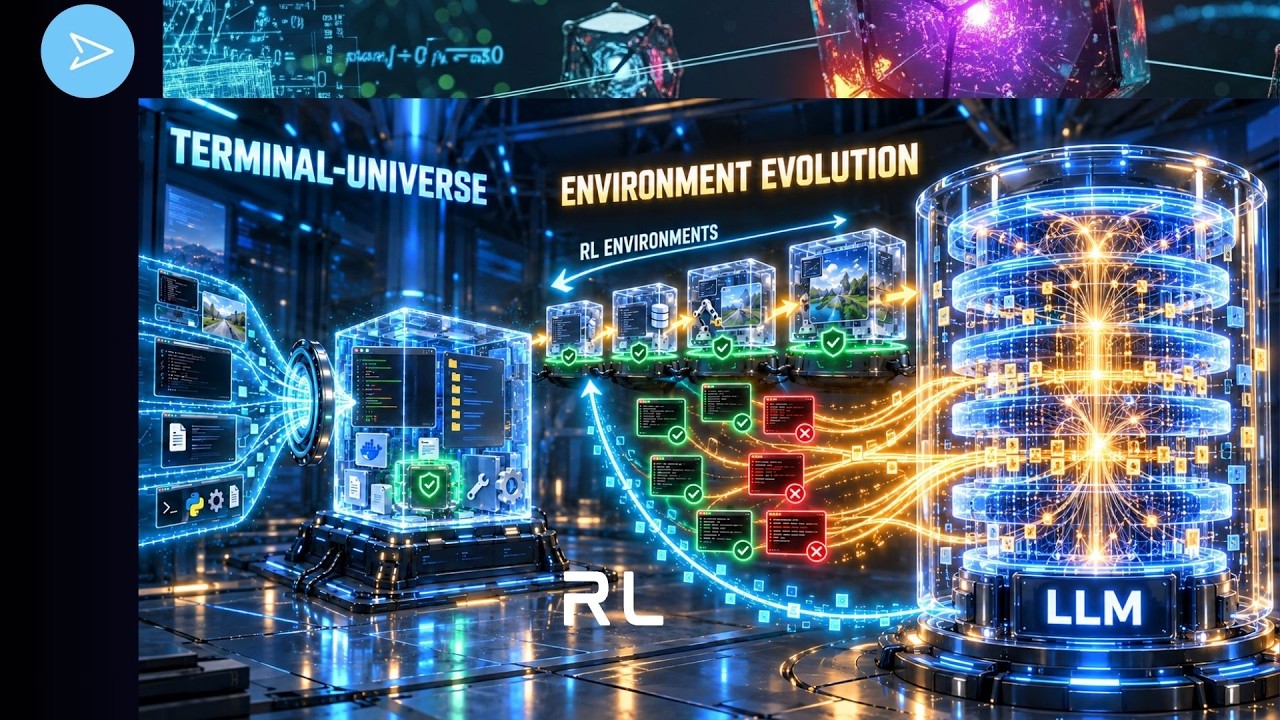
Imagine an AI that builds its own training playground and then steps up the difficulty on its own.
The Simple Version
The papers take old agent steps, turn them into a virtual environment, and then make that environment harder over time. This self‑evolving setup teaches the LLM how to improve without human‑crafted reward hacks.
How It Actually Works
Reconstructing Trajectories
Old agent behavior logs are replayed to rebuild a usable environment. This gives the system a starting point for training.
Progressive Curriculum Evolution
The rebuilt world is then made progressively harder, with built‑in checks that verify the agent’s progress. Each level serves as a new learning signal for the LLM.
Technical Deep Dive
Both pre‑prints propose a verifier‑guided curriculum where a separate model scores agent solutions and adjusts task difficulty. The curriculum is implemented as a modular pipeline that can be plugged into existing RL frameworks.
Verifier‑Checked RL
A lightweight verifier evaluates whether the agent meets safety or performance thresholds before moving to the next difficulty tier. This prevents the agent from learning unsafe or ineffective strategies.
Scalable Terminal Environments
The “Terminal‑Universe” approach turns trajectory data into parameterized terminal states, enabling rapid generation of diverse tasks. This scaling trick lets researchers train on millions of simulated steps without manual design.
Why This Matters
By letting the environment shape its own training signal, the method reduces reliance on human‑written reward functions. This could lead to faster, more generalizable LLM fine‑tuning across domains.
Key Takeaways
- Old agent trajectories become executable training worlds.
- Environments evolve to increase difficulty automatically.
- Verifiers provide safe, automated curriculum control.
- Qwen 27B can be post‑trained using these adaptive signals.
- Reduces need for manually crafted reward designs.
- Enables scalable generation of complex RL tasks.