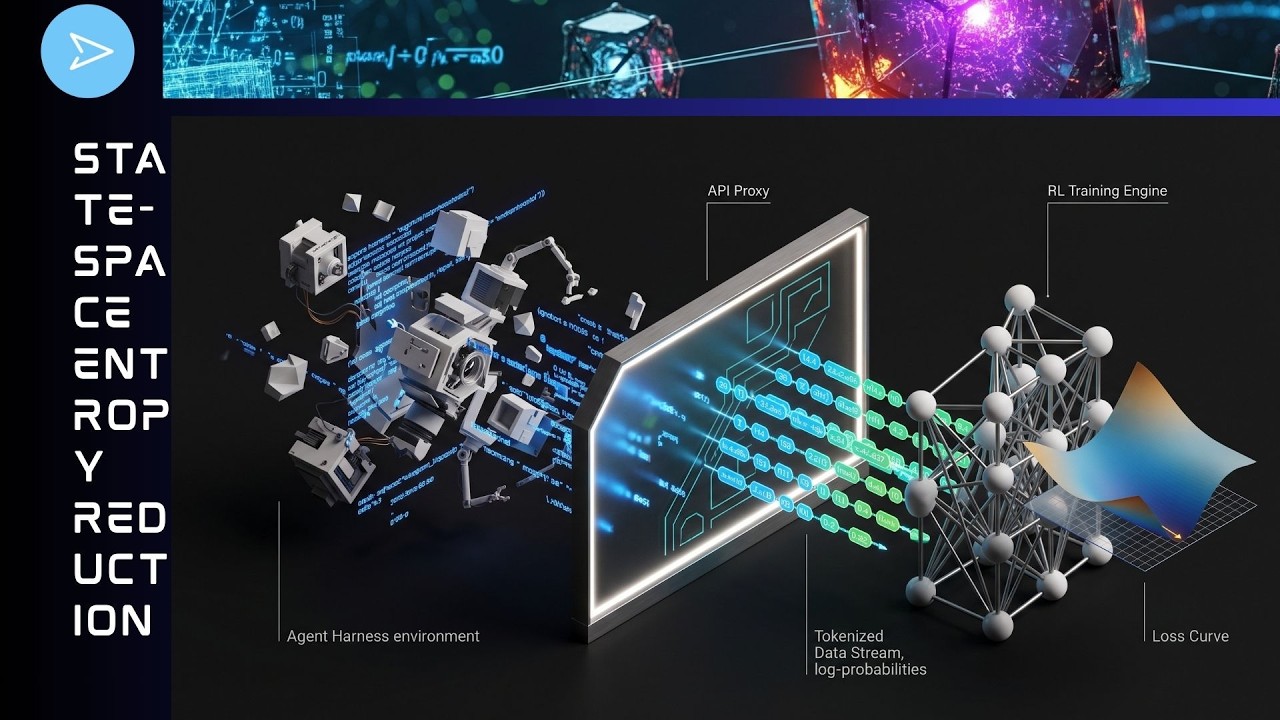
Ever felt like an RL agent is drowning in a sea of chaos? Meet the API proxy that tames it.
The Simple Version
Think of an RL agent as a sailor lost in a storm of raw sensory data. The proxy acts like a lighthouse, cutting through the noise and showing a clear path.
How It Actually Works
State Compression
The proxy takes high‑dimensional state vectors s_t and squeezes them into a compact latent code z_t. This is the first step toward manageable inputs.
Log‑Probability Mapping
From z_t we compute token log‑probabilities log that guide the next action. These scores drive the learning loop.
Technical Deep Dive
Mathematically, the proxy applies a learned transformation f(·) that minimizes the KL divergence between the raw state distribution and the latent distribution. The regularization term enforces exact entropy filtering, which smooths the loss landscape
∇L(θ). Without this exact filtering, gradients become jagged and convergence stalls.
Gradient Stability
The sterile geometry on the right represents the neural network’s parameter space. The ordered neon streams are the filtered signals that travel smoothly along the gradient descent path, ensuring reliable updates.
Why This Matters
In real‑world applications—robotics, recommendation systems, language agents—stable learning means fewer failed trials and lower compute costs. This proxy technique could become a building block for safer, more efficient AI deployments.
Key Takeaways
- The proxy compresses noisy states into a dense latent representation.
- Entropy filtering is mathematically required for smooth gradient flow.
- Without it, loss landscapes are too irregular for stable learning.
- The method bridges thermodynamic intuition with rigorous RL math.
- It promises more efficient RLHF pipelines like HybridFlow and AREAL.
- Developers can reuse the concept to tame large‑scale language model fine‑tuning.
- Future research may extend the proxy to multimodal or cross‑modal settings.