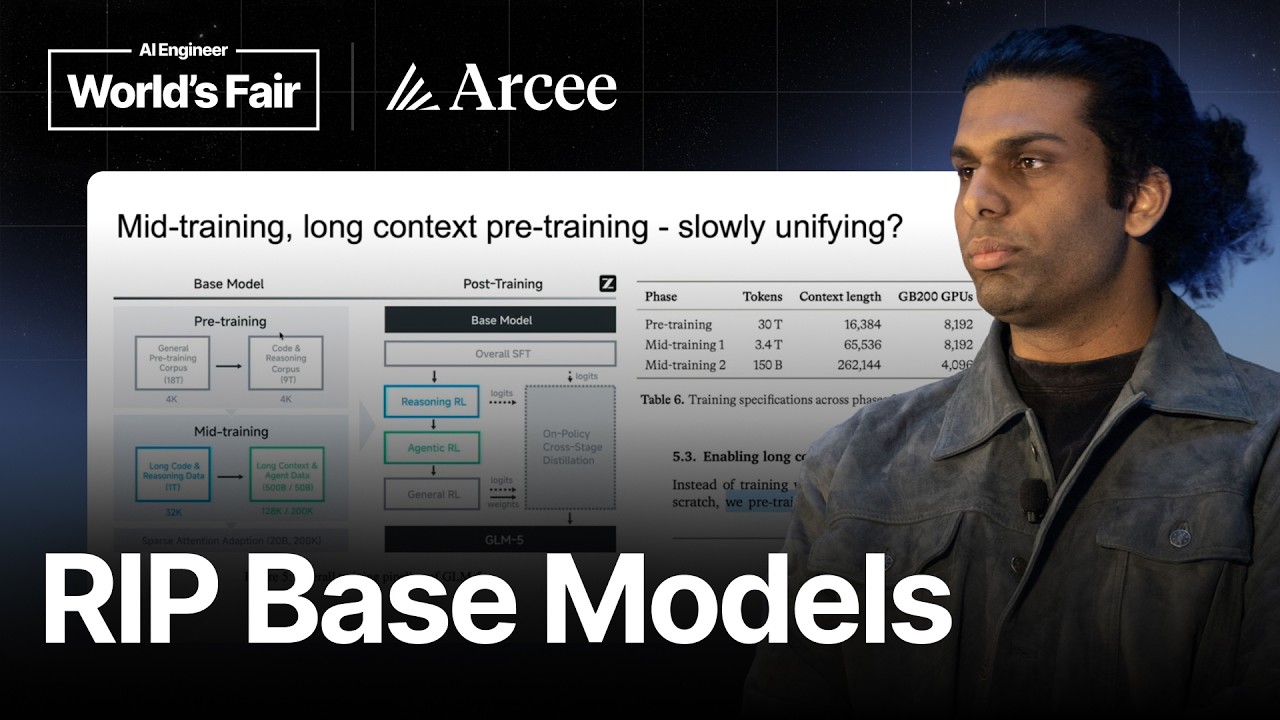
Varun Singh from Arcee AI says the old idea that a base model is just a copy of the whole internet is dead.
The Simple Version
Think of a base model as the foundation of a house. If the foundation changes, the rooms above must be rebuilt.
How It Actually Works
Mid‑Training Stage
Modern recipes inject instruction data and synthetic traces before raw web text, shaping capabilities early.
Prior for RL
The base model now carries the prior that reinforcement learning will refine, so its data mix includes post‑training‑flavored signals.
Technical Deep Dive
Coefficient Balancing
They experimented with weighted loss terms to keep representation stability during RL fine‑tuning.
Synthetic Reasoning Traces
These generated traces teach the model how to reason, reducing reliance on raw web text.
Why This Matters
Developers can no longer treat pre‑training as a simple web‑text scrape. The shift forces new pipelines that prioritize instruction and synthetic data.
When the base model’s job keeps redefining itself, missing this change can lead to models that can’t reason well or scale efficiently.
Key Takeaways
- The base model is no longer a mirror of the internet.
- Instruction and synthetic data move earlier in training.
- RL now requires the base model to carry a reasoning prior.
- Balancing coefficients early prevents instability later.
- Stable representations are essential for downstream capabilities.
- Practical recipes from Nemotron, Kimi K2, and Trinity illustrate the pattern.
- Ignoring this shift costs you in performance and scalability.