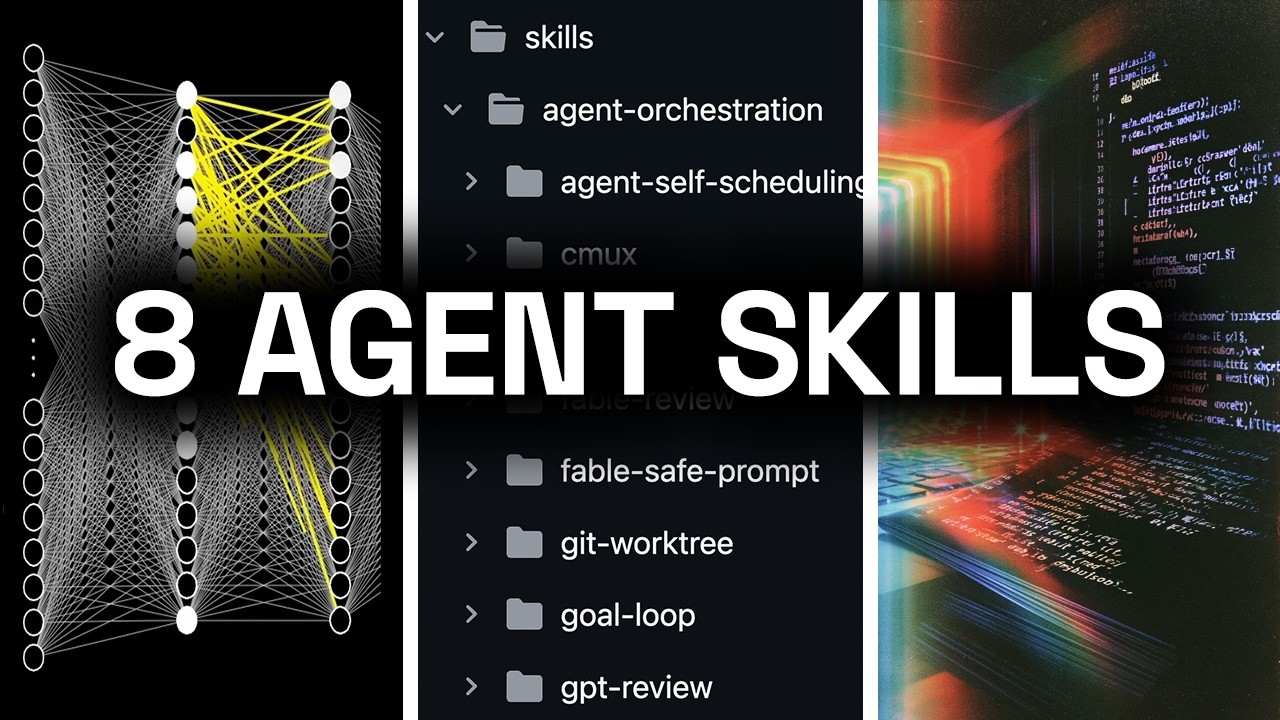
Ever wonder how an AI goes from just chatting about a project to actually executing the code and deploying it for you?
The secret isn't just a better prompt; it's giving the AI a set of 'skills' it can actually use.
The Simple Version
Imagine you hire a brilliant assistant who has read every book in the world but has no hands. They can tell you how to bake a cake, but they can't crack an egg.
Giving an AI 'skills' is like giving that assistant hands and a kitchen. Suddenly, they aren't just describing the process—they are actually performing the actions.
How It Actually Works
Defining the Toolset
An agent doesn't magically know how to use your computer. Developers create a skills repository, which is essentially a library of functions the AI is allowed to call.
Each skill has a clear name and a description that tells the AI exactly when to use it.
The Execution Loop
When you give an agent a task, it enters a loop of Reasoning and Acting. It thinks about the goal, selects the right skill, and executes it.
After the skill runs, the AI looks at the result and decides if the job is done or if it needs another skill to finish the task.
Technical Deep Dive
From a developer's perspective, Agent Skills rely heavily on Function Calling. This is where the LLM doesn't return a conversational string, but a structured JSON object.
The system uses a JSON Schema to define the input parameters the skill requires. For example, a 'send_email' skill would require 'recipient' and 'body' as defined arguments.
Most modern agent architectures follow the ReAct pattern (Reason + Act). This ensures the agent logs its internal monologue before calling a function, which drastically reduces hallucinations and improves reliability.
Why This Matters
We are moving away from the era of 'Prompt Engineering' and into the era of 'Agentic Workflows.' Instead of trying to write the perfect prompt, we are building robust tool-belts for AI.
This shift allows for true automation. AI can now manage calendars, write and execute code, and coordinate between different software platforms without human hand-holding.
Key Takeaways
- Agent Skills are functional tools that allow LLMs to interact with external systems.
- Function Calling transforms AI output from text into actionable data (JSON).
- Open-source repositories like the one mentioned allow the community to share and standardize these capabilities.
- The ReAct pattern helps agents think through a problem before acting.
- The goal is to move from Chatbots (talking) to Agents (doing).
- Modularity is key; adding a new skill is like adding a new feature to the AI's brain.