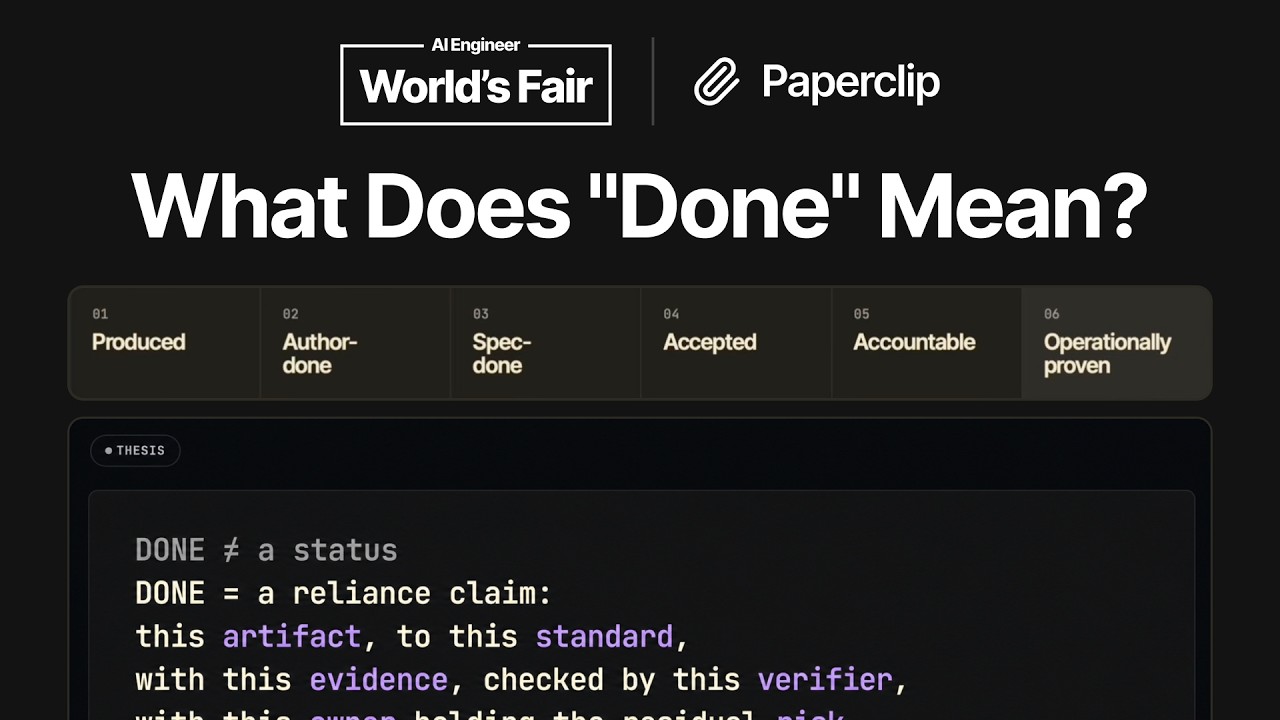
Ever wonder why “done” feels like a moving target when AI agents crank out work faster than you can check? In this talk, Dotta flips the script on how we define completion.
The Simple Version
Think of “done” like a signed receipt. The artifact proves it met the rules, the verifier checks the receipt, and the next action knows who owns the remaining risk.
How It Actually Works
Trust Protocol Foundations
Here the protocol defines what “done” looks like and how it’s recorded.
Risk‑Based Review Routing
Instead of checking everything, the system routes reviews to the right verifier based on how risky the artifact is.
Liveness Model in Action
The liveness model ties completion to a living state where the artifact can trigger the next step safely.
Technical Deep Dive
Artifacts carry metadata that states the standard they satisfied.
Verifiers consume this metadata to emit a pass/fail signal.
Ownership tags assign a responsible party for any residual risk.
Authorization fields embed a next‑action command that downstream agents can execute.
Why This Matters
Teams can avoid endless approval loops and keep work flowing.
Risk‑aware routing reduces wasted human effort.
Clear ownership lets engineers trust AI output enough to build on it.
Overall, the model turns vague confidence into a reproducible trust contract.
Key Takeaways
- “Done” must include a clear standard and evidence.
- Verification should be delegated to the right verifier.
- Risk ownership must be explicit.
- Next‑action authorization enables chaining.
- The liveness model ties completion to safe continuation.
- Trust protocols replace approval theater.
- Scaling AI teams rely on this protocol for safety.