Your multi-million dollar GPU cluster is likely spending a shocking amount of time doing absolutely nothing.
It isn't because the code is bad or the hardware is failing; it's because the very foundation of how computers talk to each other—TCP—wasn't built for the way modern AI thinks.
The Simple Version
Imagine a massive team of 1,000 world-class chefs (your GPUs) working on one giant banquet. They spend a few minutes cooking their individual parts, but every few minutes, they all have to stop and check a shared checklist to make sure they are in sync before moving to the next step.
If 999 chefs finish their check in a millisecond, but one chef is stuck in a crowd and takes two seconds to get an answer, the other 999 chefs just stand there. They can't move forward until that last person is done.
In the early days of AI, the 'cooking' phase took forever (seconds), so a tiny delay in the 'checklist' phase didn't matter. But with agentic inference, the cooking phases have shrunk to milliseconds. Now, the time spent waiting for that one slow message is just as long as the time spent doing the actual work.
How It Actually Works
The Shift from Throughput to Latency
Historically, AI training was all about throughput. You were moving gigabytes of gradients across the network, and as long as the 'pipe' was wide enough to move that bulk data, you were happy.
Today, the workload has changed shape. We are seeing a surge in tiny coordination messages, such as checking if a specific entry exists in a distributed KV (Key-Value) cache or clearing a synchronization barrier.
In this new world, the average speed doesn't matter—the 99th percentile (tail latency) does. If one tiny message gets stuck in a network queue, the entire compute cluster stalls, wasting expensive GPU cycles.
The 'Incast' Problem and the Wrong End of the Network
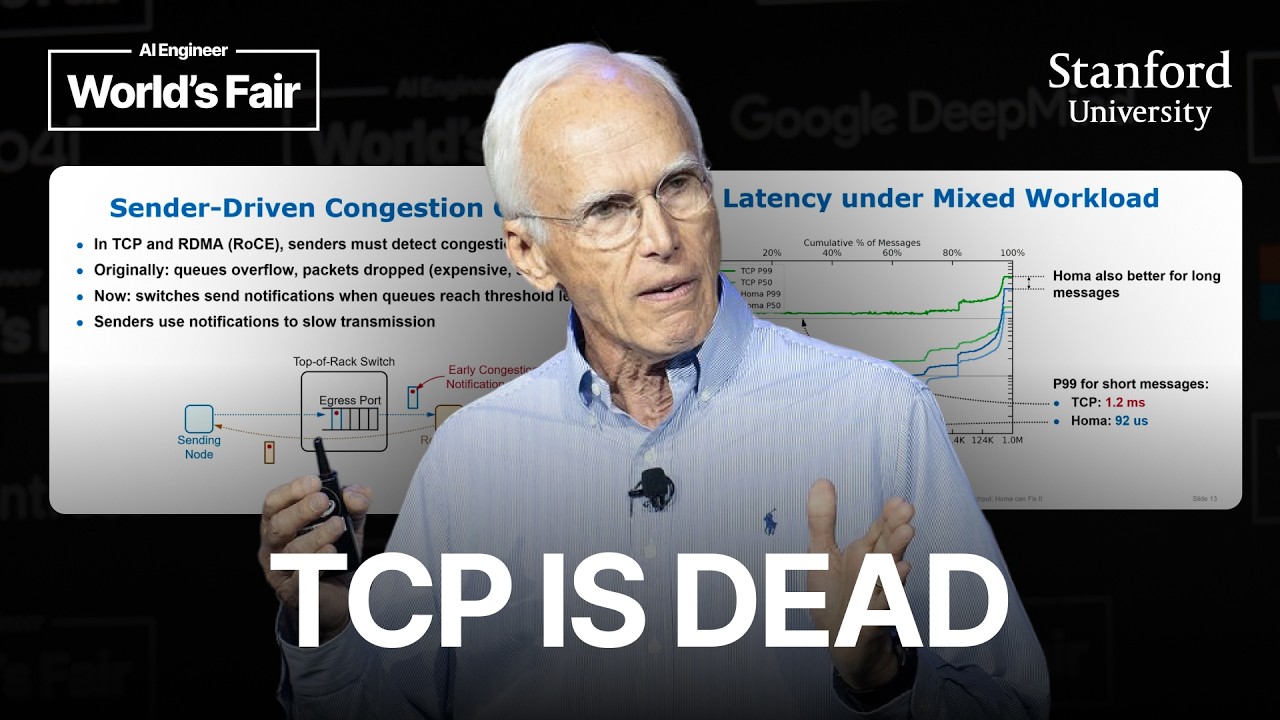
The core technical failure of TCP is where it handles congestion. In TCP, the sender is responsible for congestion control. The sender tries to guess how much data the network can handle by ramping up speed until it sees a packet drop.
The problem is that congestion doesn't happen at the sender; it happens at the last hop into the receiver. This is known as 'Incast,' where multiple nodes all send data to one receiver simultaneously, overflowing the receiver's buffer.
By the time the sender realizes there is a queue at the receiver, the information is already outdated. The sender learns about the congestion several round trips too late, leading to a cycle of over-sending and crashing known as oscillation.
Technical Deep Dive
Byte Streams vs. Message Boundaries
TCP treats data as a continuous byte stream. It doesn't actually know where one message ends and another begins; it just sees a long line of bytes. This means a tiny, urgent coordination message can get stuck behind a massive data transfer in the same queue.
Homa, a protocol developed at Stanford based on Behnam Montazeri's dissertation, replaces byte streams with discrete messages. Because the network understands message boundaries, short messages can 'overtake' long ones. This prevents a small metadata check from being trapped behind a large gradient update.
Receiver-Driven Congestion Control
Homa flips the TCP model on its head by moving congestion control to the receiver. Instead of the sender guessing the bandwidth, the process works like this:
1. The sender sends a tiny initial packet that tells the receiver exactly how large the full message is.
2. The receiver, which knows exactly how much buffer space it has left, decides when to accept the data.
3. The receiver issues a 'grant' to the sender, essentially saying, 'I have room now, send the rest of your message.'
This eliminates the guessing game. The receiver manages the queue in real-time, ensuring that the network never overflows and that high-priority small messages are granted access first.
Leveraging Hardware Priority Queues
Homa doesn't require a total rewrite of networking hardware. It is designed to use the priority queues that already exist in modern network switches. By tagging messages with different priorities, Homa ensures that the 'grants' and short messages move to the front of the line, slashing the tail latency that kills GPU efficiency.
Why This Matters
This isn't just an academic exercise; it's a financial imperative. GPUs like the NVIDIA H100 are incredibly expensive to run. If your network protocol causes them to sit idle for 20% of the time during agentic inference, you are effectively throwing away millions of dollars in compute capacity.
As we move toward more complex, agentic AI systems that require constant, rapid-fire coordination between distributed nodes, the 'old' internet protocols (TCP) become the primary bottleneck.
Moving to a receiver-driven, message-based architecture like Homa allows AI clusters to scale not just in terms of raw power, but in terms of synchronization efficiency. It turns the network from a bottleneck into a transparent highway.