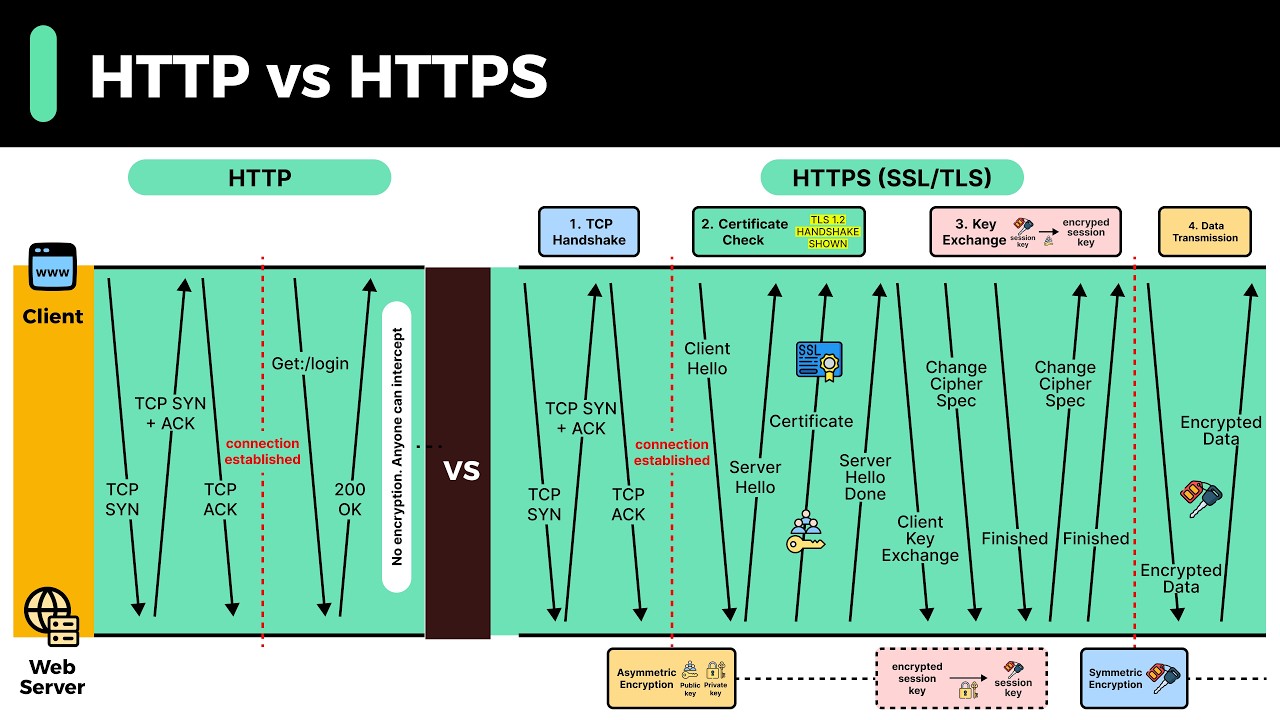
Ever wonder why your browser shows a little lock icon when you type https://
The Simple Version
Think of HTTP as a plain postcard and HTTPS as a sealed, tamper‑proof envelope.
How It Actually Works
Plain HTTP
HTTP sends data as clear text across the internet.
Secure HTTPS
HTTPS wraps that same HTTP traffic inside TLS encryption, like putting the postcard into a locked box.
Technical Deep Dive
When you type a URL starting with https://, the browser initiates a TLS handshake: it exchanges certificates, negotiates cipher suites, and establishes a symmetric key.
After the handshake, all HTTP commands — GET, POST, headers — are encrypted with that key, ensuring confidentiality and integrity.
Server certificates are signed by trusted Certificate Authorities (CAs) to prove the server’s identity, preventing man‑in‑the‑middle attacks.
Why This Matters
Without HTTPS, every password, credit‑card number, or personal message travels exposed, making it trivial for attackers to steal.
Modern web standards now flag non‑HTTPS sites as “Not Secure,” influencing user trust and SEO rankings.
For developers, understanding TLS is essential when designing APIs, microservices, or any system that communicates over the internet.
Key Takeaways
- HTTP = plain‑text communication; HTTPS = HTTP + TLS encryption.
- TLS provides confidentiality, integrity, and authentication.
- Certificate Authorities validate server identity.
- Browsers penalize HTTP sites for security warnings.
- Developers must handle TLS handshakes when building networked applications.
- HTTPS is now the baseline expectation for user trust and SEO.