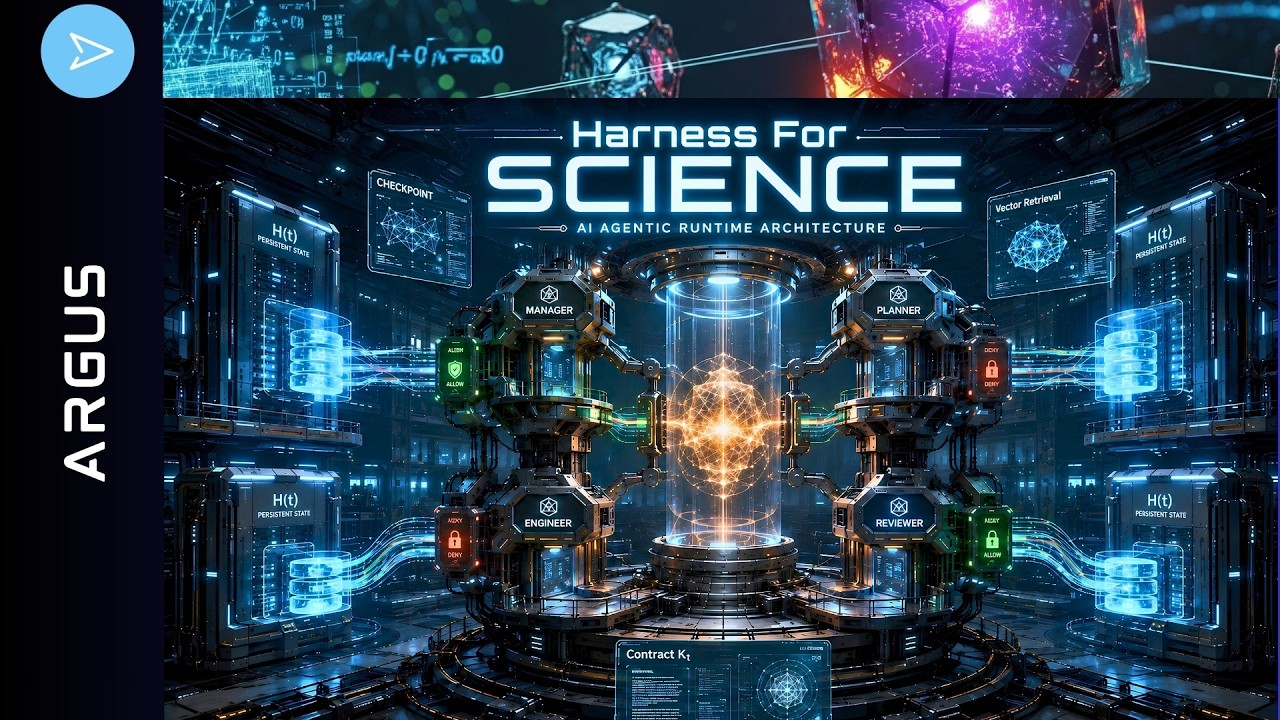
Imagine an AI that doesn't just answer your prompt, but actually evolves its own strategy to solve a complex scientific mystery. We are moving past simple chatbots and entering the era of agentic runtimes.
The Simple Version
A standard AI is like a brilliant professor who suffers from total amnesia every time you leave the room. They can solve a hard math problem instantly, but they can't lead a year-long research project because they forget what they did yesterday.
To fix this, we build a Harness. This is essentially a support system that gives the AI a notebook to write in, a supervisor to double-check its work, and a map of all the dead-ends it has already explored.
How It Actually Works
1. Externalizing State
Standard LLMs are stateless, meaning every request starts from scratch. The harness moves the AI's 'memory' into an external database.
2. Gated Commits
An AI often suffers from 'hallucination' and might believe its own mistakes. The harness introduces independent checks that must be passed before a result is officially saved.
3. Typed Trajectories
Usually, when an AI gives you an answer, you lose the 'thought process' that led there. The harness saves the entire trajectory, including the failed attempts.
Technical Deep Dive
For the devs, this is a shift from stateless inference to a stateful agentic loop. The Argus framework implements what is known as Verification-Guided Persistence.
Rather than relying on in-context learning (which is limited by the context window), the runtime manages runtime morphisms. This allows the agent to pivot its configuration or logic based on the evidence gathered in previous trajectories.
The architecture separates the Reasoning Engine (the LLM) from the Persistence Layer (the state). By treating rejected routes as 'evidence' rather than 'errors,' the system creates a feedback loop that enables runtime self-evolution without needing to retrain the underlying model weights.
Why This Matters
This is the bridge between 'AI that talks' and 'AI that does science.' By solving the continuity problem, we can finally deploy agents to handle long-horizon reasoning tasks that take days or weeks to complete.
It moves us away from the 'prompt-and-pray' method. We are creating systems that can objectively fail, learn from that failure, and pivot their strategy autonomously.
Key Takeaways
- Statelessness is the biggest hurdle for AI performing long-term research.
- External State converts memory from a session property to a retrieval operation.
- Gated Commits prevent the AI from blindly trusting its own hallucinations.
- Typed Trajectories ensure that failed attempts are preserved as valuable evidence.
- Agentic Runtimes allow AI to 'morph' its approach without needing weight updates.
- Argus is a prime example of moving toward autonomous, long-horizon reasoning.