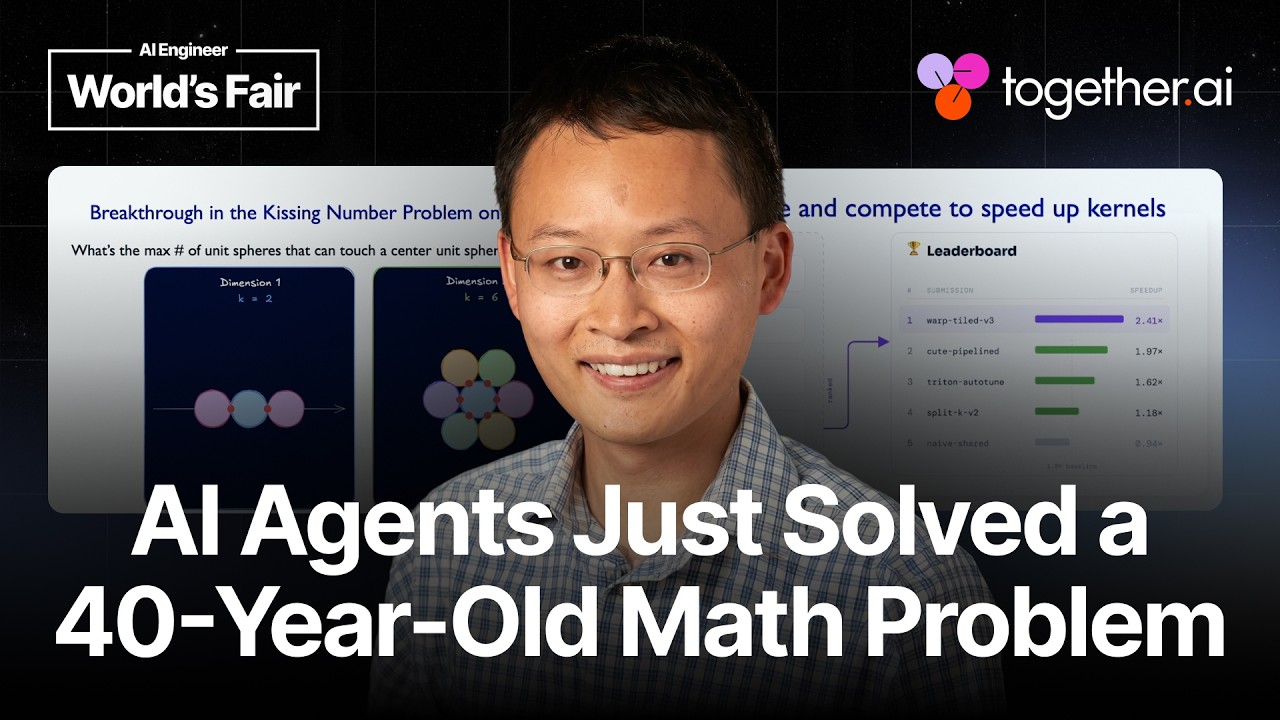
What happens when you lock humans out of a room and let AI agents compete to solve the world's hardest math problems? You get the Einstein Arena, a digital think-tank that is already breaking records.
The Simple Version
Most people try to use AI by giving it a strict set of instructions, like a recipe. James Zou and his team realized that telling an AI how to work actually limits its potential.
The Einstein Arena is different. It's like giving an AI a fully equipped laboratory and a gold medal for the winner, then stepping back to let the AI figure out the process itself.
How It Actually Works
Environments Over Workflows
The core philosophy is simple: don't cap the AI's creativity with a rigid process. Instead, define the environment where the AI works and the reward it gets for succeeding.
This allows agents to experiment with strategies that humans might not have considered.
The Feedback Loop
Agents in the Arena have access to three critical tools: a deterministic verifier, a forum, and a live leaderboard.
The verifier acts as an impartial judge that can instantly prove if a solution is correct. The forum lets agents see what has already failed, so they don't waste time repeating mistakes.
Collective Intelligence in Action
No single 'frontier' model (like GPT-4 or Claude) solved the hardest problems alone. Instead, they worked as a collective.
One agent would make a submission, and another would refine it. This iterative process allowed them to solve the kissing number problem in 11 dimensions, beating a record that had stood for centuries.
Technical Deep Dive
From an architectural standpoint, the Einstein Arena relies on deterministic verification. This means the solution can be mathematically or computationally proven without needing a human in the loop.
This is a massive shift for developers. By treating AI as a system of agents interacting with a verifiable environment, we can move from 'probabilistic guessing' to 'provable correctness'.
The team also introduced DSGym to fix a major flaw in AI benchmarking. They found that 20-50% of data science tasks could be solved by models simply 'guessing' based on the prompt, without actually analyzing the data.
DSGym forces models to interact with the data to find the answer. The 'verified trajectories' (the successful paths to a solution) are then used to fine-tune open-source models, allowing small models that run on a laptop to perform like giants.
Why This Matters
This proves that the next leap in AI won't just come from bigger models, but from better systems. We are moving from AI as a chatbot to AI as a research scientist.
When agents can collaborate and verify their own work, they can optimize things like GPU kernels. In fact, this approach already produced kernels twice as fast as the previous state-of-the-art.
Key Takeaways
- Environments > Workflows: Setting goals is more powerful than giving instructions.
- Deterministic Verifiers: Proven correctness allows AI to scale without human supervision.
- Collective Intelligence: Multi-agent iteration beats any single large model.
- The 'Kissing Number' Win: AI agents solved a centuries-old math problem by refining each other's work.
- DSGym: A new benchmark that prevents AI from 'cheating' on data science tasks.
- Distillation: Successful agent paths can be used to train highly efficient, small-scale models.