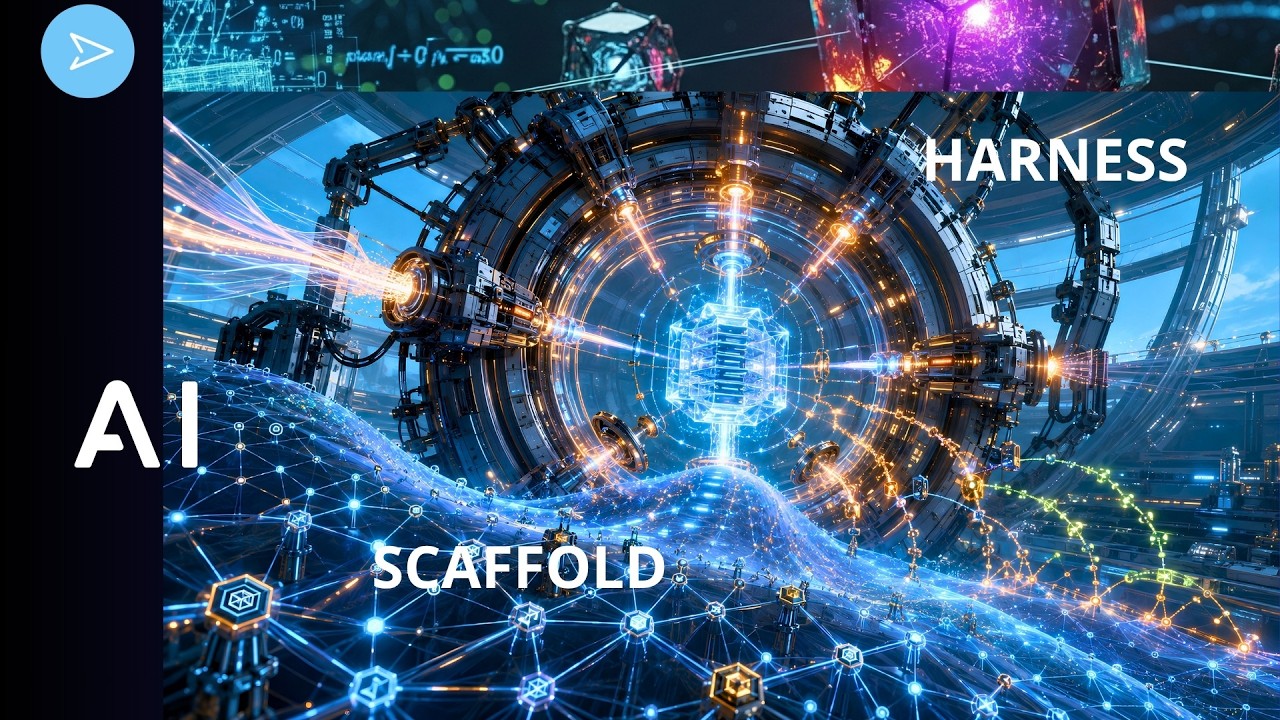
Stop trying to build a 'God-model' that knows everything. The future of AI isn't one giant brain; it's a smart coordinator managing a professional toolkit.
The Simple Version
For a long time, we thought the goal was to make one massive AI model that could do everything perfectly. This is Monolithic AI, and it's hitting a ceiling.
The new approach is the Scaffold & Harness paradigm. Instead of a single brain, we give the AI a 'workshop' of specialized tools and a 'manager' to coordinate them.
How It Actually Works
The Scaffold: Expanding Capabilities
The 'scaffold' refers to the external structures supporting the LLM. This includes Analytic Memory and Tool Acquisition.
Rather than relying on internal weights, the AI reaches out to external databases or learns how to use new software on the fly to solve a problem.
The Harness: Orchestration and Evolution
The 'harness' is the logic layer that routes tasks and allows the system to improve. This often uses Bandit-Routing to decide which agent or tool is best for a specific request.
Some systems even use Self-Play, where the AI poses its own challenges, solves them, and remembers the solution for next time.
Neuro-symbolic Thinking
To stop AI from 'hallucinating,' researchers are adding a Neuro-symbolic layer. This combines the 'gut feeling' of neural networks with the 'hard logic' of symbolic math.
Technical Deep Dive
From a developer's perspective, this is a shift toward modular agentic architecture. Instead of a single prompt-response loop, we are seeing the implementation of Ontology-Aware agents like SciToolAgent-Evo.
These agents don't just use tools; they understand the category and purpose of tools within a scientific domain, allowing them to acquire new capabilities in open-world environments.
Technically, this involves moving beyond simple RAG (Retrieval Augmented Generation) toward Analytic Memory. While RAG simply fetches a document, analytic memory synthesizes and transforms information to create new insights.
Furthermore, frameworks like NeSyFS implement a 'Fast-Slow' thinking process. 'Fast' is the intuitive LLM response, while 'Slow' is a symbolic verification step that checks for logical consistency under partial observability.
Why This Matters
This shift solves the 'brittleness' of LLMs. When an AI can evolve its own skills and verify its logic, it moves from being a chatbot to being a legitimate research assistant.
In fields like medicine or physics, we can't afford 'mostly correct' answers. The Scaffold & Harness paradigm allows for verifiable, tool-backed accuracy that monolithic models can't match.
Key Takeaways
- Monolithic AI is out: We are moving away from single, giant models toward modular systems.
- Scaffolds provide tools: External memory and tool-acquisition layers expand what AI can actually do.
- Harnesses provide logic: Routing and self-evolution allow AI to improve without needing a full retraining.
- Neuro-symbolic is the key: Blending neural intuition with symbolic logic reduces hallucinations.
- Analytic Memory > RAG: The goal is now to analyze and synthesize information, not just retrieve it.
- Self-Evolution: Modern agents can now pose their own problems and learn from the solutions.