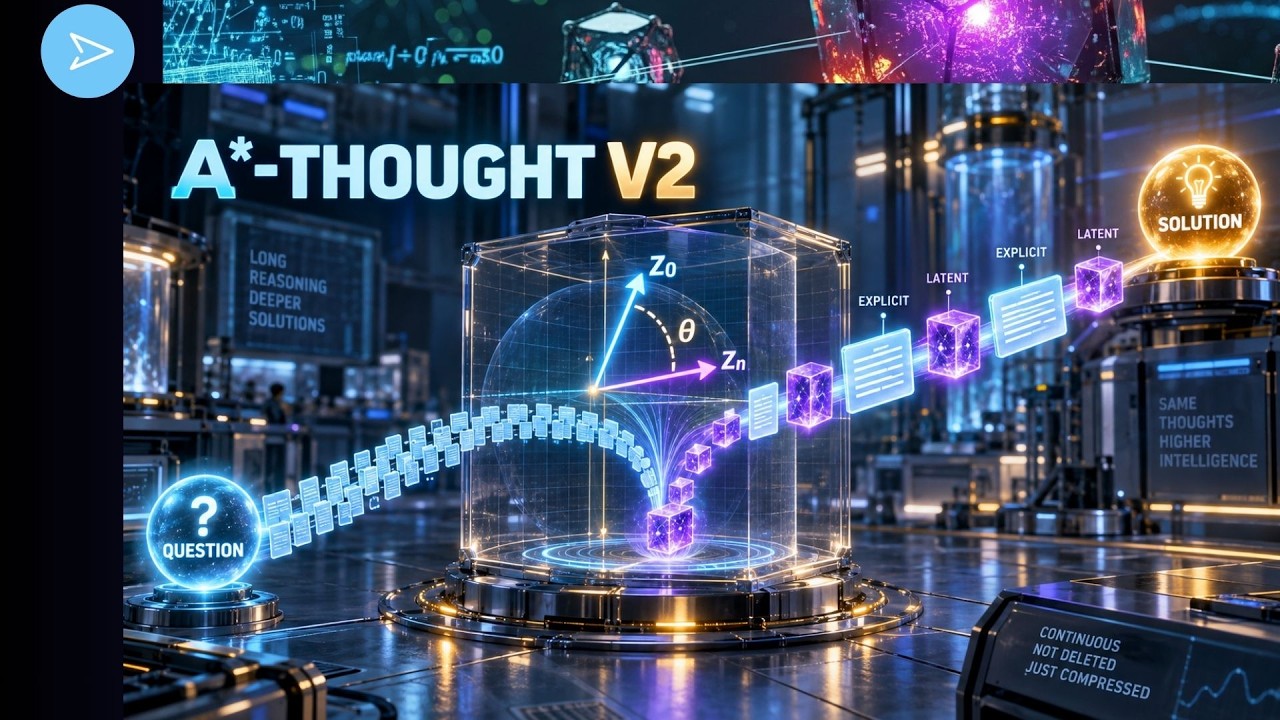
Imagine if an AI could solve a complex calculus problem in its head instantly, rather than writing out ten paragraphs of "Let's think step-by-step."
That is exactly what is happening with the breakthrough in latent reasoning and hidden-state geometry.
The Simple Version
Usually, when we want an AI to be smart, we use Chain-of-Thought (CoT). This forces the AI to write its reasoning process out loud, which helps it avoid mistakes but uses up a lot of time and tokens.
Latent reasoning is like the difference between a student showing all their work on a chalkboard and a grandmaster chess player seeing the winning move instantly in their mind.
How It Actually Works
The Problem with Visible Tokens
Every word (token) an AI generates costs computing power and time. While writing out steps helps the AI "think," it creates a bottleneck where the AI is limited by how fast it can type.
Hidden-State Geometry
Inside an LLM, "thoughts" aren't words; they are vectors (points in a high-dimensional mathematical space). The way these points move and shift is what we call the geometry of the hidden state.
A*-THOUGHT-V2's Approach
The A*-THOUGHT-V2 framework optimizes these internal movements. It allows the model to evolve its internal state through "geometric dynamics," effectively reasoning in the background before it ever produces a visible token.
Technical Deep Dive
At its core, A*-THOUGHT-V2 treats reasoning as a trajectory optimization problem within the model's latent space. Instead of relying on the discrete sampling of tokens to advance the logic, it leverages the continuous nature of hidden states.
By manipulating the Geometric Dynamics, the researchers found they could guide the model toward the correct answer without the overhead of explicit token generation. This involves refining how the model's internal representations transition from a query state to a solution state.
For developers, this means a shift from explicit prompting (e.g., "Think step by step") to architectural efficiency. The model is essentially learning to compress the reasoning trace into the hidden layers themselves.
Why This Matters
This is a massive win for latency. We can get the benefits of deep reasoning without the agonizing wait of watching a model type out a long-winded explanation.
It also drastically reduces inference costs. Since the "thinking" happens in the latent space rather than as output tokens, the cost per complex query drops significantly.
Most importantly, it brings us closer to System 2 thinking in AI—the ability to deliberate internally before speaking, much like humans do.
Key Takeaways
- Latent Reasoning is "invisible" thinking that happens between tokens.
- A*-THOUGHT-V2 uses geometric dynamics to make this process efficient.
- It reduces the need for long, token-heavy Chain-of-Thought traces.
- Hidden-State Geometry allows the AI to navigate toward answers mathematically.
- The result is faster response times and lower operational costs.
- This marks a shift from explicit output reasoning to implicit internal deliberation.