Ever wonder if there's a "golden ratio" for training an AI to actually think? New research suggests we can finally predict exactly how much pre-training versus reinforcement learning (RL) a model needs to master complex reasoning.
The Simple Version
Most LLMs are trained in two big steps. First, they read the entire internet to learn facts (pre-training). Then, they practice solving specific problems to get better at logic (RL).
Until now, deciding how much of each to do was mostly guesswork. This new research provides a formula to balance the two, ensuring the model doesn't just memorize facts, but actually learns how to reason.
How It Actually Works
The Interplay of Training Phases
Pre-training builds the world model. It gives the AI the vocabulary and the raw information it needs to function.
RL, or post-training, acts as a reasoning catalyst. It teaches the model how to chain those facts together to reach a logical conclusion.
The Discovery of Joint Scaling
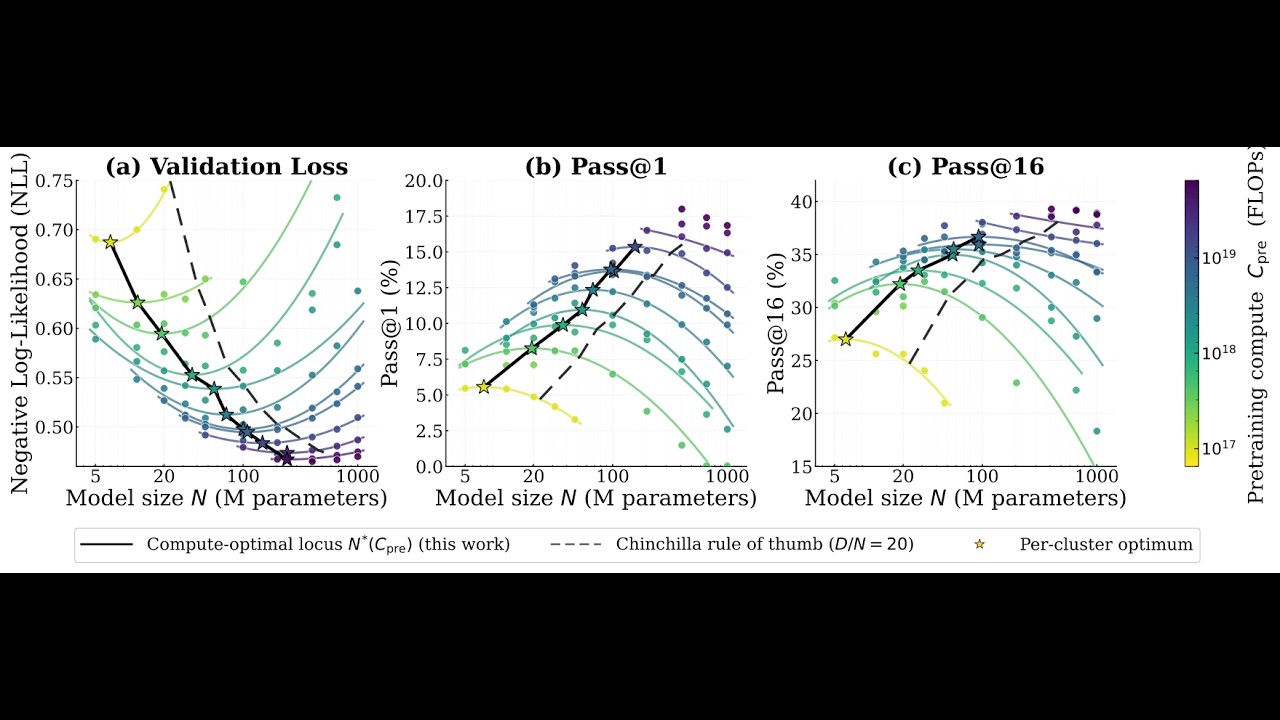
The researchers found that these two phases aren't independent. Instead, they follow a joint scaling law.
This means if you have a limited compute budget, you can mathematically determine if it's more efficient to spend that budget on more pre-training tokens or more RL iterations.
Technical Deep Dive
For the devs and architects, the core insight is the compute-optimal trade-off. The paper demonstrates that reasoning performance follows a predictable power-law relationship across both pre-training and RL compute.
Traditionally, we viewed pre-training as the "capacity" phase and RL as the "alignment" phase. This research shifts that perspective, showing that reasoning capability is a shared outcome of both processes.
By mapping the loss curves of pre-training against the performance gains of RL, researchers can now predict the final reasoning score of a model before it's even fully trained. This allows for massive optimizations in FLOPs allocation, preventing wasted compute on diminishing returns.
Why This Matters
Training frontier models costs millions of dollars in electricity and hardware. Being able to predict the outcome via a scaling law means companies can stop "guessing and checking," saving immense amounts of capital.
It also democratizes high-performance AI. Smaller labs can use these laws to find the most efficient path to reasoning, rather than trying to brute-force their way to intelligence with massive datasets.
Key Takeaways
- Pre-training and RL are two sides of the same coin when it comes to reasoning.
- A joint scaling law exists, allowing for a mathematical trade-off between the two phases.
- Reasoning isn't just an "add-on"; it's a result of how compute is balanced across the training pipeline.
- Developers can now optimize compute budgets (FLOPs) to hit specific performance targets.
- This discovery moves LLM training from an experimental art to a predictable science.