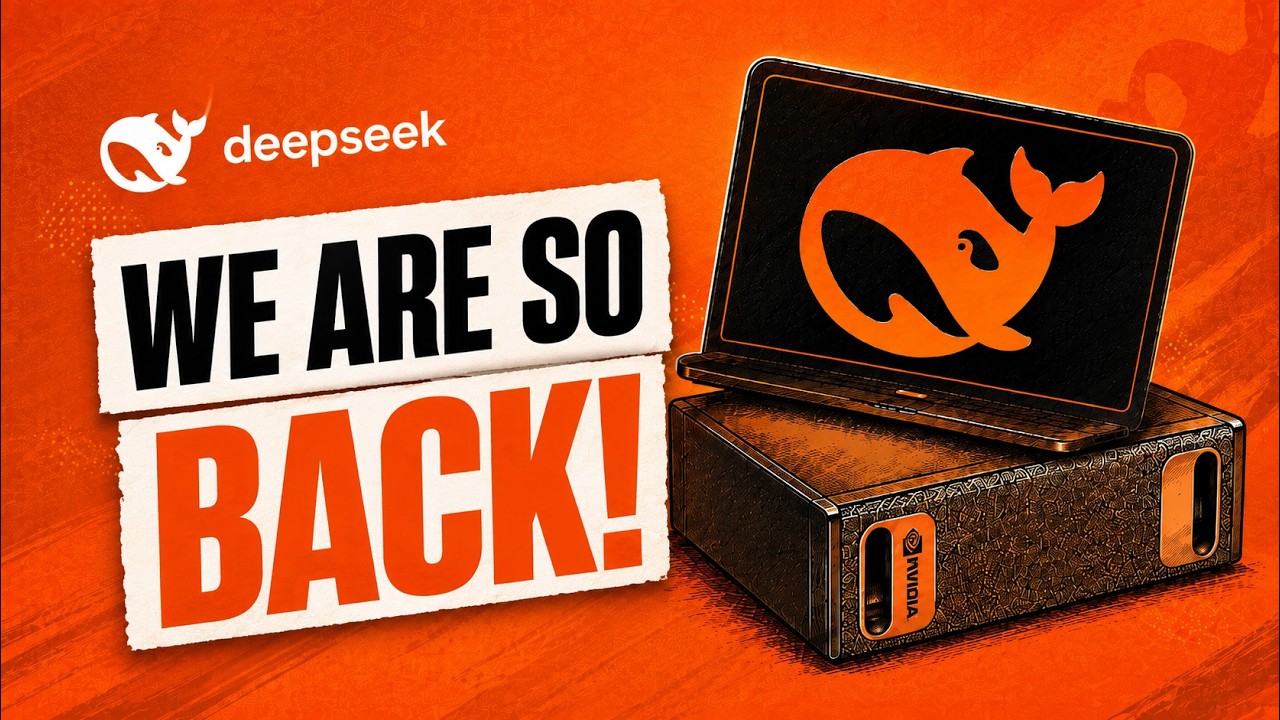
DeepSeek V4 Flash just landed, and it’s beating bigger models while staying cheap to run.
The Simple Version
Think of V4 Flash as a sports car that fits in a compact garage: high speed, low cost, and easy to drive locally.
How It Actually Works
Benchmarks only tell part of the story; the harness you use can change scores dramatically.
Benchmark Harnesses
It’s like measuring a sprinter on a track that’s slightly longer or shorter — results shift.
Cost Curve
Pricing sits at $0.02 per million input tokens and $0.30 per million output tokens, putting it near the top of the AI Index cost‑performance curve.
Local Setup
Running V4 Flash on two DGX Sparks in 4‑bit mode yields 20–30 tokens per second with a 1 million token context.
Technical Deep Dive
Model Size & Precision
V4 Flash is available in 4‑bit and 3‑bit quantized versions, requiring roughly 30 GB VRAM for 4‑bit and 20 GB for 3‑bit.
Offloading to SSD via Dwarf Star can stretch limits further.
Agentic Coding Demo
The video shows the model autonomously building a Pokémon encyclopedia and tracking an International Space Center, using the Open Code harness.
Why This Matters
These numbers prove that high‑quality LLMs no longer need massive cloud budgets; developers can experiment locally and ship AI features cheaper.
That shift could democratize AI research and accelerate real‑world applications.
Key Takeaways
- V4 Flash outperforms GLM 5.2 and approaches Opus 4.8 at a fraction of the size.
- Local inference runs at 20–30 tok/s on two DGX Sparks in 4‑bit.
- Pricing is $0.02/M input, $0.30/M output — highly cost‑effective.
- Benchmark harnesses dramatically affect reported scores.
- 4‑bit and 3‑bit modes need ~30 GB and ~20 GB VRAM respectively.
- SSD offloading with Dwarf Star expands feasible context windows.
- Agentic coding demos show practical, autonomous task completion.